EV Accessories and Mounting


PROFINESS
Profiness Solar Mounting Systems – Roof Hooks, PV Racking and Installation Hardware for European Professionals
Profiness GmbH is a German manufacturer and supplier of photovoltaic mounting and fastening systems, specialising in solar roof hooks, aluminium mounting rails, module clamps, roof attachments, aerodynamic flat-roof structures, ground-mounted systems, façade mounting and professional PV installation accessories.
Based in Mülheim an der Ruhr, Germany, Profiness develops mounting solutions for residential rooftops, commercial and industrial buildings, agricultural installations and specialised photovoltaic projects.
At 3Buy Solar, we supply and source solar mounting components for professional installers, EPC contractors, electricians, commercial project developers, PV wholesalers and approved European B2B buyers.
Our current Profiness webshop offering includes the three-way adjustable stainless-steel solar roof hook for suitable pitched-tile roof installations. For larger projects, buyers can request Profiness rails, clamps, roof attachments, flat-roof structures and complete mounting bills of materials, subject to availability and project specification.
Unlike a solar panel or inverter, a mounting system cannot be selected using electrical performance alone. Wind uplift, snow loading, roof construction, module dimensions, attachment spacing, waterproofing, corrosion exposure and installation method determine whether a structure is suitable.
The correct mounting hardware protects both the photovoltaic array and the underlying building. It also influences installation speed, labour expenditure, maintenance access and long-term project reliability.
Whether you need individual roof hooks for a residential installation, mounting rails and module clamps for repeat installer projects, or a complete east-west flat-roof racking solution for a commercial building, procurement should start with the actual site conditions and an approved structural design.
Buy Profiness Adjustable Roof Hooks at 3Buy Solar
Browse the Profiness Brand Catalogue
Request Profiness Wholesale and EPC Project Pricing
Why Choose Profiness for Solar Panel Mounting?
Profiness provides photovoltaic mounting components for different roof coverings, installation geometries and structural requirements.
The manufacturer’s systems include individual components and more complete mounting architectures, allowing installers to specify the hardware appropriate to their project.
Benefits for Solar Installers and EPC Contractors
- Roof-specific mounting: Components for tiled, trapezoidal, corrugated and standing-seam roofs.
- Adjustable roof hooks: Solutions for different tile geometries and roof alignment requirements.
- Multiple mounting rail profiles: Standard, reduced-height and reinforced aluminium profiles.
- Modular component selection: Roof hooks, rails, rail connectors, module clamps and fasteners.
- Aerodynamic flat-roof systems: East-west and south-facing configurations.
- Ballast optimisation: Engineered arrangements intended to reduce unnecessary ballast where site conditions permit.
- Specialist mounting applications: Façades, ground installations, balcony PV, fences and carports.
- Project-specific design: Manufacturer planning and technical support for appropriate mounting structures.
- Installation documentation: Mounting instructions and relevant technical certificates for specified systems.
- Professional procurement: Component quantities, packaging and complete project bills of materials.
The engineering characteristics depend on the particular Profiness system. No single roof hook, rail or clamp is universally approved for every roof type or photovoltaic module.
Profiness Complete PV Mounting Portfolio
Profiness develops mounting equipment across multiple product categories.
| Profiness product family | Main components | Professional application |
|---|---|---|
| Basic and Performance roof hooks | Stainless-steel and selected mixed-material adjustable hooks | Pitched tiled roofs |
| DragonHook | Advanced adjustable roof hook with top-access rail fastening | Installer-focused pitched-roof mounting |
| Profiness1HB / 1O | Aluminium mounting profiles | Residential rooftop PV |
| Profiness1 / Profiness2 | Reinforced mounting profiles | Higher structural requirements |
| Roof rail connectors | Rail splice and connection hardware | Multi-rail installation |
| Mid and end clamps | Module-frame clamping components | Framed solar module installation |
| Trapezoidal short rails | Direct-fix metal-roof profiles | Commercial and agricultural roofs |
| Standing-seam clamps | Roof-seam attachments | Suitable metal standing-seam roofs |
| Hanger bolts | Roof attachments | Corrugated and other approved roof constructions |
| Profiness Flat | Aerodynamic mounting with ballast optimisation | Commercial flat roofs |
| Elevation triangles | Fixed or adjustable elevation components | Selected flat-roof and ground applications |
| Profiness Wall | Façade mounting profiles and attachments | Concrete, brick and suitable building façades |
| Ground-mounted structures | Posts, rails, fixings and foundations | Outdoor PV installations |
| Solar carports | Single and double vehicle canopy structures | Commercial and residential carports |
| Solar fences | Purpose-designed PV-integrated fencing systems | Fences and specialist sites |
| Balcony PV mounting | Brackets and elevation sets | Suitable balcony and small PV installations |
| Mounting accessories | Fasteners, cable clips, rail end caps and bonding parts | Complete mounting assembly |
This table describes the wider manufacturer portfolio. The current 3Buy Solar catalogue lists the adjustable roof hook directly; other products require confirmation of the exact item and sourcing conditions.
Browse Solar Mounting Systems and Racking
Buy Profiness Adjustable Stainless-Steel Solar Roof Hooks
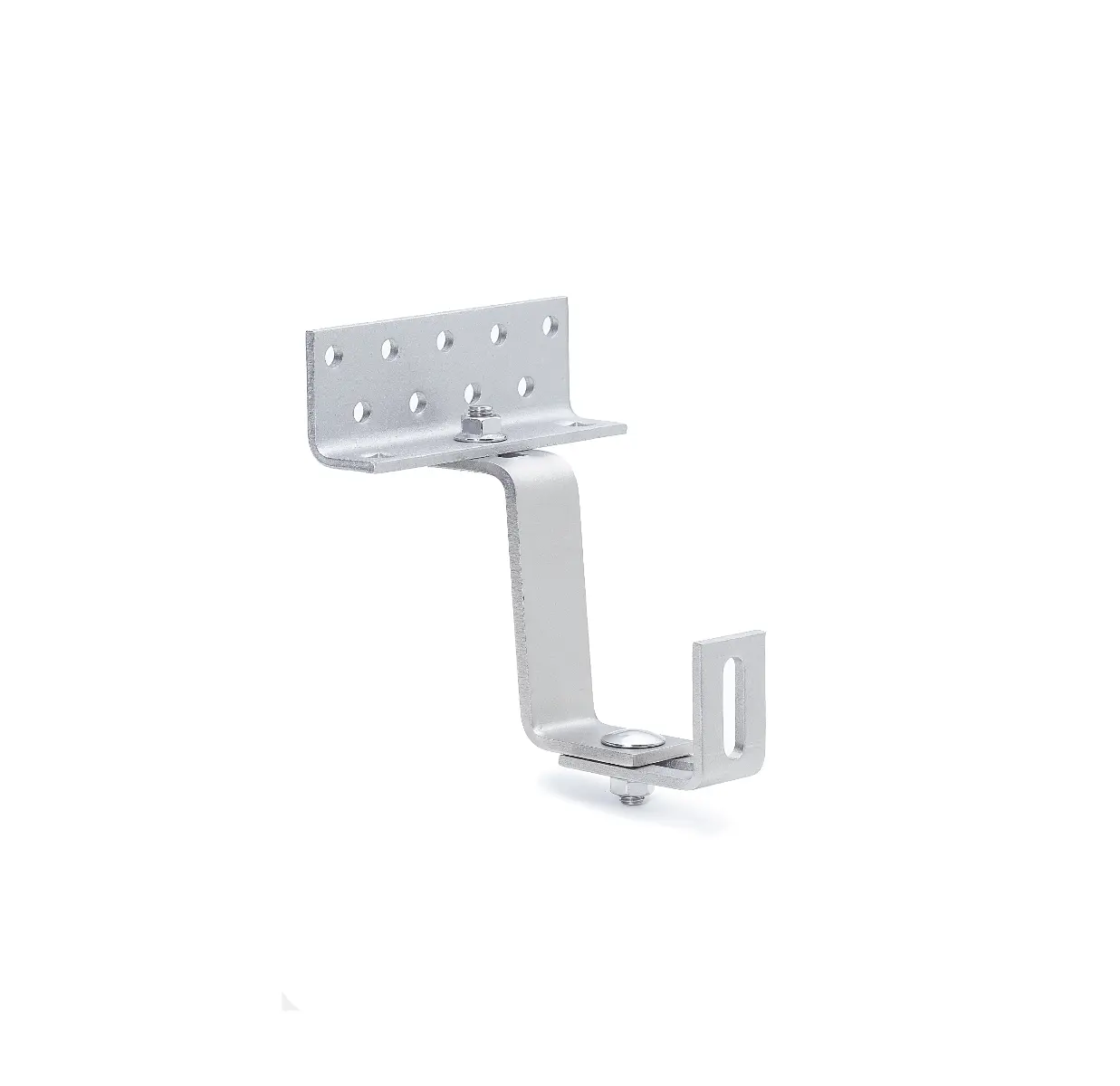
The Profiness three-way adjustable roof hook is the currently listed Profiness product at 3Buy Solar.
It is intended for suitable pitched-roof photovoltaic installations using tiled roofing and an approved roof attachment arrangement.
What Does Three-Way Adjustment Mean?
An adjustable roof hook provides installation flexibility in several directions.
Depending on the exact Profiness hook variant, the design allows:
- Lateral positioning: Selecting an appropriate fixing position relative to the underlying roof structure.
- Height adjustment: Accommodating the required clearance above battens and tiles.
- Mounting profile alignment: Fine-adjusting the rail connection to achieve the specified module-support geometry.
These adjustments help installers achieve correct alignment without relying on improvised packing or unapproved modifications.
Profiness Adjustable Roof Hook – Purchasing Information
| Purchasing parameter | Information |
|---|---|
| Product | Adjustable stainless-steel PV roof hook |
| 3Buy Solar SKU | PROFINESS-3-WAY-HOOK |
| Primary application | Suitable pitched-tile roof installations |
| Adjustment | Three-way configuration |
| Material | Stainless-steel assembly; exact grade depends on variant |
| Ordering unit | Individual roof hook |
| Catalogue packaging reference | 20 pieces per carton |
| Roof attachment | Must be designed for the roof structure |
| Rail compatibility | Confirm the approved Profiness rail and connector |
| Structural loading | Requires the correct manufacturer and project-specific values |
Important for procurement: Profiness manufactures separate Basic and Performance adjustable roof hooks with different cross-sections, steel grades and dimensions. The exact supplied article must be confirmed against its matching technical drawing before structural approval.
Why Roof Hook Selection Matters
Two roof hooks may appear similar while having different:
- Bracket thicknesses.
- Base-plate dimensions.
- Material grades.
- Adjustable height ranges.
- Load-bearing properties.
- Required fixing patterns.
- Approved rail connections.
A thicker hook is not automatically suitable for a particular roof if the attachment into the underlying structure is incorrectly specified.
Direct Purchasing and Documentation
Buy Profiness Adjustable Stainless-Steel Roof Hook
Download Profiness Adjustable Roof Hook Technical Drawing – 3Buy Solar PDF
Download Profiness Pitched-Roof Assembly Instructions – 3Buy Solar PDF
The hosted technical drawing uses German labels. For an exact Basic or Performance model match, request confirmation of the corresponding manufacturer reference and technical document.
Profiness Basic vs Performance Roof Hooks – Which Should Installers Specify?
Profiness manufactures several adjustable roof hook constructions.
The differences matter because the hook must transfer wind and snow loads into the approved roof support structure.
Profiness Basic Roof Hooks
Basic models provide adjustable fixing options for suitable tiled roofs.
Selected manufacturer specifications include stainless steel 1.4016 construction and a nominal bracket section of 30 × 5 mm.
Profiness Performance Roof Hooks
Performance-series products include different reinforced hook variants.
Depending on the exact model, these can use stainless steel 1.4301 for the bracket and stainless steel 1.4016 for the base plate.
Selected Performance products use bracket sections such as 30 × 6 mm or 35 × 6 mm.
What Matters More Than the Product Name?
Professional buyers should compare:
| Selection factor | Why it matters |
|---|---|
| Hook material | Corrosion exposure and mechanical properties |
| Bracket cross-section | Structural performance and deformation |
| Base-plate dimensions | Fixing geometry and load transfer |
| Fixing holes | Compatibility with approved timber screws |
| Adjustment range | Tile and batten clearance |
| Roof type | Appropriate tile and structure |
| Rail attachment | Approved mechanical connection |
| Hook load resistance | Wind and snow design |
| Certificate or test record | Evidence for the exact product |
Do not apply a test result, warranty or structural rating from one Profiness hook family to another without confirmation.
For repeat professional installations, using a consistent approved hook specification can simplify purchasing, installation training and material planning.
Profiness DragonHook – Advanced Roof Hook Technology
DragonHook is a newer Profiness roof-hook development intended to simplify installation while providing flexible adjustment.
The manufacturer’s DragonHook uses a combination of stainless steel and aluminium.
Its distinctive design includes the DragonHead adapter, allowing the mounting rail to be fastened from above.
DragonHook Installer Benefits
- Three-way adjustment.
- Top-access rail fastening.
- Stainless-steel bracket.
- Aluminium base plate.
- TX40 tool interface.
- Additional fine adjustment.
- Purpose-designed rail integration.
- Manufacturer-reported TÜV testing for the specified product.
This system is different from the conventional Basic three-way adjustable roof hook.
Why DragonHook Matters for Professional Procurement
Roof installation labour can be a significant portion of the total mounting cost.
A hook designed for improved access to the rail connection may reduce installation complexity under suitable conditions.
The commercial comparison should include both hardware cost and installed labour.
For DragonHook projects, request the exact hook version, matching rail, required fasteners, quantity and current manufacturer documentation.
Request Profiness DragonHook Project Pricing
Profiness Aluminium Mounting Rails – Performance and Strong Profiles
Profiness manufactures several aluminium rail profiles for photovoltaic installations.
The manufacturer’s pitched-roof portfolio includes:
| Rail profile | Published profile dimensions | General design purpose |
|---|---|---|
| Profiness1HB | 40 × 20 mm | Reduced-height profile |
| Profiness1O | 40 × 40 mm | Standard Performance profile |
| Profiness1 | Reinforced 40 × 40 mm | Higher structural requirements |
| Profiness2 | 80 × 40 mm | Reinforced profile for demanding designs |
The profile cross-section alone does not determine its permitted span or load resistance.
The usable distance between roof attachments depends on the rail’s structural properties and the actual project loading.
Rail Selection Criteria
- PV module dimensions.
- Approved module clamping arrangement.
- Module orientation.
- Wind uplift.
- Snow loading.
- Rail support spacing.
- Total rail span.
- Roof attachment geometry.
- Thermal movement.
- Cable routing.
- Required bonding arrangement.
Single-Layer vs Cross-Rail Installation
Some mounting designs use one layer of support rails.
Others require crossed profiles to achieve the necessary attachment geometry or module support.
A cross-rail structure may provide greater layout flexibility but can add material, installation labour and roof loading.
The appropriate design must follow the manufacturer’s approved structural calculations.
Rail Connectors and Thermal Expansion
Long rail runs may require rail splices or expansion joints.
A rail splice is not automatically a continuous structural connection with the same capacity as the original uninterrupted profile.
Installers must use the appropriate manufacturer joining method and respect structural and thermal movement requirements.
Shop Solar Rails, Clamps and Mounting Accessories
Profiness Solar Panel Mid Clamps, End Clamps and Fasteners
Profiness offers module clamps and mounting hardware for framed solar panels.
Mid Clamps
Mid clamps secure adjacent modules at approved frame locations.
End Clamps
End clamps secure the outside edges of module rows.
Clamp Selection
Professional installers should verify:
- Solar module frame height.
- Clamping zone.
- Minimum clamping engagement.
- Required clamp width.
- Approved tightening torque.
- Rail and fastener compatibility.
- Module mechanical load requirements.
- Electrical bonding where applicable.
A clamp advertised for one frame-height range does not automatically fit all currently available solar panels.
Profiness Mounting Accessories
The manufacturer also offers:
- Rail connectors.
- Hammer-head bolts.
- T-slot nuts.
- Stainless-steel screws.
- Locking nuts and washers.
- Roof fasteners.
- Cable clips.
- Profile end caps.
- Earthing and bonding components.
For EPC procurement, individual fasteners and accessories should be included in the bill of materials rather than left for on-site substitution.
Profiness Mounting for Tiled and Pitched Roofs
Profiness provides pitched-roof mounting solutions for different roof coverings.
Relevant applications include:
- Clay tile roofs.
- Concrete tile roofs.
- Plain-tile roofs.
- Selected slate roofs.
- Commercial pitched roofs.
- Residential rooftop solar.
- Hybrid solar installations.
- PV replacement or roof renovation projects.
Roof Structure and Attachment Design
For a tiled roof, the mounting structure must transfer forces into suitable structural members.
Roof tiles are generally not intended to carry the photovoltaic array’s structural loads.
The design should verify:
- Rafter position and condition.
- Roof timber or structural material.
- Roof-hook fixing locations.
- Approved fixing screw type.
- Screw embedment and spacing.
- Roof covering geometry.
- Required hook-to-tile clearance.
- Waterproofing details.
- Wind and snow load calculations.
Common Pitched-Roof Installation Mistakes
- Fixing hooks only to battens when the design requires structural rafter attachment.
- Using screws with insufficient embedment.
- Allowing the hook to bear incorrectly on roof tiles.
- Mixing unapproved rail and hook systems.
- Positioning module clamps outside approved zones.
- Omitting required bonding components.
- Using too few roof attachments.
- Ignoring high wind-uplift forces near roof edges.
These errors can cause roof damage, structural instability or premature maintenance.
Download Profiness Pitched-Roof Installation Manual – Hosted by 3Buy Solar
Profiness Mounting for Trapezoidal Metal Roofs
Trapezoidal sheet-metal roofs are widely used on commercial, industrial and agricultural buildings.
Profiness manufactures mounting solutions for these applications, including short rails and longer support profiles.
Profiness Trapezoidal Short-Rail Systems
Short-rail mounting can reduce the amount of continuous aluminium rail required.
Depending on the approved design, it can provide a compact attachment between the photovoltaic module and the metal roof covering.
Key Design Checks
- Exact trapezoidal profile geometry.
- Steel or aluminium sheet thickness.
- Sheet condition and corrosion.
- Roof fixing pattern.
- Position of structural purlins.
- Approved screw type.
- Fastener pull-out resistance.
- Waterproof sealing components.
- Wind-uplift requirements.
- Module clamping compatibility.
The use of suitable sealing components is essential where the attachment penetrates the metal roof.
Short Rails vs Continuous Rails
| Factor | Short rails | Continuous rails |
|---|---|---|
| Aluminium requirement | Potentially lower | Longer profile runs |
| Roof attachment | Roof-profile-specific | Depends on structural design |
| Installation | Compact direct fixing | Continuous rail alignment |
| Cable routing | Requires appropriate planning | Rail path may help cable organisation |
| Module geometry | Attachment-position dependent | May offer greater layout flexibility |
| Selection | Site-specific engineering | Site-specific engineering |
Neither approach is inherently superior for every metal roof.
Browse Professional Solar Mounting Systems
Profiness Standing-Seam and Corrugated-Roof Mounting
Standing-seam metal roofs require a different mounting approach from trapezoidal roofs.
Profiness offers appropriate seam-clamp and fastening options within its pitched-roof portfolio.
Standing-Seam Clamp Systems
Where the roof profile and manufacturer permit it, standing-seam clamps may provide a non-penetrating attachment.
However, the roof seam itself must be capable of transferring the required loads.
A non-penetrating attachment does not eliminate the need for structural calculations or roof-manufacturer approval.
Corrugated Roofs
Suitable corrugated roofs may use hanger bolts or other approved fastening arrangements.
The actual fixing method depends on roof construction and the load-bearing structure beneath the covering.
For older agricultural buildings, roof-covering condition and material hazards require particular attention before installation.
Profiness Flat-Roof Mounting – Aerodynamic East-West and South Systems
Profiness Flat is the manufacturer’s aerodynamic mounting system portfolio for photovoltaic installations on suitable flat and low-slope roofs.
The range includes:
- East-west layouts at 10°.
- South-facing layouts at 10°.
- South-facing layouts at 15°.
- Selected customised and roof-parallel configurations.
Profiness describes low-ballast mounting solutions for different roof constructions, including concrete, bitumen, membrane, gravel and selected green-roof applications.
The exact system depends on the surface and underlying structure.
Flat-Roof Mounting Without Roof Penetration
Certain Profiness flat-roof systems can be installed using ballast instead of direct roof penetration, provided the manufacturer’s approved design permits that configuration.
This is particularly relevant where roof waterproofing must be preserved.
However, a ballasted system still requires verification of:
- Roof dead-load capacity.
- Additional ballast weight.
- Local wind uplift.
- Roof-edge and corner zones.
- Friction coefficient.
- Sliding resistance.
- Roof membrane compatibility.
- Drainage.
- Maintenance access.
- Snow accumulation.
- Required fire-safety clearances.
Low ballast does not mean zero ballast, and penetration-free does not mean structurally unrestricted.
Flat-Roof Design and Wind-Tunnel Data
Profiness publishes aerodynamic mounting information developed using wind-tunnel assessment.
For installers, this can be valuable when the project requires ballast optimisation and reduced structural loading.
The actual ballast plan must be calculated for the site, roof height, wind region and roof geometry.
A ballast schedule from another project must not be reused without verification.
Roof Slope Restrictions
The manufacturer’s mounting documentation distinguishes between installations that can be ballasted without penetrations and configurations requiring additional mechanical fixing.
For example, the published flat-roof guidance describes ballast-only arrangements for appropriate low roof slopes and additional requirements for higher slopes.
Always follow the exact system manual and site-specific calculation.
Browse Flat-Roof and Ballasted Solar Mounting Systems
Request Profiness Flat-Roof Mounting BOM and Quotation
Profiness East-West vs South-Facing Flat-Roof Mounting
For commercial rooftops, the choice between east-west and south-facing layouts affects both installed PV capacity and electricity generation.
East-West Mounting
Profiness’s east-west 10° system is relevant where installers want to use roof space efficiently and spread electricity generation more broadly across the day.
Potential advantages include:
- Greater installed module density on certain roofs.
- More morning and afternoon generation.
- Reduced inter-row spacing in suitable designs.
- Lower ballast requirements in some aerodynamic configurations.
- Improved matching with certain commercial load profiles.
South-Facing Mounting
Profiness offers 10° and 15° south-facing systems.
Potential advantages include:
- Strong module-level annual yield at suitable sites.
- More concentrated midday generation.
- Installation configurations tailored to specific roof areas.
- Flexible row spacing and shading optimisation.
Which Mounting Layout Is Better for a Warehouse?
The answer depends on the site.
A south-facing design may achieve higher annual yield per installed kWp, while an east-west layout may accommodate more installed capacity within the available rooftop area.
For an EPC quotation, compare:
| Evaluation metric | Why it matters |
|---|---|
| Total installed kWp | How much PV capacity fits on the roof |
| Annual kWh/kWp | Specific generation yield |
| Total annual kWh | Actual site-wide electricity production |
| Morning/afternoon production | Customer consumption matching |
| Self-consumption | Value of electricity used on site |
| Export limitations | Grid connection restrictions |
| Mounting cost | Hardware and ballast |
| Structural load | Roof engineering feasibility |
| Installation labour | Construction economics |
| Maintenance access | Long-term servicing |
A mounting system offering the highest specific yield does not automatically produce the most electricity or the highest return from the available roof area.
For commercial projects, compare complete installed cost and annual energy value, not just mounting price per panel.
Profiness Solar Mounting for Commercial and Industrial Rooftops
Commercial photovoltaic installations present additional engineering and procurement challenges.
Typical projects include:
- Logistics warehouses.
- Manufacturing facilities.
- Agricultural buildings.
- Commercial halls.
- Retail properties.
- Office buildings.
- Solar carports.
- Industrial flat roofs.
For larger installations, the mounting system can materially affect project schedule, labour costs and roof loading.
Commercial Roof Assessment
Before procurement, obtain:
- Roof construction drawings.
- Roof material and covering type.
- Roof dimensions and pitch.
- Building height.
- Project location.
- Available structural load reserve.
- Existing rooftop equipment and obstructions.
- Wind and snow design conditions.
- PV module dimensions and weight.
- Proposed module layout.
Why Commercial Installers Need a Complete Mounting BOM
An incomplete mounting order can delay a project even when the solar panels and inverters have arrived.
Missing rails, clamps, fasteners, ballast trays or roof-specific fixings can create additional deliveries, labour costs and site visits.
For EPC projects, the mounting package should therefore be ordered against an approved bill of materials rather than an approximate number of mounting components per kWp.
Browse Commercial Solar Panels
Request Profiness Commercial PV Mounting
Profiness Ground-Mounted Solar Structures
Profiness also develops ground-mounted photovoltaic support solutions.
Unlike rooftop installations, ground-mounted structures must address soil conditions, foundation design and outdoor environmental exposure.
Typical Applications
- Small ground-mounted PV installations.
- Agricultural solar arrays.
- Commercial ground-mounted projects.
- Selected open-field installations.
- Special-purpose PV structures.
Ground-Mount Design Requirements
- Soil bearing capacity.
- Groundwater conditions.
- Terrain slope.
- Frost depth.
- Foundation design.
- Wind and snow loading.
- Corrosion exposure.
- Drainage.
- Array height and spacing.
- Maintenance access.
- Module clamping and rear-side clearance.
A ground-mount system that performs on one site cannot automatically be replicated on another without appropriate structural and geotechnical checks.
For bifacial modules, ground clearance and row geometry also influence rear-side irradiance.
Profiness Wall – Solar Façade Mounting
Profiness manufactures façade mounting products for suitably engineered photovoltaic installations.
Its wall-mounting range includes solutions for different building substrates, such as:
- Concrete.
- Masonry and brick.
- Insulated façades.
- Trapezoidal sheet-metal façades.
- Selected other approved construction types.
Façade Mounting vs Rooftop Mounting
Vertical PV mounting requires a different assessment of loads and attachments.
The installer should verify:
- Wall structural material.
- Anchor type and embedment.
- Insulation thickness.
- Thermal bridging.
- Wind loading.
- Façade fire-safety requirements.
- Module mounting orientation.
- Cable routing.
- Waterproofing.
- Maintenance access.
The manufacturer’s Profiness Wall range should be specified using its actual façade installation instructions and approved support design.
Profiness Solar Carports and Solar Fences
Profiness has extended its photovoltaic mounting offering into structures outside conventional roofs.
Profiness Solar Carports
The manufacturer lists single- and double-vehicle solar carport products.
A current Single Performance carport design accommodates nine photovoltaic modules within the specified module format.
Solar carports require appropriate foundations, drainage, wind and snow design and vehicle-clearance requirements.
The PV modules are not necessarily included in the mounting structure purchase.
For procurement, confirm the exact module dimensions and approved attachment configuration.
Profiness Solar Fences
The manufacturer also offers solar fencing products incorporating dedicated photovoltaic modules.
Some solar fence products use customised panel sizes and cannot be built from arbitrary standard rooftop modules.
A solar fence should be treated as an integrated structural and photovoltaic product rather than a conventional module mounting rail system.
Additional Procurement Considerations
- Foundation design.
- Mechanical safety.
- Wind loading.
- Corrosion exposure.
- Vehicle clearance where applicable.
- Module replacement options.
- Cable protection.
- Applicable planning and building permissions.
Request Profiness Solar Carport or Solar Fence Sourcing
Profiness Balcony Solar Mounting and Special Installations
Profiness’s wider portfolio also includes mounting sets for balcony PV, fence attachment and selected compact installations.
These products address smaller-scale mounting requirements but still require suitable structural attachments.
For balcony systems, check:
- Railing construction.
- Mechanical load capacity.
- Wind exposure.
- Module size and weight.
- Preventing accidental component detachment.
- Fall protection.
- Electrical cable routing.
- Applicable building permissions.
A balcony railing should not automatically be assumed suitable to support a photovoltaic module without engineering assessment.
Profiness Structural Calculations – Wind, Snow and Roof Load Requirements
Structural design is the most important technical requirement for professional PV mounting procurement.
Solar mounting components must withstand the loads generated by the actual installation environment and transfer them safely to the supporting structure.
European Wind Loading
EN 1991-1-4 is a key Eurocode reference for wind actions on structures.
The design must consider:
- Building location.
- Building height.
- Roof geometry.
- Exposure.
- Wind pressure and suction.
- Roof-edge and corner zones.
- Mounting geometry.
- System-specific aerodynamic information.
Wind uplift can be a controlling design condition, particularly for flat roofs and roof-edge installations.
European Snow Loading
EN 1991-1-3 addresses snow loads.
Relevant factors include:
- Geographic snow loading.
- Roof slope.
- Snow drifting.
- Roof obstructions.
- Module tilt.
- Structural capacity.
- Local climatic conditions.
Structural Load Path
A complete mounting system transfers forces through several components:
Solar panel frame → module clamp → mounting rail → roof hook or support → fastener → building structure.
Every element in this sequence must be suitable for the design loads.
A strong aluminium rail does not compensate for an insufficient roof screw or weakened structural timber.
Professional Mounting Documentation
For a properly engineered system, installers should obtain:
- Mounting layout.
- Structural calculations.
- Roof attachment schedule.
- Rail type and permissible spans.
- Module clamp positions.
- Required fastener specification.
- Ballast schedule where applicable.
- Installation instructions.
- Relevant product testing or approval.
- Inspection and commissioning records.
The correct documentation depends on the system and local project requirements.
Profiness Mounting Compatibility with Modern High-Power PV Modules
Modern photovoltaic modules are available in many dimensions, frame heights and construction types.
Profiness mounting systems can be evaluated for suitable conventional framed modules, including high-power residential and commercial products.
However, module power in watts does not determine mechanical mounting compatibility.
Before ordering, verify:
| Module property | Mounting-system implication |
|---|---|
| Module length and width | Rail position and module spacing |
| Module frame height | Clamp compatibility |
| Module weight | Dead load and installation handling |
| Mechanical load rating | Permitted mounting and clamping |
| Approved clamp zones | Correct support positions |
| Portrait or landscape installation | Rail and clamp layout |
| Glass-glass construction | Manufacturer-specific mounting limits |
| Bifacial construction | Rear-side clearance and support shading |
| Module thermal expansion | Gaps and permitted movement |
Related Solar Panel Brands
Installers can evaluate Profiness mounting solutions alongside appropriately selected PV modules available through 3Buy Solar.
Relevant ranges include LONGi solar panels, Trina Solar modules and other high-efficiency photovoltaic products.
A brand name alone is not proof of mechanical mounting approval. Always follow the exact module manufacturer’s installation instructions.
Electrical Bonding, Lightning Protection and Cable Management
A solar mounting system also forms part of the complete photovoltaic installation environment.
Metallic structures may require equipotential bonding and integration with the building’s electrical safety design.
Bonding and Earthing
The correct bonding arrangement depends on:
- Module manufacturer’s bonding provisions.
- Mounting-system design.
- Electrical installation standards.
- Connector and clamp bonding approvals.
- Corrosion compatibility.
- Continuity requirements.
Do not assume electrical continuity through every anodised rail joint or module clamp.
Only use bonding components approved for the specific purpose.
Lightning Protection
Solar mounting equipment must be assessed in relation to any existing lightning protection system.
Applicable separation distances, bonding requirements and surge protection should follow the actual design and relevant standards.
Solar DC Cable Management
PV cables must be supported to avoid:
- Abrasion.
- Contact with sharp edges.
- Excessive movement.
- Unnecessary strain on connectors.
- Contact with roof surfaces where unsuitable.
- Exposure to damaging heat or water accumulation.
Profiness cable clips and the related 3Buy Solar cabling categories can support a properly planned installation.
Shop PV Protection and Disconnectors
Profiness Solar Mounting BOM – What EPC Contractors Should Order
For professional installations, a complete bill of materials is essential.
A typical mounting BOM may include:
| BOM component | Information required |
|---|---|
| Roof hooks or attachments | Type and calculated quantity |
| Aluminium rails | Profile and total length |
| Rail connectors | Matching type and number |
| Mid clamps | Module frame compatibility and quantity |
| End clamps | Module frame compatibility and quantity |
| Roof screws or bolts | Approved dimensions and grade |
| Flat-roof bases or ballast trays | System-specific quantity |
| Ballast blocks | Project-calculated weight |
| Protection mats | Roof membrane compatibility |
| Cable management | Clips, trays and routing accessories |
| Earthing and bonding | Approved components |
| Spare materials | Agreed installation allowance |
Why There Is No Universal Number of Roof Hooks per Solar Panel
Roof-hook quantity depends on the project.
For example, a row of ten modules does not automatically require twenty or thirty hooks.
The attachment quantity is influenced by wind loading, snow loading, rail span, support positions and the actual roof structure.
Professional installers should use the approved mounting layout and structural design to determine quantities.
Profiness Complete Mounting Project Enquiries
For project-specific purchasing, 3Buy Solar can evaluate a supplied approved BOM or a request for the required Profiness mounting components.
Manufacturer design assistance and structural documentation must be confirmed for the project rather than assumed to be included with every component order.
Request Profiness Full BOM and EPC Pricing
Profiness Mounting System Prices – Cost per Panel vs Complete Installed Cost
The price of an individual roof hook is only one part of a solar mounting installation.
Professional buyers should compare the total mounting package.
What Determines Mounting-System Cost?
- Roof type.
- Roof geometry and pitch.
- Required structural loading.
- Module count and dimensions.
- Rail profile and length.
- Attachment quantity.
- Roof access and handling.
- Fasteners and clamps.
- Ballast requirements.
- Installation labour.
- Shipping and logistics.
- Design and documentation requirements.
The Cheapest Roof Hook Is Not Necessarily the Cheapest Installation
A less expensive hook may be appropriate for one project, while a more adjustable or reinforced product may reduce installation time or better satisfy structural requirements elsewhere.
The correct purchasing comparison should include the specified fixing system, labour and site conditions.
Buying by Component or Complete Project BOM
Individual component orders can be appropriate for repairs, small installations or standard installer stock.
Complete mounting BOMs are preferable for larger projects where the installation must match an engineered structural plan.
For B2B customers, a complete BOM helps avoid missing components, repeated deliveries and unplanned site visits.
View Profiness Mounting Product Prices
Request 3Buy Solar B2B Pricing
Profiness Datasheets, Installation Manuals and Structural Documents
Professional PV mounting requires technical documentation matched to the actual components.
3Buy Solar hosts the following Profiness files directly on its own website.
Profiness Roof Hook – Technical Drawing
Download Profiness Adjustable Roof Hook Technical Drawing – 3Buy Solar PDF
The drawing identifies the three-way adjustable Basic stainless-steel hook construction and its component geometry.
The file is hosted by 3Buy Solar, although its labels are in German.
Profiness Pitched-Roof Installation Manual
Download Profiness Pitched-Roof Mounting Instructions – 3Buy Solar PDF
This document covers the manufacturer’s pitched-roof mounting architecture and related installation practices.
Product Page and Documentation
Profiness Adjustable Roof Hook – Product, Technical Downloads and Ordering
For other Profiness systems, including flat-roof mounting, trapezoidal roof structures, façades and specialist components, the correct system-specific installation manual and design documentation should accompany a confirmed project quotation.
The manufacturer’s technical library is available through the official Profiness website.
Certification and Warranty Documentation
For professional tenders, identify the specific:
- Profiness product or system.
- Manufacturer article number.
- Applicable load testing or approval.
- Structural calculation.
- Installation instructions.
- Material specification.
- Applicable warranty terms.
- Site-specific mounting layout.
Do not assume one certificate or test report covers every Basic, Performance, DragonHook, flat-roof or façade product.
For warranties, use the current product-specific manufacturer’s written terms and 3Buy Solar’s confirmed sales conditions.
Profiness Mounting Systems – European B2B Wholesale and EPC Procurement
3Buy Solar supports professional purchasing of photovoltaic mounting and installation components across Europe.
Typical buyers include:
- Residential solar installers.
- Commercial PV contractors.
- EPC companies.
- Qualified electricians.
- Solar equipment wholesalers.
- Resellers and solar webshops.
- Commercial building developers.
- Project procurement departments.
- PV maintenance contractors.
What Can You Buy or Request?
- Profiness adjustable roof hooks.
- Profiness Basic and Performance roof-hook variants.
- Profiness DragonHook.
- Aluminium mounting profiles.
- Mid clamps and end clamps.
- Rail connectors and fixings.
- Trapezoidal and standing-seam roof attachments.
- Flat-roof mounting structures.
- Aerodynamic east-west and south systems.
- Façade and ground-mounted systems.
- Project-specific accessory quantities.
- Complete mounting BOM sourcing.
Currently listed components can be ordered through the webshop. Additional Profiness systems are subject to quotation and sourcing confirmation.
How to Request a Profiness Mounting Quotation
For the most accurate offer, provide:
- Project location: Country and postcode.
- Installation type: Pitched roof, flat roof, metal roof, façade or ground.
- Roof covering: Tile, trapezoidal sheet, membrane, concrete or other.
- Roof dimensions and pitch.
- Building height.
- Solar module model, dimensions and quantity.
- Module orientation: Portrait or landscape.
- Proposed array layout: Including relevant obstacles.
- Wind and snow design data: Where available.
- Required mounting components or approved BOM.
- Documentation requirements: Structural design, certificates and manuals.
- Delivery destination and project schedule.
Where no approved BOM exists, state whether you need a complete mounting-system specification or only a commercial quotation for identified components.
Request Profiness Installer, Wholesale and EPC Pricing
Why Buy Profiness Mounting Hardware Through 3Buy Solar?
3Buy Solar combines professional photovoltaic component purchasing with access to solar panels, inverters, electrical protection, solar cables, energy storage systems and complete PV kits.
Direct Purchasing for Listed Profiness Hardware
The three-way adjustable roof hook has its own product page with purchasing functionality and technical document links.
Project-Specific Component Procurement
Professional customers can submit exact mounting requirements, roof layouts and quantities for a quotation.
Related Solar Equipment
Installers can coordinate mounting hardware with panels, inverters, cables and electrical accessories from the wider catalogue.
European B2B Buying
Approved buyers can access the 3Buy Solar procurement process, price-list resources and project-order support.
Professional Technical Resources
3Buy Solar provides a manufacturer brand catalogue, installation-related technical content and supporting documentation.
Logistics and Collection Options
Subject to order readiness and stock location, eligible confirmed orders may use the 3Buy Solar Collection Service at Törökbálint, Hungary.
Read About the 3Buy Solar Collection Service
Collection of a particular Profiness order must be confirmed before dispatching a vehicle.
Profiness Solar Installation Resources – 3Buy Solar Articles
Professional mounting decisions should form part of the complete photovoltaic system design.
Solar Panel Installation Guide for European Installers
3Buy Solar – Solar Panel Installation Guide 2026
A first-party resource covering installation planning, roof assessment, mounting, electrical system integration and commissioning.
Solar Rails, Clamps and Mounting Systems
3Buy Solar – Professional Solar Rails and Mounting Components
Installer-focused guidance on rail selection, roof hooks, module clamps, roof attachments and other mounting accessories.
Professional Solar Mounting and Racking
3Buy Solar – Solar Mounting Systems for Residential and Commercial PV
A purchasing resource for mounting systems across tiled roofs, flat roofs, metal roofs and ground installations.
Solar Wholesale for Resellers
3Buy Solar – Wholesale Solar Components for Resellers
Relevant to wholesalers and solar webshops buying installation components for resale or recurring projects.
Collection and Project Logistics
3Buy Solar Collection Service – Törökbálint Logistics Hub
Information on collection arrangements for eligible confirmed solar equipment orders.
Profiness Technical Training – Official 3Buy Solar YouTube
The official 3Buy Solar YouTube channel offers additional photovoltaic industry and technical resources for professional installers, electricians and EPC contractors.
Topics relevant to Profiness mounting projects include:
- Solar roof installation.
- Photovoltaic module layout.
- Residential and commercial system design.
- Mounting hardware and installation planning.
- Solar inverter integration.
- PV electrical protection.
- Solar cable routing.
- Complete solar kits.
Watch 3Buy Solar Technical Videos
Product-specific Profiness installation instructions and the approved mounting design remain authoritative for fixing methods, fasteners and structural requirements.
Profiness Developments – Faster Installation, Flat-Roof Efficiency and New PV Applications
The photovoltaic mounting industry continues to evolve as modules become larger and rooftop projects require more efficient installation methods.
Faster Roof Hook Installation
Profiness’s DragonHook development focuses on easier adjustment and top-access rail fastening.
For installers, reducing repetitive roof operations can influence project labour costs.
Aerodynamic Ballast Optimisation
Newer flat-roof mounting designs increasingly focus on reducing unnecessary ballast while maintaining structural performance.
The correct solution depends on site-specific wind and roof loading.
Larger Solar Modules
Larger photovoltaic modules place greater demands on mechanical handling, clamp positions, rail spacing and supporting structures.
Mounting-system compatibility must therefore be assessed against exact module dimensions and installation instructions.
East-West Commercial Rooftops
Low-tilt east-west mounting remains relevant for warehouses and commercial buildings where roof-space utilisation and daytime electricity demand influence project economics.
Vertical and Façade PV
Building façades and solar fences provide additional PV installation surfaces, but require different structural and fire-safety considerations from conventional rooftops.
Solar Carports
PV canopies create additional opportunities for electricity generation at parking facilities and other outdoor locations.
Such projects require suitable structural design, foundations, drainage and vehicle clearance.
Procurement and Engineering Integration
Professional mounting procurement increasingly benefits from complete BOMs, documented structural design and standardised installation components.
For EPC contractors, these factors can be more important than simply selecting the lowest-cost individual roof hook.
Frequently Asked Questions About Profiness Solar Mounting Systems
What is Profiness?
Profiness is a German manufacturer and supplier of photovoltaic mounting and fastening systems, including roof hooks, rails, clamps, flat-roof structures, façade mounting and other PV support components.
Does Profiness manufacture solar mounting systems for tile roofs?
Yes. Profiness offers roof hooks, aluminium rails and associated fixing components for suitable tiled-roof photovoltaic installations.
What Profiness products can I buy at 3Buy Solar?
The current catalogue lists the Profiness three-way adjustable stainless-steel roof hook. Additional mounting components may be requested through project-specific sourcing.
What is a three-way adjustable solar roof hook?
It is a mounting attachment with adjustment options that help installers position the roof hook and align the supporting rail correctly.
What is the difference between Profiness Basic and Performance roof hooks?
The families include different bracket sections, materials and structural designs. The exact hook must be identified by manufacturer reference and matching technical documentation.
What is Profiness DragonHook?
DragonHook is an advanced adjustable roof hook using mixed stainless-steel and aluminium construction and a top-access rail fastening design.
Does Profiness make mounting rails?
Yes. The manufacturer’s portfolio includes several aluminium rail profiles, including standard and reinforced variants.
Does Profiness manufacture solar panel clamps?
Yes. Profiness offers mid clamps, end clamps and related mounting accessories for suitable framed modules.
Does Profiness provide flat-roof mounting?
Yes. Profiness Flat includes aerodynamic systems for suitable flat and low-slope roofs.
Does Profiness offer east-west PV mounting?
Yes. The manufacturer offers an east-west flat-roof system with a nominal 10° module tilt.
Does Profiness offer south-facing mounting?
Yes. The flat-roof portfolio includes 10° and 15° south-facing configurations.
Can Profiness flat-roof systems be installed without roof penetrations?
Selected configurations permit ballast-only installation, subject to roof slope, structural capacity and the manufacturer’s site-specific design.
Does a Profiness ballasted system require structural calculations?
Yes. Roof loading, wind uplift, sliding resistance and ballast requirements must be checked for the actual building and site.
Can Profiness be used on trapezoidal metal roofs?
Yes. The manufacturer offers suitable trapezoidal short-rail and related mounting solutions.
Does Profiness have standing-seam roof clamps?
Yes. Appropriate standing-seam mounting solutions are part of its wider roof mounting range.
Does Profiness manufacture mounting systems for façades?
Yes. Profiness Wall covers different approved façade construction types.
Does Profiness make ground-mounted solar structures?
Yes. The manufacturer provides ground-mounted PV solutions that require suitable foundations and structural design.
Does Profiness manufacture solar carports?
Yes. Its wider portfolio includes single- and double-carport structures designed around specified module dimensions.
Does Profiness offer solar fences?
Yes. Profiness has integrated solar fencing products. Some variants use dedicated custom-sized modules rather than ordinary rooftop panels.
Can Profiness mounting systems support large glass-glass solar panels?
Selected systems may be suitable, provided module dimensions, clamp zones, weight and mechanical loads match the approved mounting design.
How many roof hooks do I need per solar panel?
There is no universal fixed number. The required quantity depends on rail span, wind and snow loading, roof structure and the approved system design.
Are Profiness mounting systems CE or TÜV certified?
Profiness publishes testing and certification information for specific products and systems. Certification must be verified for the exact supplied variant; it should not be assumed for the entire portfolio.
Is every Profiness system covered by a ten-year warranty?
Do not assume so. Any contractual warranty period and coverage must be confirmed in the applicable current manufacturer and seller documentation.
Where can I download Profiness installation instructions?
3Buy Solar hosts the pitched-roof installation instructions and adjustable hook technical drawing on the relevant product page.
Can I order a complete Profiness flat-roof mounting BOM?
Professional buyers can submit their roof dimensions, module layout and technical requirements to 3Buy Solar for a project-specific sourcing quotation.
Does 3Buy Solar supply Profiness mounting hardware throughout Europe?
3Buy Solar accepts European B2B procurement enquiries. Product availability, quantity and delivery arrangements must be confirmed for the exact order.
Where can I buy Profiness roof hooks wholesale?
Professional installers and resellers can buy the listed roof hook through 3Buy Solar or request larger-volume pricing.
Buy Profiness Solar Mounting Systems in Europe – 3Buy Solar Professional B2B Supply
Looking for Profiness adjustable roof hooks, aluminium mounting rails, PV module clamps, pitched-roof mounting, trapezoidal short rails, flat-roof east-west structures or complete commercial mounting BOMs?
3Buy Solar supports professional installers, EPC contractors, electricians, PV wholesalers, resellers and project procurement teams sourcing photovoltaic mounting components across Europe.
For direct purchasing, select the currently listed Profiness adjustable roof hook.
For larger roof-mounting requirements, request the appropriate mounting design, product references, quantities and delivery conditions.
Buy Profiness Adjustable Solar Roof Hooks
Browse Profiness Mounting Products
Shop Solar Rails, Clamps and Mounting Systems
Request Profiness Project BOM, Bulk Pricing and Delivery Quote
Access 3Buy Solar Professional B2B Pricing
Visit the Official 3Buy Solar YouTube Channel
3Buy Solar – European B2B Solar Mounting, PV Racking and Photovoltaic Equipment Procurement for Professional Installers and EPC Contractors.