EV Accessories and Mounting


How to Size a Solar Panel System with Microinverters: Complete 2025 Professional Guide for European Installers
Designing and sizing a solar panel system using microinverters has become one of the most reliable ways to deliver exceptional performance, shading tolerance, and long-term adaptability for residential and commercial installations across Europe. As the demand for high-efficiency systems grows—and as installers shift from traditional string inverter layouts to module-level smart electronics—knowing how to size microinverter-based systems is now essential for every professional EPC, solar installer, wholesaler, and B2B procurement team.
This in-depth guide explains exactly how to size a solar PV system with microinverters, step-by-step, using practical calculations, procurement-ready considerations, and design rules adapted to 2025–2026 standards. We cover panel-to-microinverter matching, AC limits, DC oversizing, cable layouts, future battery expansions, hybrid compatibility, and professional field tips used by top installers.
Whether you’re installing for a homeowner, reselling microinverter solarkits through a webshop, or planning projects through a solar PV supplier or solar wholesaler, this guide gives you the tools to design systems that outperform competitors like Memodo, Krannich, Energy3000, BayWa.re, Segen Solar, Solarkit, Menlo Electric, and EWS.
What Makes Microinverters Different? (Why Sizing Matters More Than Ever)
In a traditional string inverter system, panels are wired in series and operate at a shared string voltage. Performance is limited by the weakest panel. A microinverter system, by contrast:
Converts DC to AC at the module level.
Allows each solar panel to operate independently.
Offers maximum power point tracking (MPPT) per panel.
Improves production under partial shading, complex roofs, or mixed orientations.
However, the design logic changes.
Instead of calculating string voltage, open-circuit limits, or tracker capacity, you size based on per-panel microinverter limits, grid AC output, and manufacturer pairing rules.
For 2025 microinverter systems, key technical considerations include:
AC output rating per microinverter
Allowed DC oversizing percentage (typically +20–60%)
Maximum number of microinverters per AC branch circuit
Grid compliance (EN 50549-1/-2)
Backup or storage compatibility (AC-coupled batteries)
This guide will walk you through all of these.
1. Step-by-Step: How to Size a Solar PV System with Microinverters
Step 1: Identify the Customer’s Annual Energy Demand
Sizing begins with understanding annual kWh consumption.
Most European homes fall between 3,500–6,500 kWh/year, whereas small businesses range from 8,000–25,000 kWh/year.
Basic Rule of Thumb
Typical production factors (2025):
| Country | Annual Yield (kWh/kWp) |
|---|---|
| Germany | 950–1,050 |
| Austria | 1,050–1,150 |
| Hungary | 1,150–1,300 |
| Italy | 1,200–1,500 |
| Spain | 1,400–1,700 |
Example:
A homeowner in Austria (1,100 kWh/kWp) with 5,500 kWh annual use:
This means ~8–10 modern high-efficiency panels (e.g., 500–650W).
Step 2: Select the Solar Panels Based on Roof Area & Efficiency
For microinverter systems, solar panel choice drives the microinverter selection.
High-efficiency 2025 panel ranges:
| Type | Typical Power | Best Use |
|---|---|---|
| Mono PERC | 430–550W | Standard rooftops |
| TOPCon | 500–620W | High-efficiency residential |
| IBC/Premium | 600–720W | Small roofs, premium installations |
| Commercial n-type | 650–720W | Large rooftops |
Most installers choose TOPCon 500–620W in 2025 due to:
High efficiency
Better low-light performance
Good price/performance at solar distributors
Let’s assume panels are 550W for calculation.
Step 3: Choose Microinverters Based on Panel DC Rating & Oversizing Rules
2025–2026 microinverters commonly used in Europe include:
Hoymiles HMS/HMT Series
TSUN TSOL-MCQ Series
Enphase IQ8 Series
APsystems DS3/DS3D/QS1
DEYE Micro Series
Each brand specifies:
Maximum DC power per input
Maximum short-circuit current
Maximum recommended solar panel wattage
Number of MPPTs per unit (1, 2, or 4)
Maximum AC output power
Understanding Microinverter Input Limits
Example: A Hoymiles HMS-600-1T microinverter:
Max recommended PV power: 300–380W
MPPT input: 60V
DC max current: 14A
AC output: 600W
DC oversizing allowed: up to 150% (brand-dependent)
This type doesn’t suit modern 550W panels.
For 550W panels, preferred models are:
HMS-800, HMS-1000
TSUN 700–1000 series
Enphase IQ8+ / IQ8M
APsystems DS3/DS3D
How DC Oversizing Works
Microinverters generally allow 120–160% DC oversizing to maximize yearly yield.
Example:
A 550W panel on a 366W AC microinverter may seem mismatched, but:
The panel rarely hits full STC power
Oversizing compensates for temperature losses
Annual kWh lead to significantly higher production
However, don’t exceed manufacturer rules.
Panel-to-Microinverter Pairing Table (2025)
| Panel Power | Recommended Microinverter |
|---|---|
| 400–450W | 300–400W microinverters |
| 500–550W | 450–600W microinverters |
| 600–650W | 600–800W microinverters |
| 650–720W | 800–1100W microinverters |
| Dual module / 2 panels | 800–1200W dual MPPT |
| 4-panel units | 1500–2000W quad-input |
Step 4: Calculate the Number of Panels per Microinverter
Microinverters come as:
Single-input (1 panel per microinverter)
Dual-input (2 panels per unit)
Quad-input (4 panels per unit)
Example Calculation
For a 5 kWp system using 550W panels:
Assume 10 panels.
Now choose the microinverter configuration:
Option A: 10 x Single Microinverters (1:1)
✔ Maximum design flexibility
✔ Best for mixed orientations
✔ Easy to scale
✔ Highest redundancy
Option B: 5 x Dual Microinverters (2:1)
✔ Lower material cost
✔ Faster installation
✔ Fewer components
Option C: 3 Quad Microinverters + 1 Single
✔ Best for commercial rooftops
✔ Clean cabling
✔ Strong economics
Microinverter-based design is modular—this is a major advantage.
Step 5: AC Branch Circuit and Cable Sizing
Microinverters connect to the AC bus cable through branch connectors. NEC and EU guidelines require:
Maximum number of microinverters per AC branch cable
Protection by appropriate overcurrent device
Correct cable thickness for voltage drop (<3% recommended)
Typical 2025 Values
| Microinverter | Max units per AC branch |
|---|---|
| 350–600W | 8–12 units |
| 800–1200W | 6–8 units |
| Quad models 1500–2000W | 3–4 units |
Cable sizing rule of thumb
For residential AC trunk lines: 2.5 mm² to 4 mm²
For commercial runs: 4–6 mm²
Always check national grid code and manufacturer design manual.
Step 6: Consider Battery and Energy Storage Compatibility
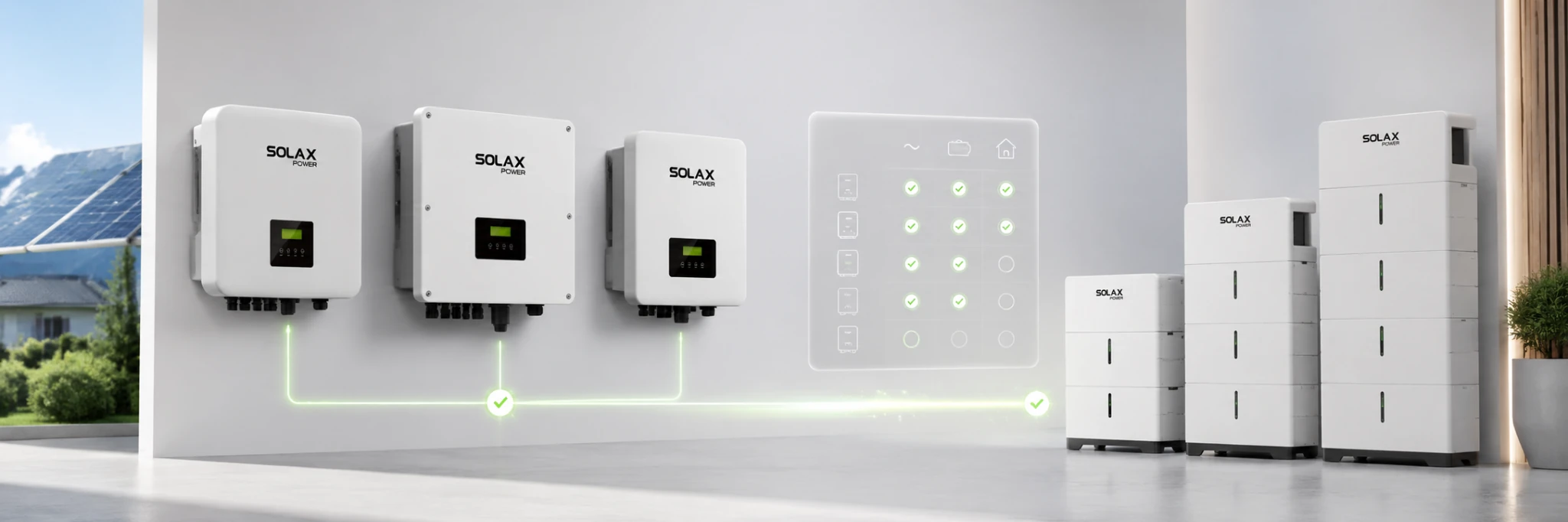
Microinverters typically work with AC-coupled energy storage such as:
Tesla Powerwall 3
Enphase IQ Battery
Huawei LUNA AC-coupled
Sofarsolar AMASSTORE AC units
This means:
The inverter is separate from the battery inverter
No DC-coupled storage possible
Perfect for retrofits and modular upgrades
Key Rule:
Microinverters do not replace a hybrid inverter.
If the installation requires mandatory storage from Day 1, then a hybrid string inverter is often better.
But for flexibility, microinverters + AC storage is ideal.
Step 7: Apply DC Oversizing Safely (Professional Sizing Method)
A simple method to determine if the panel is appropriate:
Panel-to-Microinverter DC/AC Ratio
Example:
550W panel with a 600W AC microinverter:
Oversizing example:
550W panel with 366W microinverter:
This may be allowed, depending on the brand.
Safe zones (industry standard 2025):
| DC/AC Ratio | Suitability |
|---|---|
| 0.9–1.3 | Excellent |
| 1.3–1.5 | Allowed with conditions |
| >1.5 | Not recommended |
Step 8: Final System Sizing Example (Full Calculation)
Let’s size a 10-panel 550W system using microinverters.
Panels:
Microinverter selection (dual-input option)
Using 5 × 1100W microinverters (2 inputs each):
DC/AC Ratio:
AC branch layout:
If max 6 units per branch:
Safe and compliant.
Professional Considerations for Installers, EPCs & B2B Buyers
A. Grid Compliance: EN 50549-1/2 Requirements
European markets require:
Anti-islanding
Power factor control
Reactive power support
Frequency/voltage ride-through
Dynamic grid support
Always select microinverters pre-certified for your market.
B. Procurement Planning for B2B Buying
When ordering from a solar PV supplier, solar distributor, or solar wholesaler, check:
Panel/microinverter wattage match
AC trunk cables and connector compatibility
Junction boxes for roof transitions
Rapid shutdown compliance (especially for NL/UK markets)
Warranty alignment (premium brands offer 12–25 years)
Availability of complete microinverter solarkits
C. Future Expansion
Microinverter systems are inherently modular, enabling:
Adding panels without redesigning strings
Adding AC-coupled batteries anytime
Mixing panel orientations (E/W/S/N)
Gradual system scaling for commercial sites
Top Microinverter Brands to Consider from Premium Solar Distributors (2026)
1. Hoymiles
Best price/performance
Strong EU availability
12–25 year warranty
Large portfolio (single, dual, quad)
2. TSUN
Excellent for two-panel systems
Strong reliability
Compact designs
3. Enphase IQ8
Market-leading technology
Grid-forming capability
Long warranty (up to 25 years)
4. APsystems
Perfect for 2–4 panel units
Very strong AC output
Ideal for commercial rooftops
Common Mistakes to Avoid When Sizing Microinverter Systems
| Mistake | Why It’s a Problem |
|---|---|
| Using underpowered microinverters | Reduces annual yield significantly |
| Ignoring DC oversizing limits | Can cause overheating and clipping |
| Mixing panel types on the same multi-input microinverter | Leads to mismatch losses |
| Exceeding maximum AC branch load | Safety & compliance issues |
| Choosing wrong connector types | Installation delays |
| Assuming DC-coupled storage works | Microinverters require AC storage |
Microinverter Sizing Is Simple When You Follow the Right Steps
Sizing a solar panel system with microinverters requires a shift away from string-inverter thinking. Instead of voltage, strings, and trackers, you work with:
Panel wattage
Microinverter AC rating
DC oversizing limits
AC branch rules
Future battery/expansion needs
When done correctly, microinverters offer:
Higher efficiency
Flexible design
Better shading performance
Safer low-voltage operation
Superior scalability
For installers, EPCs, and B2B procurement teams, a well-sized microinverter-based system is not only easier to design but also easier to expand, service, and upsell.
If you need procurement support, stock availability, or complete microinverter solarkits (including premium TOPCon solar panels, microinverters, solar batteries, cables, AC accessories, and mounting systems), simply let me know—I can generate the full product bundle tailored to your webshop or installation project.
Watch our solar training and installation videos on 3Buy Solar Youtube Channel.