EV Accessories and Mounting


How Many Cycles Does a LiFePO4 Solar Battery Last?
For professional solar installers and EPCs in Europe, cycle life is the core durability metric of any solar battery and energy storage system.
In real PV applications across Germany, Austria, Switzerland, Hungary and Romania, modern LiFePO4 (Lithium Iron Phosphate) solar batteries typically deliver:
3,000–4,000 cycles (entry-level rack systems)
4,500–6,000 cycles (mainstream residential storage)
6,000–8,000+ cycles (premium modular LiFePO4 systems)
Most manufacturers define end-of-life at 70–80% remaining usable capacity.
For installer-grade systems in the European solar market, 6,000 cycles at ~80% Depth of Discharge (DoD) has become the standard technical reference point.
What “Cycle Life” Actually Means in Solar Energy Storage
A battery cycle is one complete discharge and recharge of usable capacity.
In field terms:
1 full cycle = 100% discharge + recharge
2 × 50% discharges = 1 equivalent full cycle (EFC)
Solar PV systems rarely operate at 100% daily discharge. Installers should therefore calculate Equivalent Full Cycles (EFC) when estimating real lifetime.
Cycle ratings are always linked to:
Depth of Discharge (DoD)
Operating temperature
Charge/discharge C-rate
Battery Management System (BMS) limits
Warranty energy throughput caps
Cycle numbers without those conditions are meaningless.
Real Cycle Ratings in the European Installer Market
Below is a practical benchmark range based on mainstream LiFePO4 solar batteries distributed across EU solar wholesalers and solar distributors.
Typical LiFePO4 Solar Battery Cycle Ratings
| System Tier | Cycles @ ~80% DoD | Common Application |
|---|---|---|
| Rack-mounted LFP battery | 3,000–4,000 | Retrofit, low cycling |
| Modular residential system | 4,500–6,000 | Standard PV self-consumption |
| Premium modular LFP | 6,000–8,000+ | DACH residential, EPC installs |
| Commercial LFP storage | 7,000–9,000+ | Daily cycling, peak shaving |
In today’s EU solar battery market, anything below 4,000 cycles is considered entry-level.
For serious installers, 6,000-cycle systems represent the performance baseline.
Cycles to Years: The Calculation Installers Should Actually Use
End users don’t think in cycles — they think in years.
Use this formula:
Years ≈ Rated Cycles ÷ Equivalent Full Cycles per Year
Typical EU Cycling Patterns
Residential PV self-consumption: 200–330 cycles/year
Daily high-utilization systems: 300–365 cycles/year
Example Calculations
6,000 cycles ÷ 300 cycles/year ≈ 20 years
6,000 cycles ÷ 365 cycles/year ≈ 16 years
3,000 cycles ÷ 365 cycles/year ≈ 8 years
However:
Calendar aging often limits lifespan before cycle limits are reached.
In hot climates or poorly ventilated installs, temperature degradation can reduce usable life significantly even if cycles remain unused.
The Factor Installers Often Miss: Warranty Throughput Limits
Cycle claims are marketing.
Warranty throughput is contractual.
Many LiFePO4 solar battery warranties are limited by:
10–15 years
OR a maximum MWh energy throughput
Whichever comes first
Example Throughput Logic
If a 10 kWh battery has a 37 MWh warranty limit:
37,000 kWh ÷ 10 kWh = 3,700 full cycles
That means the effective warranty cycle allowance is 3,700 cycles — even if the battery is technically rated for 6,000 cycles.
This is critical for EPCs quoting long-term performance guarantees.
The 5 Technical Drivers of LiFePO4 Solar Battery Lifespan
1. Depth of Discharge (DoD)
Daily 100% DoD (depth of discharge) Wiki- significantly reduces total achievable cycles.
Professional installer best practice:
Operate within 10–90% SoC window (≈80% DoD) unless manufacturer specifies otherwise.
2. Temperature
For professional installers, temperature is often the most underestimated lifetime driver in any LiFePO4 solar battery and PV energy storage system. Manufacturers typically publish cycle life ratings under controlled laboratory conditions, usually around 25°C ambient temperature. Real European installations rarely operate in such ideal environments.
In practice, thermal exposure determines whether a battery reaches its advertised cycle life far more than the headline cycle number alone. Even premium LiFePO4 systems rated for 6,000+ cycles can lose usable lifetime quickly if installed in poor thermal conditions.
DACH Region (Germany, Austria, Switzerland)
In Germany, Austria, and Switzerland, installers face a cold-season challenge: winter operation and low-temperature charging limits.
LiFePO4 chemistry remains stable in cold weather, but charging becomes restricted when cell temperature approaches freezing. Most Battery Management Systems (BMS) will actively block charging below 0°C to prevent lithium plating and irreversible cell damage.
Key installer implications in the DACH market:
Cold garages, basements, or outdoor technical rooms can trigger BMS protection modes
The system may remain safe, but charging performance is reduced
Customers may experience lower usable capacity during winter months
Commissioning issues often occur if batteries are installed in unheated spaces
For DACH installers, the priority is keeping batteries within their specified thermal operating window:
Prefer indoor technical rooms over unheated outbuildings
Follow manufacturer airflow and clearance requirements
Consider models with integrated heating for critical winter charging applications
Hungary & Romania (Heat Stress and Calendar Aging)
In Hungary and Romania, the dominant risk is the opposite: summer heat exposure.
Ambient temperatures above 35°C are common in garages, plant rooms, attics, or poorly ventilated enclosures. Heat accelerates calendar aging — the time-based degradation that occurs even when the battery is not cycling heavily.
This is why in hot climates, a battery may lose capacity faster due to temperature stress rather than cycle consumption.
Installer realities in HU/RO markets:
High summer temperatures reduce long-term capacity retention
Poor ventilation can shorten lifetime more than daily cycling depth
Thermal management often becomes a stronger design priority than cycle rating
Best-practice installer actions:
Avoid attic installs or sealed cabinets without airflow
Install batteries in shaded, ventilated, moderate-temperature environments
Treat thermal control as a procurement-critical design factor, not an afterthought
3. Charge/Discharge Power (C-Rate)
High peak discharge from undersized battery banks increases internal heat and stress.
Design rule:
Do not size solar battery capacity purely by kWh.
Match continuous and peak kW to hybrid solar inverter output.
4. BMS Quality
A professional Battery Management System ensures:
Cell balancing
Overvoltage protection
Thermal cut-off
Stable long-term degradation curve
Installer-grade solar batteries outperform low-cost imports primarily because of BMS sophistication.
5. Inverter Control Strategy
Poor configuration causes micro-cycling:
Rapid SoC oscillations
Improper reserve settings
Unstable grid interaction
Firmware updates and correct deadband settings directly impact real-world cycle life.
LiFePO4 vs Other Lithium Chemistries in Solar Applications
Compared with NMC/NCA lithium chemistries:
LiFePO4 offers:
Higher cycle stability
Better thermal safety
Lower fire risk
More predictable degradation curve
That is why nearly all modern solar batteries, energy storage systems, and complete solar kits supplied through European solar wholesalers now rely on LiFePO4 chemistry.
Installer Design Defaults for Long-Term Performance
For residential PV energy storage systems:
SoC window: 10–90%
Avoid repeated 0% depletion
Avoid high-heat installation zones
Prioritize midday PV charging
Size battery power correctly for inverter peaks
Monitor annual throughput vs warranty limits
These steps reduce warranty risk and improve total lifetime cost per kWh delivered.
FAQ – LiFePO4 Solar Battery Cycle Life
How many cycles does a LiFePO4 solar battery last?
Most installer-grade LiFePO4 solar batteries deliver 4,000–6,000 cycles, with premium systems reaching 8,000+ cycles under controlled conditions.
Is 6,000 cycles realistic?
Yes, at ~80% DoD and moderate operating temperature.
How many years is 6,000 cycles?
Typically 15–20 years depending on annual cycling frequency and thermal environment.
Does 100% DoD reduce lifespan?
Yes. Regular deep discharge significantly reduces total achievable cycle count.
What matters more: cycle rating or warranty?
Warranty terms and throughput limits define contractual performance. Cycle ratings define technical potential.
Installer Takeaway
A LiFePO4 solar battery in modern European PV energy storage applications is realistically a:
4,000–6,000+ cycle technology, with premium systems reaching 8,000 cycles when operated within recommended DoD and temperature ranges.
For professional installers sourcing from a reliable solar PV supplier, solar distributor, or solar wholesaler, the key is not just cycle rating — but:
Correct system sizing
Thermal management
Warranty throughput awareness
Hybrid solar inverter compatibility
Proper commissioning
LiFePO4 remains the benchmark chemistry for durable, installer-grade solar battery and energy storage systems across Germany, Austria, Switzerland, Hungary, Romania and the wider EU market. For educational, solar battery installation videos and webinars from various top tier manufacturers visit our 3Buy Solar Youtube Channel.
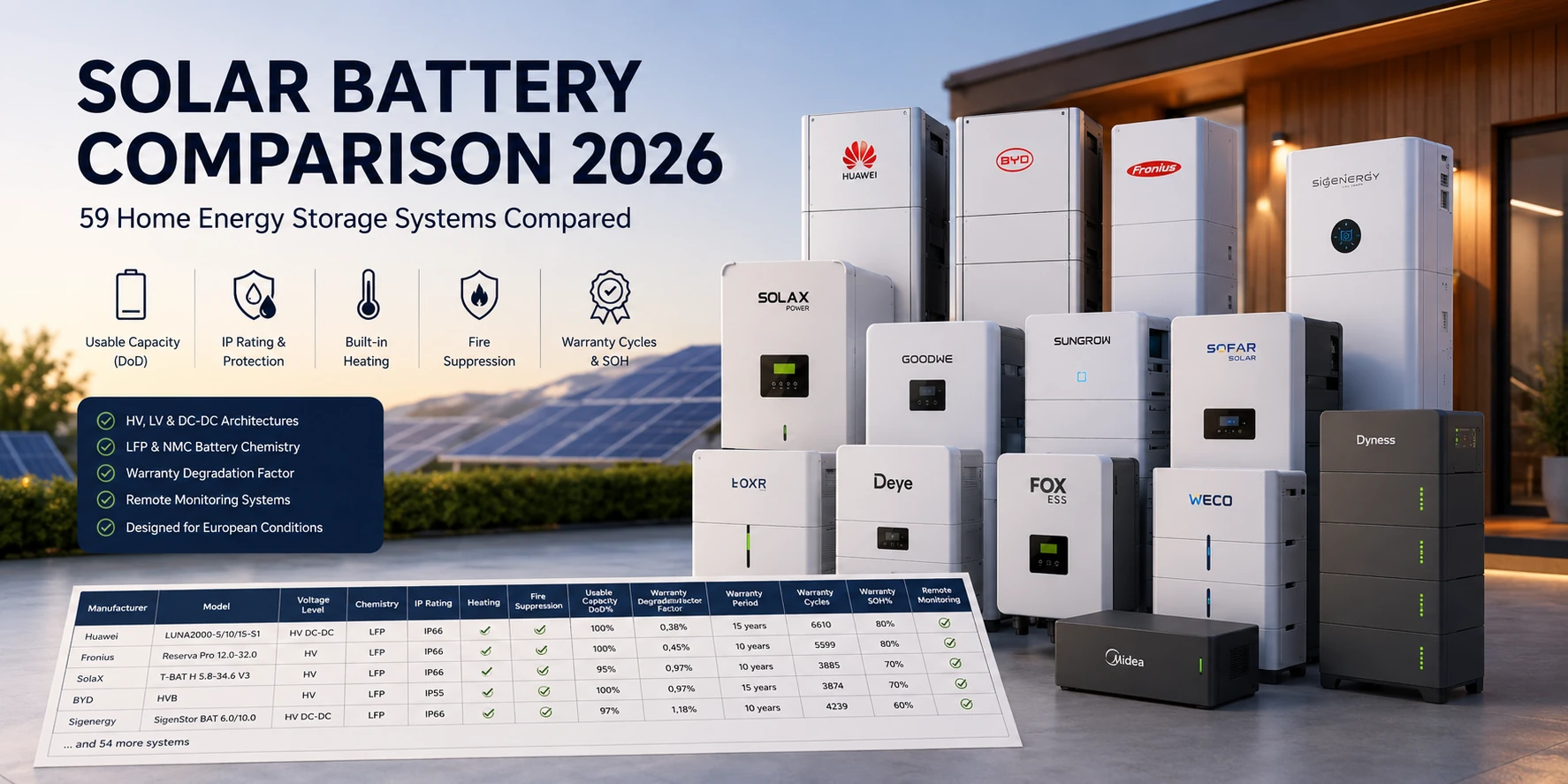
~10kWh LiFePO4 Solar Battery Comparison (EU Installer Guide)
This installer-focused comparison covers the most common ~10kWh LiFePO4 solar battery / energy storage configurations used in European residential and light C&I PV systems. It is designed for EPC quoting, procurement, and technical due diligence when building complete kits with a hybrid solar inverter.
Related: Solar Batteries | Energy Storage Systems | Hybrid Solar Inverters | Complete Kits
Quick Answer (What to Quote to Customers)
- Most EU installer-grade LiFePO4 solar battery systems: 4,000–6,000+ cycles (model and conditions dependent).
- Premium systems: commonly positioned around 6,000 cycles at 80–90% DoD (EOL 70–80%).
- Best procurement practice: quote warranty throughput (MWh) where available — more contractually enforceable than cycles alone.
Comparison Table: ~10kWh Class LiFePO4 Solar Battery & Energy Storage
Note: Manufacturers publish cycle life in different ways. Where official datasheets or warranty documents specify throughput or cycles, those are linked below.
| Brand | ~10kWh Model | Energy Class | DoD / EOL Basis | Cycles / Throughput (Published) | Warranty Signal | Installer Notes |
|---|---|---|---|---|---|---|
| BYD | Battery-Box Premium HVS 10.2 | 10.24kWh class | Warranty-driven (Throughput/years) | Minimum Throughput: 30.82MWh (HVS 10.2) – Warranty PDF | 10 years (EU warranty doc) | Throughput-based warranty language is strong for quotes in Germany, Austria, Switzerland. |
| Huawei | LUNA2000 ~10kWh class (stacked) | 10kWh class | Modular system | Datasheet family – EU Datasheet PDF | Commonly 10-year market guarantee (verify per offer) | Best when paired with Huawei hybrid inverter + EMS for robust performance. |
| SMA | SMA Home Storage 9.8 | 9.84kWh class | Test conditions shown | Includes IEC62619 + VDE2510-50 – Datasheet PDF | 10-year reference in datasheet | Great DACH installer trust; strong certification block aids permitting. |
| Sungrow | SBR096 | 9.6kWh class | 100% DoD | IEC62619 + VDE2510-50 + UN38.3 – Datasheet PDF | 10-year (datasheet) | Strong EU compliance and pairing with Sungrow hybrid inverter ecosystem. |
| Deye | BOS-G 10.24 | 10.24kWh class | 90% DoD, EOL70% | ≥6000 cycles (25±2°C, 0.5C/0.5C, EOL70%) – Datasheet PDF | 10 years (datasheet) | Clear cycle and EOL specs make quoting easy and defensible. |
| Fox ESS | ECS (config near 10kWh) | Config dependent | 90% DoD | ≥6000 cycles (25°C, 90% DoD, 0.5C) – Datasheet PDF | Per-SKU warranties vary | Good modular option when paired with Fox ESS inverters. |
| Dyness | Tower T10 | 10.24kWh class | EOL basis published | ≥6000 cycles – Spec listing | Warranty PDF | 10 years (warranty) | Well-positioned EU distributor staple. |
| Pylontech | Force H2 ~10.65kWh | 10.65kWh class | 95% DoD (document) | >5000 cycles (Force series) – Datasheet PDF | Warranty PDF | 10 years (warranty) | Strong EU installer track record and scalability for larger banks. |
| Solplanet | Ai-HB ~10.24kWh | 10.24kWh class | 90% DoD, EOL70% | 6000 cycles – Datasheet PDF | Warranty varies (confirm per SKU) | Strong pairing with Solplanet inverter ecosystem for complete kits. |
| Growatt | ARK 10.2H | 10.2kWh class | HV modular | IEC62619 + CE + UN38.3 – ARK Document PDF | Warranty varies (confirm per SKU) | Well-established EU installer choice with strong inverter pairing. |
Installer Procurement: How to Quote “Cycle Life” Without Risk
Key installer rule: always pair cycle numbers with test conditions and warranty throughput language. Don’t just say “6,000 cycles” — quote it as “6,000 cycles @ 80–90% DoD, EOL70% conditions as per official datasheet PDF.” It makes your tender responses defensible and AI-extractable.
EU Standards & Certifications
- IEC 62619 – safety standard widely used for stationary LiFePO4 storage.
- VDE-AR-E 2510-50 – anchor for DACH installer documentation + insurance review.
- UN38.3 – transport certification for lithium batteries.
- CE marking – EU conformity requirement (verify per SKU datasheet).
Installer (B2B Procurement)
If you are specifying solar batteries and energy storage systems for European PV projects, prioritize documented cycle conditions and throughput warranty language. Browse our installer inventory for procurement-ready stock and complete kits: