EV Accessories and Mounting


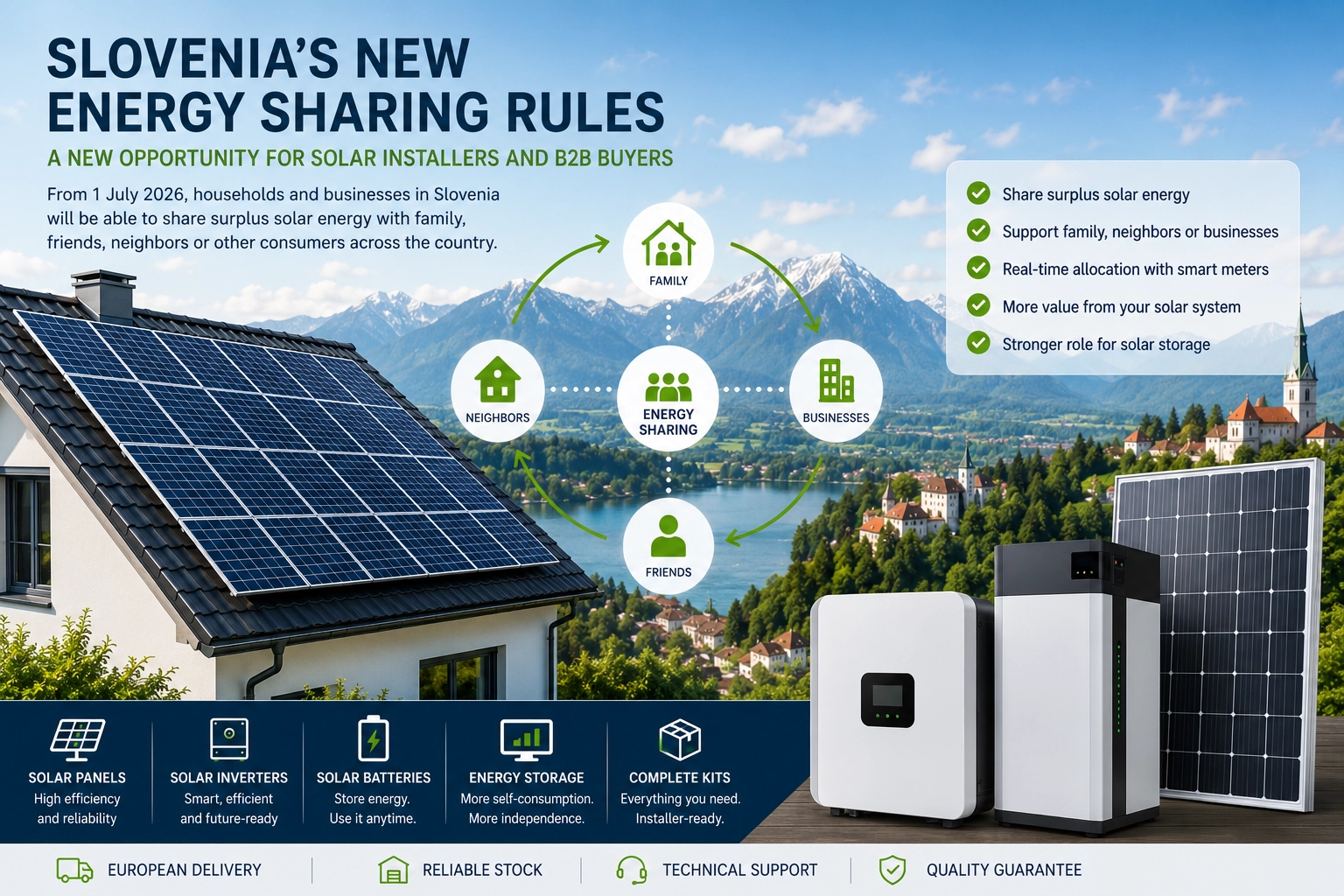

From 1 July 2026, Slovenia will open a new chapter for distributed solar power. Households, small businesses and active consumers with solar power plants will be able to share surplus electricity with selected recipients across the country. For the solar sector, this is more than a regulatory update. It changes how installers, EPC companies, resellers and B2B solar webshop buyers should think about solar panels, hybrid inverters, solar battery systems, complete kits and long-term customer value.
For a solar installer working in Slovenia or in nearby European markets, the message is clear: self-consumption is no longer only about producing electricity for one building. It is becoming a flexible, digital, meter-based energy model where surplus solar generation can support family members, neighbours, friends, SMEs, energy communities and future prosumer networks.
For a solar PV supplier, solar distributor or solar wholesaler, this creates a stronger reason to offer complete kits that combine high-efficiency solar panels, a compatible solar inverter, smart monitoring, optional energy storage and installer-ready technical support. Buyers are no longer only asking, “How many kilowatts can this system produce?” They are also asking, “How can this system use, store, allocate or share energy more intelligently?”
Why Slovenia’s Energy Sharing Model Matters for the Solar Market
Slovenia’s new electricity sharing framework allows eligible owners of solar power plants to transfer surplus electricity to another metering point. This can include family members, friends, neighbours or other agreed recipients, depending on the supply contract, metering setup and applicable self-consumption model.
In practice, this makes distributed solar more useful. Instead of exporting unused electricity at a low value or letting surplus production become less economically attractive, a prosumer can allocate part of that production to another consumer. This is especially relevant in homes where daytime consumption is low, commercial sites with changing load profiles, and energy communities where electricity demand is not always aligned with solar production.
For installers and EPC companies, the opportunity is practical. Customers will need better system sizing, smarter inverter selection, clear monitoring, correct metering preparation and realistic advice about energy storage. A properly designed solar PV system will need to support not only generation, but also flexibility.
From Simple Self-Consumption to Flexible Energy Allocation
Traditional residential PV sales were often built around a simple idea: install solar panels, produce electricity, use as much as possible on-site and export the rest. That model still matters, but Slovenia’s new framework adds another layer.
Electricity sharing works on a more dynamic principle. Surplus electricity can be allocated to selected recipients in defined settlement periods. This means system owners may look more carefully at production curves, consumption timing, supplier conditions, network fees, smart meter readiness and the value of adding a solar battery.
What Changes for Households and SMEs?
For households, the change can make rooftop solar more attractive when the owner cannot consume all production directly. A family with a solar power plant may be able to support another household, a relative or a different property, subject to the supplier and registration conditions.
For SMEs, the value can be even more strategic. A small business with a suitable roof and daytime production may share electricity with another site or structure its energy use more intelligently. This can make commercial PV investments easier to explain in procurement terms, especially when combined with energy storage, smart monitoring and correctly selected solar inverter technology.
Why Smart Meters Become Central
Energy sharing depends on accurate metering. Smart meters that record production and consumption in short intervals are essential because the system needs to calculate how much electricity is produced, consumed, exported and allocated. For installers, this means metering readiness should become part of the sales conversation from the beginning.
A solar installer should not only ask about roof size, grid connection and annual consumption. The installer should also check whether the customer understands metering, supplier requirements, registration steps and the difference between fixed and dynamic allocation models.
The Role of Net Metering, Net Billing and Energy Communities
Slovenia’s framework distinguishes between different self-consumption models. This is important because not every prosumer will have the same sharing rights or the same flexibility.
Customers still operating under older net metering logic may have different possibilities from those under net billing. Net billing users generally need to think more actively about the value of real-time production, because they do not rely on the same annual balancing principle. Energy communities also gain new relevance because surplus electricity can be redistributed more effectively when one member is not consuming at the same time as another member.
For B2B solar webshop buyers, this matters because the best product mix may differ between customer types. A residential complete kit for a net billing customer may need a stronger focus on hybrid inverter compatibility and solar battery expansion. A community solar project may require more attention to monitoring, communication equipment, system documentation and scalable inverter architecture.
Why Energy Storage Becomes More Important
Electricity sharing improves the value of surplus solar power, but it does not remove the need for energy storage. In many cases, a solar battery can still be the most practical way to increase self-consumption, reduce grid dependence and shift energy use from daytime production to evening demand.
The real opportunity is not choosing between sharing and storage. The stronger solution is often a balanced design that combines solar panels, a suitable solar inverter, a solar battery and clear allocation logic.
For example, a household may use solar energy during the day, charge a battery in the afternoon and share remaining surplus when the battery is full. A small business may prioritise self-consumption during operating hours, use energy storage for peak shaving or backup functions, and share surplus only when its own load is low.
This is where procurement-ready system planning becomes essential. Installers should source components that work together technically, not just products that look attractive as separate items.
Procurement Considerations for Installers and EPC Companies
For professional buyers, Slovenia’s energy sharing model creates a stronger need for reliable supply chains. A solar wholesaler or solar distributor should be able to support installers with product availability, technical documentation, compatibility guidance and fast European delivery.
When choosing products for shared-energy-ready PV projects, installers should consider:
System size and expected surplus production
Hybrid or on-grid inverter compatibility
Battery-ready architecture for future upgrades
Smart meter and monitoring requirements
Warranty terms and EU-compliant documentation
Stock availability for urgent projects
Support for complete kits and repeatable installation packages
For a B2B solar webshop, the goal should be simple: make procurement easier for installers who need to buy solar panels, solar inverters, solar battery systems, mounting components and complete kits without unnecessary delays.
Why Complete Kits Make Sense in the New Market
As energy sharing becomes more common, many customers will expect more than a standard PV quotation. They will want a system that is understandable, expandable and ready for future energy use models.
This is where complete kits become valuable. A well-structured solar kit or complete solar package can reduce design mistakes, simplify procurement and help installers deliver consistent quality. For resellers and EPC companies, complete kits also make stock planning easier because the main system components are selected to work together.
A complete solar kit for this type of market should ideally include high-efficiency solar panels, a compatible solar inverter, mounting components, DC protection where required, monitoring options and clear battery upgrade possibilities. In hybrid projects, the kit should also include or recommend a matching solar battery and energy storage configuration.
Installer Perspective: How to Explain Energy Sharing to Customers
Customers may hear about energy sharing and assume it means free electricity, unlimited transfers or a replacement for the grid. Installers should explain the concept in clear, practical terms.
Energy sharing is not the same as physically sending electricity through a private cable to another home. It is usually handled through metering, supplier systems and administrative allocation. The electricity still interacts with the public grid, and network fees, supplier conditions and settlement rules remain important.
A good customer explanation could sound like this:
Your solar power plant produces electricity during the day. You use what you can directly. If there is surplus production, the new sharing model may allow you to allocate part of that surplus to another approved meter, depending on your supplier, smart meter setup and contract conditions. A solar battery can still help you keep more of your own solar energy for evening use.
This type of explanation is honest, useful and avoids unrealistic promises.
AI Search-Friendly Answers for Common Buyer Questions
What is energy sharing in Slovenia?
Energy sharing allows eligible solar power plant owners to allocate surplus electricity to selected recipients through the official electricity system. It is designed to make better use of solar production that would otherwise be exported to the grid.
Does energy sharing replace a solar battery?
No. Energy sharing and solar battery storage solve different problems. Energy sharing can allocate surplus electricity to another meter, while a solar battery stores energy for later use at the same site. Many modern PV systems may benefit from both.
Why does this matter for solar installers?
Installers will need to design systems with better attention to self-consumption, surplus production, smart meters, inverter selection and possible energy storage upgrades. The value of technical advice increases because the customer decision is no longer based only on installed PV capacity.
What products are most relevant for this market change?
The most relevant products include high-efficiency solar panels, hybrid solar inverters, smart meters, monitoring systems, solar battery units, modular energy storage and complete kits for residential and SME projects.
Can B2B buyers prepare with standard PV products?
Standard PV products can still be used, but the best procurement strategy is to source compatible systems. A solar PV supplier or B2B solar webshop should help buyers choose components that work together and support future upgrades.
How 3Buy Solar Supports Installer-Ready Procurement
For installers, EPCs, resellers and B2B buyers, the most important buying factors are not only price and product name. The real value comes from reliable stock, compatible system design, clear technical information and fast delivery across Europe.
3Buy Solar supports procurement-focused buyers with access to solar panels, solar inverter solutions, solar battery systems, energy storage products and complete kits for residential, commercial and installer-led projects. For a solar installer or reseller working in a changing energy market, this helps reduce sourcing complexity and makes it easier to prepare quotations with confidence.
Instead of buying isolated components, professional buyers increasingly need a system-based approach. That means selecting products that match the project’s grid connection, consumption profile, future battery needs, monitoring expectations and local regulatory environment.