


 EV Accessories and Mounting


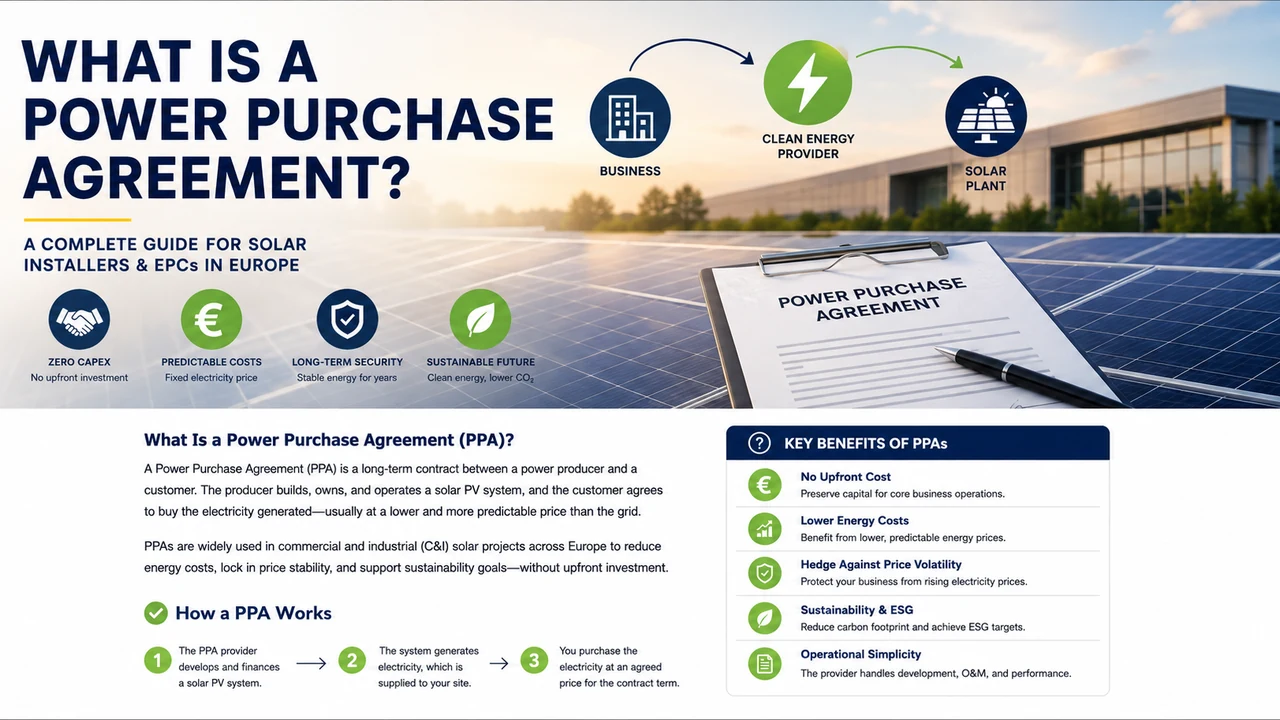


A Power Purchase Agreement, usually shortened to PPA, is a long-term contract under which an electricity producer sells electricity to a buyer under agreed commercial conditions.
In the European solar market, the electricity producer may operate a rooftop solar PV system, commercial solar installation, utility-scale solar plant or hybrid solar and battery energy storage project. The buyer, commonly called the offtaker, can be a manufacturer, logistics operator, data centre, supermarket chain, commercial property company, industrial facility, energy supplier or another large electricity consumer.
For professional solar installers, electricians and EPC contractors, understanding PPAs is becoming increasingly important.
A PPA is not simply an alternative payment method for a solar PV system. It can determine how the project is financed, who owns the solar panels and solar inverter, how the installation is designed, how energy is metered, who is responsible for maintenance and ultimately how the project generates revenue.
The European PPA market is also becoming more established. In April 2026, the European Commission published a specific recommendation aimed at removing barriers to Power Purchase Agreements and other long-term energy purchase agreements across the EU.
For professional solar installers and electricians moving into commercial and industrial solar, solar battery systems and larger EPC projects, PPAs therefore sit at the intersection of technical design, solar procurement, financing and electricity trading.
What Does PPA Mean?
PPA stands for Power Purchase Agreement.
The contract sets out the commercial relationship between the company producing electricity and the organisation purchasing it.
ACER, the EU Agency for the Cooperation of Energy Regulators, defines PPAs as contractual arrangements between electricity producers—frequently renewable-energy generators—and electricity buyers.
In practical terms, a PPA normally establishes matters such as electricity pricing, contract duration, expected generation, energy delivery, metering, billing and the responsibilities of the parties.
For a solar project, the basic structure is straightforward:
Solar plant → electricity generation → PPA → electricity buyer
The contractual details behind that structure can nevertheless become complex, particularly for larger commercial and industrial solar projects.
How Does a Solar Power Purchase Agreement Work?
A solar PPA starts with an electricity-generating asset.
That might be a 300 kWp commercial rooftop installation, a 5 MW solar park or a much larger utility-scale solar PV project.
A project developer, investment fund, energy company or dedicated project company may finance and own the installation.
A professional solar installer or EPC contractor then designs, procures and constructs the system using equipment such as solar panels, solar inverters, mounting systems, transformers, switchgear and potentially battery energy storage.
Once operational, the solar PV system generates electricity.
The buyer purchases that electricity according to the conditions established in the PPA.
Instead of the business necessarily purchasing the complete solar installation upfront, it may therefore purchase the electricity produced by the installation over an agreed period.
That distinction is fundamental.
Under a conventional solar CAPEX project, the customer normally buys the asset.
Under many PPA structures, the customer primarily buys energy.
Why Are Power Purchase Agreements Important in Europe?
One of the main attractions of a PPA is long-term visibility.
The electricity generator gains greater certainty over future revenue.
The electricity buyer gains greater visibility over the price or pricing mechanism applied to part of its future electricity consumption.
This revenue certainty can help make renewable-energy projects easier to finance.
European policy is increasingly supporting that market. The European Commission’s April 2026 recommendation specifically addresses barriers that continue to restrict wider PPA adoption.
Solar PPAs are already materially contributing to European deployment.
SolarPower Europe’s March 2026 analysis found that public energy auctions and corporate PPAs together supported 92 GW of solar capacity in the European Union between 2022 and 2025. Spain remained a particularly active corporate solar PPA market, with more than 2 GW of corporate solar PPAs signed annually between 2023 and 2025.
That matters for installers because a customer that will not approve a large upfront solar investment may still approve a long-term electricity purchasing arrangement.
What Is an Onsite Solar PPA?
An onsite solar PPA involves solar generation installed directly at, or very close to, the electricity customer’s premises.
Imagine a large logistics warehouse with suitable roof space.
A third-party investor finances a 2 MWp rooftop solar installation. The solar panels are installed on the warehouse, but the warehouse operator does not necessarily own them.
Instead, the warehouse agrees to purchase the solar electricity generated by the system.
The business therefore gains access to onsite renewable generation without necessarily paying the entire solar PV system cost upfront.
The project owner receives revenue from electricity sales.
The solar EPC contractor receives revenue from designing, supplying, installing and commissioning the system and may also receive recurring revenue from operation and maintenance.
For professional installers, onsite PPAs can therefore unlock commercial projects where a technically suitable customer has substantial electricity consumption but prefers to preserve its capital for its core business.
Typical applications include factories, warehouses, logistics centres, supermarkets, hotels, agricultural facilities, commercial offices, industrial buildings and solar carports.
What Is an Offsite PPA?
An offsite PPA connects an electricity buyer with a renewable-energy plant located away from the customer’s premises.
For example, a manufacturing company might purchase electricity associated with a large solar plant located elsewhere in the same country.
The power does not necessarily travel directly from the solar farm to the factory through a private cable.
Instead, electricity normally enters the wider electricity network, with commercial delivery, settlement, guarantees of origin, balancing and supplier arrangements used to create the contractual relationship.
Offsite PPAs can be relevant where the customer’s electricity consumption is much greater than the solar PV potential of its own roof or land.
They may also work for corporate groups operating several sites.
Physical PPA vs Virtual PPA
Professional installers entering larger projects will often hear the terms physical PPA and virtual PPA.
They are not the same.
Physical PPA
A physical PPA provides for contractual electricity delivery.
The structure can involve the renewable generator, corporate offtaker, electricity supplier, grid operator, balancing party and potentially other energy-market participants.
Physical delivery does not necessarily mean that the renewable project is physically connected directly to the customer’s property.
The public electricity grid may still be used.
Virtual PPA
A virtual PPA—sometimes called a synthetic or financial PPA—is primarily a financial arrangement rather than a direct physical electricity supply contract.
The buyer may continue purchasing its physical electricity through its normal electricity supplier.
Separately, the renewable generator and corporate buyer settle differences between an agreed PPA price and a reference electricity-market price.
The structure can provide price-hedging benefits, but it also introduces additional financial, accounting and market-price considerations.
ACER notes that European PPAs vary considerably in their commercial structures and design.
What Is a Corporate PPA?
A corporate PPA, often abbreviated to cPPA, is a Power Purchase Agreement where the electricity buyer is a company.
Corporate buyers may include manufacturers, data centres, food-production businesses, retail chains, hotels, logistics groups, automotive companies, property portfolios and technology companies.
Corporate PPAs have become an important route to market for European renewable-energy projects.
For the corporate buyer, the objective may be to secure renewable electricity, gain greater visibility over future electricity expenditure, support sustainability commitments or reduce exposure to certain forms of wholesale electricity-price volatility.
For the project developer, a long-term corporate buyer can provide the predictable future revenue required to support project financing.
For the installer or EPC contractor, the PPA can be the commercial mechanism that allows an otherwise technically viable solar project to actually reach construction.
How Long Does a Solar PPA Last?
Power Purchase Agreements are normally long-term contracts.
There is no universal duration that applies to every European project.
The appropriate term depends on the project economics, financing structure, country, customer creditworthiness, expected electricity generation, solar equipment lifetime, roof or land lease, grid arrangement and investor requirements.
The important point for installers is that the equipment may need to perform reliably for a substantial portion of the contract.
That makes lifecycle procurement critical.
Choosing a solar inverter exclusively because it is slightly cheaper on installation day can become a poor decision if replacement availability, warranty support or service coverage creates extended downtime ten years later.
The same applies to solar panels, monitoring equipment and solar battery systems.
How Is the Electricity Price Set in a PPA?
A PPA does not automatically mean a completely fixed electricity price.
Different commercial structures can be used.
A fixed-price PPA may establish an agreed price per kWh or MWh for a defined period.
An indexed PPA can link pricing to a market or inflation index.
Other agreements may use floor-and-ceiling structures, market-linked mechanisms, escalation clauses or financial settlement arrangements.
The important commercial question is therefore not simply:
“What is the PPA price?”
It is:
“How is the PPA price calculated throughout the complete contract?”
For an installer involved in project development, this distinction matters because electricity revenue ultimately supports the economics behind the solar equipment procurement and project financing.
PPA Price vs Electricity Tariff
Businesses evaluating onsite PPAs should be careful when comparing the PPA price with their existing electricity bill.
A normal commercial electricity invoice can include much more than the cost of energy.
Depending on the European market, the invoice may contain network charges, taxes, balancing costs, supplier margin, capacity-related charges, levies and other regulated components.
An onsite solar PPA can reduce the amount of electricity imported from the grid.
It does not automatically eliminate every cost associated with the electricity connection.
Professional project modelling therefore needs to compare the actual avoided electricity cost, not merely the headline electricity tariff.
Who Owns the Solar Panels Under a PPA?
In many PPA models, the electricity customer does not own the solar PV system during the contract.
Ownership may remain with a developer, infrastructure investor, utility, fund, energy company or dedicated special-purpose vehicle.
The customer provides the location and purchases electricity.
The project owner owns the asset and receives revenue.
At the end of the PPA, the contract may allow several possibilities.
The customer may purchase the system.
Ownership may transfer under predefined conditions.
The PPA may be extended.
The project owner may continue operating the installation.
In some circumstances, the equipment may eventually be removed.
For solar installers and electricians, this should be established early because asset ownership affects warranty management, maintenance, equipment replacement and technical decision-making.
What Is the Role of the Solar Installer in a PPA?
The PPA itself is an electricity contract.
The solar installer creates the physical asset that makes that electricity contract possible.
In larger projects, the installation business may act as the EPC contractor.
EPC stands for Engineering, Procurement and Construction.
The contractor may be responsible for site assessment, system engineering, energy-yield modelling, solar panel procurement, solar inverter selection, mounting-system design, electrical protection, cabling, transformer integration, grid connection, monitoring, battery energy storage integration, testing and commissioning.
The PPA provides the long-term commercial framework.
The EPC contractor delivers the actual power-generating plant.
That distinction is crucial.
A PPA Is Not an EPC Contract
These terms should never be used interchangeably.
A Power Purchase Agreement governs the sale and purchase of electricity.
An EPC contract governs the engineering, procurement and construction of the solar installation.
A large commercial solar project may therefore have a PPA, EPC agreement, operation and maintenance agreement, roof or land lease, financing documents, grid-connection agreement, equipment supply agreements and insurance documents operating at the same time.
Professional installers should always know which agreement determines their own payment and liability.
The EPC contractor should not automatically carry commercial risks belonging to the electricity offtaker or project investor.
PPA Projects Require Bankable Solar Equipment
Long-term energy revenue changes the way solar equipment should be evaluated.
For professional PPA projects, equipment is not simply purchased to reach commissioning.
It needs to support reliable generation for many years afterwards.
Solar panels should therefore be assessed on more than module price.
Relevant considerations include manufacturer reliability, product warranty, performance warranty, degradation profile, certifications, mechanical loading and long-term availability.
Solar inverters should be evaluated according to efficiency, architecture, serviceability, grid-code compliance, monitoring capability, manufacturer support, spare-part availability and replacement strategy.
Battery energy storage adds another layer.
Solar battery projects may require evaluation of cell chemistry, usable capacity, cycle life, warranted throughput, battery management system compatibility, PCS architecture, thermal management, fire protection, EMS functionality and future augmentation requirements.
SolarPower Europe’s February 2026 EPC Best Practice Guidelines significantly expanded their treatment of hybrid solar PV and battery energy storage systems, reflecting the growing importance of PV+BESS project integration.
For a financed PPA installation, the cheapest purchase price is therefore not necessarily the lowest project cost.
Solar PPA and Battery Energy Storage
Battery storage is becoming increasingly relevant to solar PPAs.
Solar production typically peaks during daylight hours.
Commercial electricity demand does not always follow exactly the same profile.
A solar battery or commercial BESS can store surplus energy and move part of that electricity into different operating periods.
Depending on the project and market rules, storage can increase onsite self-consumption, reduce export, support peak-load management, provide flexibility and help manage exposure to periods of very low electricity prices.
Europe is increasingly considering solar and storage as interconnected components of the electricity system. SolarPower Europe’s 2026 Solar+ modelling places substantial battery-storage expansion alongside future solar deployment.
The contractual treatment of storage is particularly important in a PPA.
The parties need to understand who owns the battery, who determines when it charges or discharges, whether grid charging is allowed, who receives flexibility revenues, how battery losses are treated and who carries degradation risk.
Those are not minor technical details.
They can materially change project economics.
Guarantees of Origin and PPAs
European renewable electricity can be associated with Guarantees of Origin, commonly abbreviated as GOs.
These certificates provide evidence regarding the origin of renewable electricity.
A PPA should establish how the relevant Guarantees of Origin are handled.
The corporate offtaker may want them transferred together with the electricity because environmental attributes can be important to the company’s renewable-energy procurement strategy.
The European Commission’s 2026 PPA work specifically addresses Guarantees of Origin and their role in improving the functioning of European long-term energy purchasing arrangements.
What Does Bankable PPA Mean?
A bankable PPA is a Power Purchase Agreement that lenders or investors consider sufficiently robust to support financing of the underlying renewable-energy project.
Bankability depends on considerably more than the electricity price.
The lender needs confidence that project revenue can actually be generated and collected.
This means the creditworthiness of the electricity buyer matters.
So do contract duration, termination provisions, pricing, volume obligations, grid connection, project permits, security arrangements, technology selection, EPC quality, equipment warranties and operation and maintenance.
A technically excellent solar installation can still struggle to secure project finance if the revenue contract is weak.
Likewise, a strong PPA cannot compensate indefinitely for poor engineering.
The financial model and technical design must work together.
What Is Offtaker Risk?
The company purchasing electricity under the PPA is the offtaker.
Offtaker risk is the possibility that the buyer fails to meet its contractual obligations.
Suppose a solar project is financed on the assumption that an industrial company will purchase electricity for 15 years.
If that company becomes insolvent after three years, the project may lose an important portion of its anticipated revenue.
Investors therefore evaluate the buyer’s financial strength.
That can include company accounts, balance sheet, payment history, guarantees and overall creditworthiness.
The same solar installation can therefore have very different financing prospects depending on who signs the PPA.
What Is Solar PPA Volume Risk?
Solar PV output is variable.
Generation changes according to weather, season, system availability, module degradation and curtailment.
The customer’s electricity consumption can also change.
A factory might add another production line.
A warehouse might become vacant.
A business might reduce operating hours.
A PPA therefore needs a mechanism for dealing with differences between projected and actual electricity volumes.
Depending on the contract, electricity may be purchased on a pay-as-produced basis, according to fixed-volume commitments or through more sophisticated delivery structures.
For installers developing onsite PPA projects, realistic consumption modelling is essential.
Oversizing the solar PV system simply to increase installed kWp can damage the commercial model if large volumes of electricity cannot be used economically onsite.
Negative Electricity Prices and Solar PPAs
Periods of negative wholesale electricity prices have become an increasingly relevant consideration in European renewable-energy markets.
When large volumes of renewable power are available at the same time as relatively low electricity demand or network constraints, wholesale prices can sometimes fall below zero.
A sophisticated PPA should therefore define what happens during negative-price periods.
Questions may include whether the solar plant continues generating, whether curtailment is permitted, who carries lost-generation risk and whether a battery energy storage system can absorb part of the production.
This is also one reason flexible electricity demand and energy storage are becoming more important alongside solar.
ACER has repeatedly highlighted both the growth of PPAs and the need for European electricity markets to develop greater flexibility.
What Is Curtailment Risk?
Curtailment occurs when a solar PV plant could technically generate electricity but its output is deliberately reduced.
Grid congestion, export limits, market conditions or instructions from network operators can all potentially contribute.
For a PPA project, lost generation can mean lost revenue.
The contract must therefore clarify who carries that financial risk.
This issue is becoming increasingly relevant in markets with rapidly growing renewable deployment.
SolarPower Europe’s 2026 European PPA analysis identifies grid congestion and curtailment among the factors influencing project economics and corporate PPA activity in parts of Europe.
What Happens if the Solar System Underperforms?
PPA revenue depends on electricity generation.
That makes system performance commercially important.
Generation may fall below expectations because of inverter downtime, module degradation, unexpected shading, soiling, electrical faults, poor installation, equipment failure, grid outages or inaccurate initial yield assumptions.
EPC and O&M agreements may therefore include performance requirements.
Depending on the project, those could cover plant availability, performance ratio, energy yield, response times or liquidated damages.
For professional solar installers, conservative and technically defensible yield modelling is generally more valuable than exaggerated production forecasts.
The electricity produced over the project’s lifetime matters more than making the initial proposal look impressive.
What Is the Difference Between a PPA and Buying a Solar PV System?
With a conventional direct solar purchase, the customer buys the system.
The customer funds or finances the CAPEX, owns the solar panels and solar inverter and receives the economic benefit of the electricity generated.
With a solar PPA, a third party may finance and own the installation.
The customer buys electricity rather than purchasing the complete asset upfront.
The PPA structure can therefore preserve customer capital.
The trade-off is that the customer enters into a long-term contractual relationship instead of simply owning the equipment outright.
Neither model is universally better.
The correct choice depends on financing costs, expected electricity savings, taxation, risk appetite, project ownership strategy and the customer’s available capital.
Solar PPA vs Solar Lease
A solar lease is also different from a PPA.
With a PPA, payment is usually linked to the electricity generated or supplied.
With a lease, payment is generally associated with use of the asset.
A customer might therefore pay a defined amount per kWh under a PPA but a fixed periodic payment under a lease.
Commercial, tax and accounting consequences vary by jurisdiction and contract design.
What Should Solar Installers Check Before Joining a PPA Project?
Before committing engineering resources or ordering solar equipment, a professional installer should understand who owns the project, who is paying the EPC invoice, whether project financing has actually been approved, whether grid capacity is available and whether planning or permitting conditions remain outstanding.
The contractor should also understand the required solar panel, solar inverter and solar battery specifications, warranty obligations, performance guarantees, commissioning requirements, metering architecture and EPC payment milestones.
Particular attention should be paid to projects where the installation contractor’s payment becomes dependent on long-term PPA revenue.
An EPC contractor normally needs a clearly defined construction payment structure.
Financing the project for the asset owner is not automatically the EPC contractor’s responsibility.
How Does a PPA Solar Project Reach Construction?
A professional commercial project commonly begins with customer energy analysis.
The developer reviews historic electricity consumption, load profiles and tariffs.
The solar installer or engineering team then assesses the roof or site, electrical infrastructure, structural limitations, available area and grid connection.
A preliminary system is designed.
Expected installed capacity, annual generation, onsite consumption, export and equipment requirements can then be modelled.
The developer and electricity buyer negotiate the commercial PPA.
Technical, legal and financial due diligence follows.
Once the investor or lender is satisfied and the project reaches financial close, EPC procurement can proceed.
Solar panels, solar inverters, mounting systems, transformers, switchgear, monitoring equipment and battery energy storage can then be ordered.
The EPC contractor constructs and commissions the plant.
Only after the system satisfies the necessary technical and contractual requirements does normal PPA electricity generation and billing begin.
Why PPA Projects Matter to Professional Solar Installers
PPAs can expand the addressable C&I solar market.
Consider a business that wants a 2 MWp rooftop solar system but does not want to allocate substantial capital to the project.
A conventional solar proposal may therefore be rejected even if the installation would produce attractive long-term savings.
A PPA investor can potentially fund the asset instead.
The business receives renewable electricity.
The investor receives long-term electricity revenue.
The installer receives an EPC project.
That creates opportunities for professional solar contractors capable of delivering larger and more technically demanding installations.
It can also generate long-term work involving operation and maintenance, solar inverter replacement, performance monitoring, system extensions and battery energy storage.
PPAs and the European Solar Market
Power Purchase Agreements are becoming part of a broader evolution in the European electricity market.
Developers now increasingly evaluate several possible routes to market, including corporate PPAs, electricity auctions, merchant electricity sales, Contracts for Difference and hybrid structures.
The EU’s electricity-market framework is designed to encourage greater use of longer-term contracts that reduce dependence on short-term wholesale electricity prices, while the Commission’s April 2026 recommendation seeks to remove remaining obstacles to PPA participation.
At the same time, solar remains central to Europe’s future electricity system. SolarPower Europe reports EU installed solar capacity reached approximately 406 GW by the end of 2025, with substantially further deployment expected toward 2030.
For installers, the commercial discussion is therefore changing.
Customers increasingly want to know not only:
“How much does the solar PV system cost?”
but also:
“How can the project be financed, owned and supplied over its operating life?”
Understanding PPAs helps professional contractors participate in that conversation.
Choosing Solar Equipment for a PPA Project
Long-term electricity revenue requires a long-term procurement strategy.
Professional EPC contractors should therefore evaluate equipment according to total lifecycle economics rather than exclusively according to initial purchase price.
Solar panels need credible warranties and predictable degradation.
Solar inverters need serviceability, European technical support and realistic replacement planning.
Solar batteries require compatible battery management systems, clear throughput warranties and a well-defined operational strategy.
Monitoring equipment needs to provide reliable long-term performance data.
The solar PV supplier or solar wholesaler also matters.
Reliable European logistics, product continuity, technical documentation, manufacturer support, warranty handling and access to compatible components can directly influence project availability.
For a PPA project, every avoidable day of downtime can potentially reduce revenue.
Frequently Asked Questions About Power Purchase Agreements
What is a Power Purchase Agreement?
A Power Purchase Agreement, or PPA, is a long-term contract between an electricity producer and a buyer. It establishes how electricity will be purchased and can define pricing, duration, energy volumes, metering and commercial responsibilities.
What is a solar PPA?
A solar PPA is a Power Purchase Agreement linked to electricity generated by a solar PV system. The owner of the solar project sells electricity to an offtaker according to agreed long-term conditions.
How does an onsite solar PPA work?
Under an onsite PPA, solar panels are installed at or close to the customer’s premises. A third-party investor may own and finance the system while the customer purchases the electricity it generates.
What is an offsite PPA?
An offsite PPA connects an electricity buyer with a renewable-energy project located away from the buyer’s premises. The public electricity network and market arrangements are normally involved in the delivery or settlement structure.
What is a corporate PPA?
A corporate PPA is a Power Purchase Agreement where a company purchases renewable electricity under a long-term contract with an electricity producer or project owner.
Who owns the solar panels under a PPA?
In many solar PPA structures, the system is owned by a developer, investor or project company rather than the electricity customer. The PPA and related agreements determine ownership and what happens to the equipment when the contract ends.
Is a PPA the same as a solar lease?
No. A PPA normally links customer payments to electricity generated or supplied, whereas a lease generally involves paying for the use of the solar asset.
Is a PPA the same as an EPC contract?
No. A PPA governs the purchase and sale of electricity. An EPC contract governs the engineering, procurement and construction of the solar PV installation.
Can battery storage be included in a solar PPA?
Yes. Solar battery and commercial energy storage systems can be incorporated into PPA projects. The commercial structure should clearly establish battery ownership, charging rights, dispatch control, degradation, losses and any additional energy-market revenues.
Why do businesses sign PPAs?
Businesses can use PPAs to obtain longer-term electricity-price visibility, procure renewable electricity and support the development or financing of solar and other renewable-generation assets.
What are the main risks of a PPA?
Important risks can include electricity-price changes, customer credit risk, generation differences, curtailment, negative electricity prices, imbalance costs, grid limitations, project delays, equipment performance and regulatory changes.
Are Power Purchase Agreements used in Europe?
Yes. PPAs are established across European renewable-energy markets, and EU policy is actively supporting wider adoption. Contract structures, taxation, grid rules and regulatory requirements differ between European countries.
Power Purchase Agreements: The Bottom Line
A Power Purchase Agreement is a long-term commercial framework connecting electricity generation, project financing and energy procurement.
For the electricity buyer, a PPA can provide access to renewable electricity and greater visibility over future energy expenditure.
For the project owner, the PPA can provide revenue certainty that helps make a new solar PV installation financeable.
For the professional solar installer, electrician or EPC contractor, it can turn a technically viable commercial project into an actual construction opportunity.
That is why installers working with commercial solar panels, solar inverters, solar batteries and complete energy storage systems should understand PPAs even when they are not negotiating the electricity contract themselves.
A successful PPA project depends on several elements working together: a credible electricity buyer, financeable commercial terms, accurate engineering, reliable equipment and professional long-term operation.
For installers sourcing equipment across Europe, procurement is therefore part of the financial model.
Solar panels, solar inverters, solar battery systems and other energy storage equipment should be selected not simply according to their purchase price on installation day, but according to expected energy generation, system compatibility, warranty support, technical documentation, service availability and lifecycle reliability.
In a normal equipment sale, downtime creates an unhappy customer.
In a PPA project, downtime can also mean lost electricity revenue.
That difference is exactly why understanding Power Purchase Agreements is becoming increasingly valuable for professional solar installers, EPC contractors and electricians operating in Europe’s commercial solar and energy storage market.