EV Accessories and Mounting



Choosing a solar battery in 2026 involves considerably more than comparing storage capacity, warranty years and manufacturer names. For European solar installers, EPC contractors and homeowners, the real question is how a battery will perform within a complete solar PV system — and whether it remains a sensible investment after installation, commissioning and years of daily cycling.
A 10 kWh solar battery from one manufacturer may offer different usable energy, charging power, temperature protection, inverter compatibility and warranty conditions from another product with exactly the same advertised capacity. Those differences affect backup runtime, winter operation, future expansion, system efficiency and ultimately the cost of stored electricity.
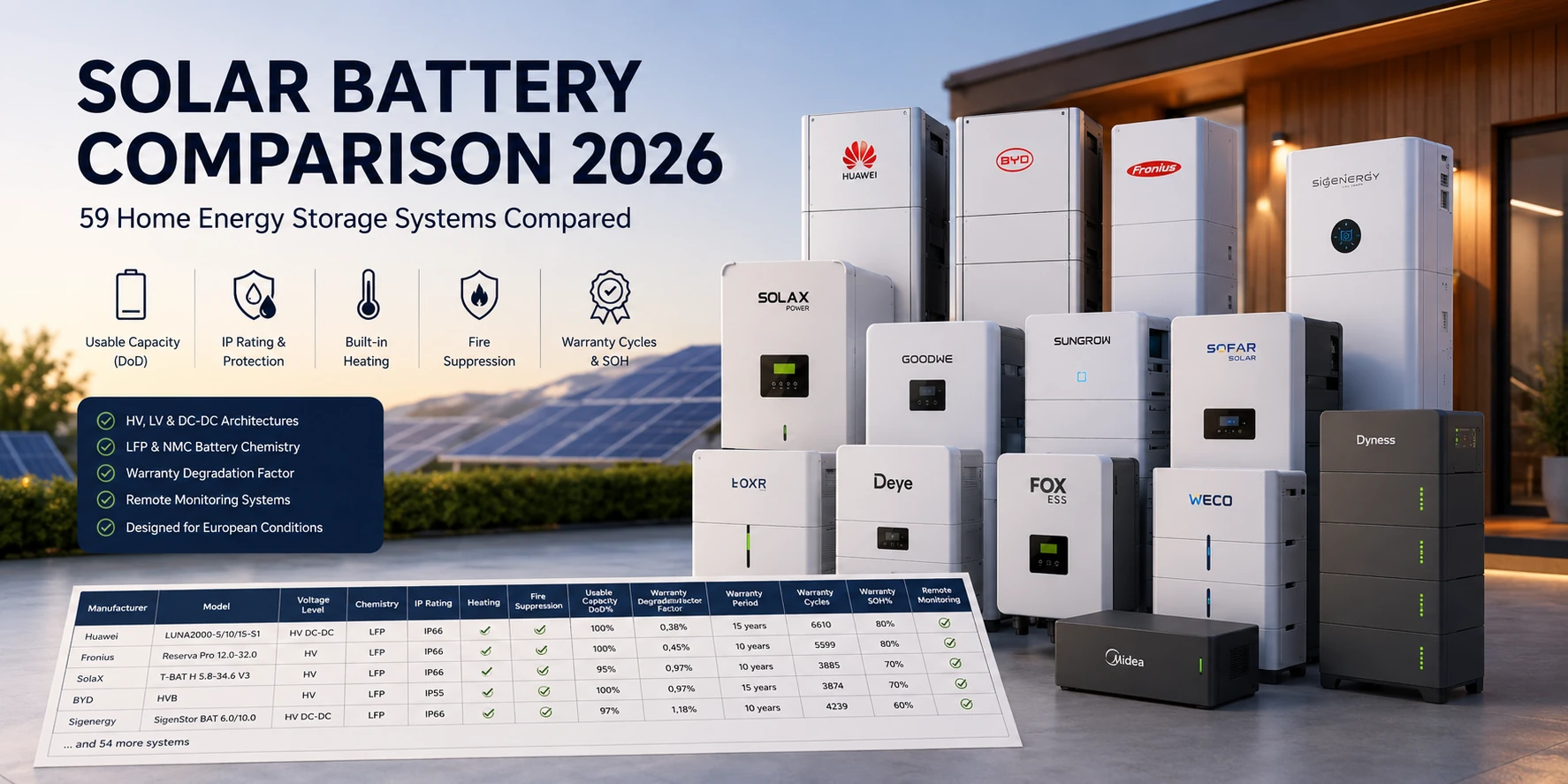
In this 3Buy Solar comparison, we examine 59 residential solar battery systems and product families from 23 manufacturers, including Huawei, BYD, Fronius, SolaX, Deye, Fox ESS, Dyness, Solplanet, Sigenergy, Sungrow and GoodWe.
Our objective is to help buyers make an informed technical and commercial decision. We compare the published battery characteristics, explain their practical implications, identify products worth shortlisting for different installation requirements and show how to evaluate the complete cost of an energy storage system.
The reference data originates from the Hungarian Battery Association’s 2026 battery comparison. The selection guidance, system design examples, procurement criteria and manufacturer documentation checks below form 3Buy Solar’s additional technical assessment. This is a desk-based comparison, not an independent laboratory test or measured reliability ranking.
Updated: 13 October 2026 | Technical and procurement review by 3Buy Solar
Which Solar Battery Is Best in 2026? The Short Answer
There is no single best solar battery for every home or commercial installation.
Based on the published characteristics of the systems reviewed, Huawei LUNA2000-S1, Fronius Reserva Pro, SolaX Triple Power, Deye SE-F16 MAX, BYD Battery-Box, Dyness Tower Pro, Sigenergy SigenStor and Solplanet Ai-HB are all worth evaluating for different technical requirements.
The most suitable product depends primarily on the existing or proposed hybrid solar inverter, required usable energy, charge and discharge power, installation temperature, backup requirements, expansion plans and total installed price.
3Buy Solar’s Installer Shortlist — By Application
| Installation requirement | Solar battery systems worth considering | Main procurement consideration |
|---|---|---|
| Premium high-voltage residential storage | Huawei LUNA2000-S1 | Inverter compatibility, controller configuration and warranty |
| Large residential and light-commercial storage | Fronius Reserva Pro | Modular HV capacity, inverter ecosystem and system cost |
| Cold-climate residential installations | SolaX Triple Power HV, Huawei LUNA2000-S1 | Battery heating, charging temperature and IP protection |
| 48V backup and hybrid systems | Deye SE-F16 MAX | Continuous current, compatible inverter and parallel configuration |
| Modular HV storage with third-party inverter options | BYD Battery-Box | Exact approved inverter and BCU compatibility |
| Scalable residential battery banks | Dyness Tower Pro | Tower configuration, expansion rules and optional heating |
| Integrated inverter and battery architecture | FOX ESS Avocado P100, Sigenergy SigenStor | Complete system power, storage capacity and ecosystem requirements |
| Modular Solplanet installations | Solplanet Ai-HB G2 and G2-E | Indoor/outdoor suitability, BMS and approved hybrid inverter |
These are application-based shortlisting suggestions, not a claim that the products have been independently tested against one another.
For current product availability and procurement options, visit the 3Buy Solar battery storage shop.
How We Compare 59 Solar Battery Systems
Most solar battery comparison articles focus on headline capacity, a handful of specifications and the manufacturer’s stated warranty period.
That is not enough for professional system design.
For this comparison, we consider three groups of technical and commercial criteria.
1. Battery Technology and Performance
The first group determines what the solar battery can deliver under actual operating conditions:
- Low-voltage or high-voltage battery architecture.
- Lithium iron phosphate (LFP) or other cell chemistry.
- Nominal and usable energy capacity in kWh.
- Maximum continuous charging and discharging power in kW.
- Maximum battery current in amperes.
- Depth of discharge (DoD).
- Battery-to-battery or system round-trip efficiency.
- Battery management system (BMS) and communication requirements.
2. Installation, Safety and Service Life
The second group addresses suitability for the intended installation environment:
- IP20, IP21, IP55, IP65 or IP66 enclosure protection.
- Permitted installation location.
- Minimum charging and discharging temperatures.
- Integrated or optional battery heating.
- Integrated fire-suppression features, where documented.
- Manufacturer warranty duration.
- Guaranteed remaining state of health (SOH).
- Warranty energy-throughput limits.
- Battery module expansion and replacement rules.
3. European Installer and Procurement Requirements
The final group considers what happens when a technically attractive battery has to become a complete, working energy storage installation.
That includes approved inverter compatibility, battery controllers, meters, cables, protection devices, country-specific documentation, commissioning requirements, manufacturer support, delivery arrangements and total cost.
A battery may look exceptional in a specifications table but be unsuitable for a project because it is not approved for the selected solar inverter.
Likewise, an apparently inexpensive 10 kWh battery may be a poor commercial choice if additional control equipment, commissioning work or incompatible accessories materially increase the installed cost.
Our assessment therefore prioritises a correctly engineered, commissionable system rather than an isolated battery specification.
Solar Battery Capacity vs Power: The Most Important Difference
Battery capacity and battery power are frequently confused.
Capacity, measured in kWh, tells you how much energy a battery can store. Power, measured in kW, tells you how quickly that energy can be delivered or absorbed.
Consider two hypothetical solar battery systems.
| Parameter | System A | System B |
|---|---|---|
| Nominal battery capacity | 10 kWh | 10 kWh |
| Usable DoD | 90% | 90% |
| Approximate usable battery energy | 9 kWh | 9 kWh |
| Continuous discharge power | 5 kW | 10 kW |
| Ideal discharge time at rated power | 1.8 hours | 0.9 hours |
Both batteries provide approximately the same amount of usable energy. System B, however, can supply twice the instantaneous power.
That distinction becomes critical when customers expect the solar battery to support electric cooking, heating equipment, pumps, several simultaneous household circuits or substantial backup loads.
Actual AC output is also limited by the inverter, BMS, operating temperature and installation configuration.
A battery advertised as 15 or 16 kWh is therefore not automatically capable of delivering 15 or 16 kW.
For battery-backed installations, we recommend checking both required kWh and required kW before choosing the battery model.
Low-Voltage vs High-Voltage Solar Batteries
One of the most consequential decisions in energy storage system design is whether to use a low-voltage (LV) or high-voltage (HV) solar battery.
Neither architecture is universally superior.
Low-Voltage Solar Batteries — 48V and 51.2V Systems
Low-voltage solar batteries commonly operate around the 48V or 51.2V nominal range and are used with compatible LV hybrid inverters, battery inverters and off-grid energy systems.
At these voltages, delivering substantial power requires high current.
For example, at a nominal battery voltage of 51.2V, a 200A discharge current corresponds to approximately 10.24 kW of DC power before electrical and conversion losses.
For installers, this creates specific engineering requirements involving battery cabling, conductor size, protective devices, connections, busbars and maximum inverter battery current.
LV batteries remain attractive for suitable off-grid, backup and hybrid solar PV installations. They can also provide flexible battery-bank configurations where parallel operation is supported.
Explore low-voltage LiFePO4 solar batteries at 3Buy Solar.
High-Voltage Solar Batteries
High-voltage batteries operate at considerably higher DC voltages, commonly using several modules in series or a controlled higher-voltage battery architecture.
For the same electrical power, higher voltage reduces current.
This can lower resistive losses in DC conductors and simplify the electrical design of suitable systems. Actual overall efficiency, however, depends on the inverter, power electronics, operating point and battery architecture; higher voltage alone does not guarantee a more efficient complete system.
HV batteries are particularly common in modern grid-connected residential hybrid systems and modular storage configurations.
Examples include Huawei LUNA2000-S1, Fronius Reserva, BYD Battery-Box and several SolaX and Solplanet battery families.
Compare high-voltage solar batteries for hybrid inverters.
What Is an HV DC-DC Battery?
Some energy storage systems incorporate dedicated DC-DC conversion or module-level battery optimisation.
These designs can provide additional control over individual battery modules and may improve flexibility when expanding a system.
Sigenergy, for example, describes integrated DC-DC battery optimisation intended to support mixing battery modules with different ages or characteristics in manufacturer-approved configurations.
However, the presence of DC-DC conversion is not a guarantee that old and new modules can always be combined without restrictions.
Expansion rules depend on the battery manufacturer’s published documentation, firmware, BMS and approved configuration.
3Buy Solar recommendation: Choose the battery voltage architecture only after the exact inverter model and battery interface have been established.
Lithium Iron Phosphate Batteries: Why LFP Dominates the Comparison
LFP, or lithium iron phosphate, is the dominant cell chemistry in the 59-system reference dataset.
Of the 59 product-family entries, 57 are recorded as LFP. One LG FLEX family is listed as NMC, while the chemistry of the SolarEdge BAT-10K1P is not stated in the supplied comparison.
LFP has become particularly relevant to stationary solar energy storage because of its thermal stability, cycle-life characteristics and suitability for repeated daily charging and discharging.
Nevertheless, chemistry alone does not determine battery safety or service life.
The complete system must also have appropriate battery management, electrical protection, thermal control, mechanical construction and installation conditions.
A poorly installed LFP system should not be considered safe simply because its cells use LFP chemistry.
For residential and light-commercial installations, our preference is to evaluate the complete manufacturer-certified battery system rather than relying on battery chemistry as an isolated quality indicator.
How Much Usable Energy Does a 10 kWh Solar Battery Provide?
An advertised battery capacity does not necessarily represent the amount of energy available to the connected load.
Depth of discharge defines the portion of nominal battery capacity that the manufacturer permits to be used under its specified conditions.
For example:
| Nominal capacity | Permitted DoD | Approximate usable battery energy |
|---|---|---|
| 10 kWh | 80% | 8.0 kWh |
| 10 kWh | 90% | 9.0 kWh |
| 10 kWh | 95% | 9.5 kWh |
| 10 kWh | 100% | 10.0 kWh |
These calculations are illustrative. They do not include conversion losses, operating reserve settings or any distinction between the manufacturer’s reported nominal and usable capacity.
A practical example is the Solplanet Ai-HB-E-100A 10.24 kWh high-voltage battery, listed by 3Buy Solar with approximately 9.21 kWh usable capacity under its 90% DoD specification.
When comparing prices, that usable capacity is a more meaningful starting point than the nominal 10.24 kWh figure.
Is 100% DoD Better Than 90%?
Not automatically.
A higher permitted DoD gives access to a greater proportion of the stated battery capacity, but a manufacturer may specify a smaller operating window to manage battery stress and support its intended warranty profile.
A comparison should consider usable capacity, cycle life, warranted throughput, remaining SOH and actual system cost together.
A product with 90% DoD can still represent a better purchase than one with 100% DoD.
Solar Battery Warranty: Why 10 Years Is Not Enough Information
Solar battery warranties are frequently presented as a simple 10-year or 15-year promise.
The detailed conditions are considerably more important.
Manufacturers may define warranty limits using calendar time, cumulative energy throughput, permitted operating temperatures, installation requirements, registration conditions and remaining battery capacity.
A battery guaranteed to retain 80% of its initial usable energy at a defined warranty endpoint is not directly equivalent to another product guaranteed to retain 60%, particularly where permitted throughput also differs.
That is why a meaningful comparison should review:
- Warranty duration in years.
- Guaranteed state of health.
- Permitted energy throughput in MWh.
- Any cycle-related limitations.
- Applicable temperature and operating restrictions.
- Whether the warranty is tied to specific compatible equipment.
- Country-specific warranty conditions and registration requirements.
What Is the Warranty Degradation Factor?
The Hungarian Battery Association’s comparison includes a calculated warranty degradation factor intended to compare the warranted loss of capacity against a normalised amount of discharged energy.
Its methodology uses the difference between 100% capacity and the warranted remaining SOH, divided by the permitted energy throughput normalised to a 10 kWh battery.
The factor can be interpreted as approximate capacity-loss percentage points per MWh of normalised warranted discharged energy. The original source uses inconsistent unit labels, so the numerical figures in our table are presented as a comparative index, not as an ordinary percentage of annual battery degradation.
Under the association’s calculation, lower figures represent a more favourable relationship between the guaranteed remaining capacity and the permitted energy throughput.
This is useful when comparing different warranty structures. It is not a laboratory measurement, a predicted real-world degradation rate or an overall product-quality score.
Likewise, calculated warranty cycles are derived from the stated warranty throughput. They should not be confused with tested physical cycle life or a guarantee that the battery will fail after a particular number of cycles.
Our Technical Assessment of Leading Solar Battery Manufacturers
Huawei LUNA2000-S1 — High-Voltage Residential Energy Storage
Huawei’s LUNA2000-S1 is one of the most technically interesting battery families in this comparison.
The reference dataset gives the LUNA2000-5/10/15-S1 the lowest numerical warranty degradation factor, 0.38, with a listed 15-year warranty and 80% guaranteed SOH.
Huawei’s published specifications identify a broader S1 family covering 5 kWh, 6.9 kWh, 10 kWh, 11.9 kWh, 13.8 kWh, 15 kWh and additional configurations up to approximately 20.7 kWh of usable energy per tower, depending on the module combination.
The manufacturer also specifies IP66 enclosure protection, lithium iron phosphate chemistry and maximum charge/discharge power that varies with battery configuration.
Those figures matter because a single-module installation and a three-module installation do not have identical power capability.
The strengths of the LUNA2000-S1 platform include its integrated battery management architecture, environmental protection and coordinated inverter ecosystem.
The main procurement consideration is compatibility with the exact Huawei inverter generation and the required battery power/control module.
3Buy Solar assessment: An attractive option for premium Huawei-based residential PV systems, particularly where high-voltage integration and environmental protection are important. Its strong warranty index should not be treated as evidence that it will outperform every competing battery in real-world operation.
Huawei inverters and energy storage at 3Buy Solar | Official Huawei LUNA2000-S1 specifications
Fronius Reserva Pro — Scalable Storage for Larger Homes and SMEs
Fronius Reserva Pro deserves particular consideration for larger residential properties, small businesses and agricultural installations.
The manufacturer specifies a modular high-voltage platform ranging from approximately 11.9 kWh to 31.9 kWh usable capacity per tower, with approved parallel configurations allowing larger systems.
Fronius lists a 10-year warranty with 80% SOH, LFP chemistry and IP65 protection.
Important technical correction: Some comparison data lists the Reserva Pro as IP66. Fronius’s current published technical specification states IP65, and that is the value used in the revised reference table below.
The Reserva Pro is developed for integration with compatible Fronius hybrid inverter platforms, including supported GEN24 Plus and Verto Plus configurations.
This makes it relevant where the entire PV, battery, energy-management and backup architecture is being specified around the Fronius ecosystem.
A further procurement consideration is the number of battery modules, battery management unit, base and any required backup-switching components included in the quotation.
3Buy Solar assessment: A strong candidate for premium modular HV installations where customers require more than a basic 10 kWh residential battery and value integrated manufacturer support.
Fronius Reserva Pro 12.0 — 11.9 kWh battery set at 3Buy Solar | Official Fronius Reserva Pro technical information
SolaX Triple Power — High-Voltage Storage for European Installations
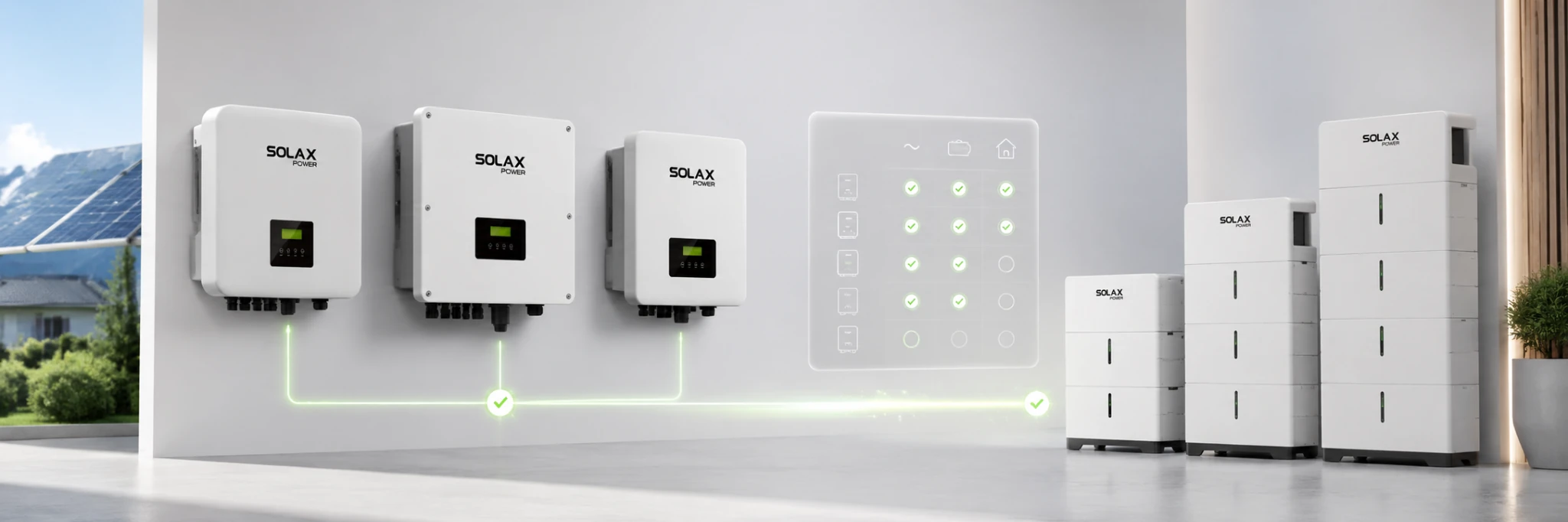
SolaX provides several high-voltage battery platforms that are particularly relevant for installers already working with SolaX hybrid inverter systems.
The reference comparison includes the HS50E-D, T-BAT-SYS-HV-S3.6 and T-BAT H 5.8–34.6 V3 families.
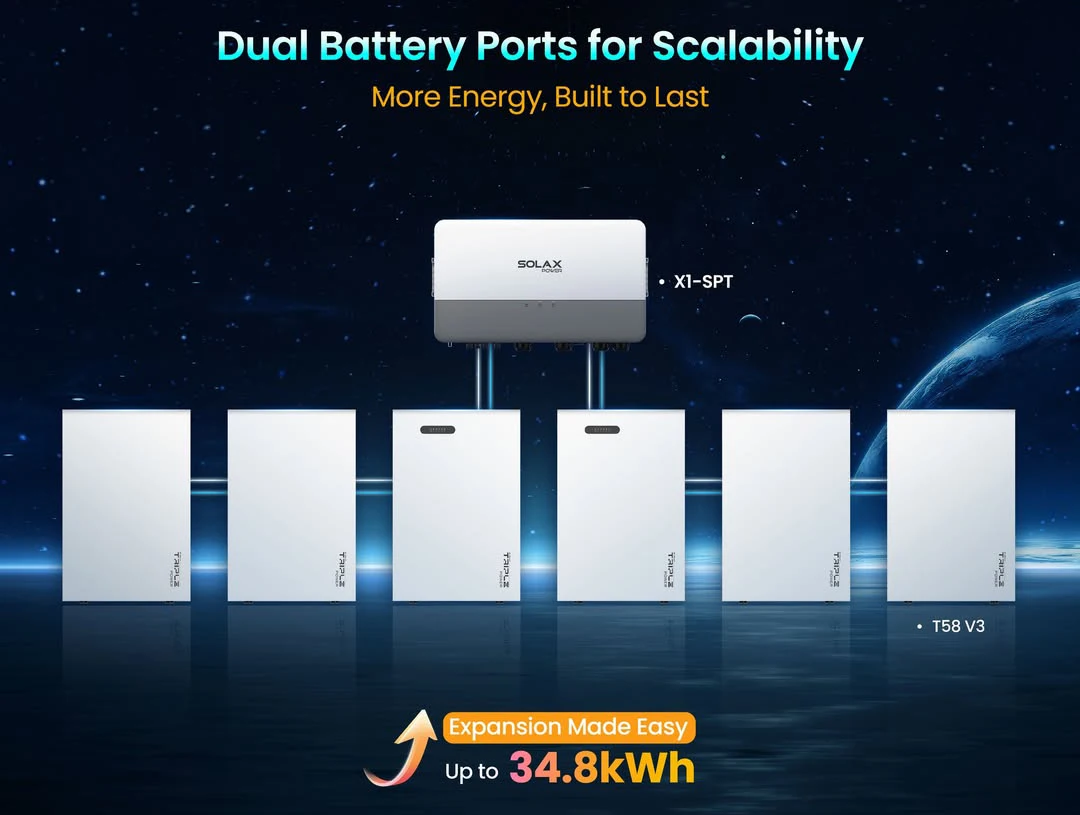
The manufacturer’s published documentation for the T-BAT-SYS-HV-S3.6 identifies 3.6 kWh battery modules, modular stacking, LFP chemistry, IP65 protection and a heating-enabled configuration for low-temperature operation.
The T-BAT H 5.8 V3 family offers 95% DoD and IP66 protection according to the manufacturer installation documentation.
Battery heating can be particularly relevant in unheated garages, outdoor technical spaces and other locations exposed to low winter temperatures.
However, installers must confirm whether heating is standard or configuration-dependent for the actual battery model.
The important compatibility questions concern the inverter generation, supported battery management unit, module quantities and permitted expansion configuration.
3Buy Solar assessment: SolaX offers a technically credible solution for HV residential storage where the project is designed around an approved SolaX inverter-battery combination. Battery generation and BMS selection are essential procurement details.
SolaX solar batteries and hybrid inverters at 3Buy Solar | Official SolaX T-BAT-SYS-HV-S3.6 specifications
Deye SE-F16 MAX — 16 kWh Low-Voltage Battery for Hybrid and Backup Systems
Deye’s low-voltage battery family addresses a different installation requirement from premium HV residential towers.
The SE-F16 MAX is a particularly relevant example for installers designing higher-capacity 48V-class hybrid solar systems.
The product is specified with approximately 16 kWh nominal storage, a 51.2V architecture, LFP chemistry and IP65 enclosure protection.
Its combination of substantial storage capacity and a low-voltage interface can be useful in appropriately engineered battery-backup installations.
The most important limitation is not the battery capacity but the available current and the inverter’s charge/discharge capability.
A 16 kWh battery cannot deliver unlimited power simply because it stores more energy.
When designing higher-current systems or parallel battery banks, installers need to confirm approved system topology, communication equipment, current limits, cables, protection and inverter compatibility.
The standard indoor-oriented Deye battery variants and IP65 MAX products also have different environmental installation requirements.
3Buy Solar assessment: A practical candidate for high-capacity LV hybrid and backup installations where the connected inverter, BMS and current capability have been verified. Compare the required 16 kWh battery configuration rather than assuming every Deye SE-F16 variant is identical.
Deye SE-F16 MAX — 16 kWh IP65 battery at 3Buy Solar | Deye SE-F16-C indoor battery alternative | Official Deye manufacturer website
BYD Battery-Box — Modular High-Voltage Storage With Approved Inverter Ecosystems
BYD is an important option for installers seeking modular high-voltage storage.
The reference comparison includes HVS, HVS+, HVM, HVM+, HVE and HVB battery families.
Their technical and warranty arrangements are not identical.
The association’s dataset lists 15-year warranties for selected HVB and HVE families, while other listed systems have 10-year warranties and different guaranteed SOH figures.
This illustrates why comparing BYD products requires attention to the exact battery generation.
One of BYD’s major advantages is its published manufacturer documentation, including model-specific inverter compatibility lists, installation instructions and warranty documents.
For an installer working with a supported third-party inverter, that documentation is particularly valuable.
However, compatibility should never be assumed simply because the inverter manufacturer supports another BYD battery family.
Battery-Box model, BCU version, inverter firmware and permitted module quantities must all be checked.
3Buy Solar assessment: Particularly relevant for professional HV storage projects where approved inverter compatibility and modular system configuration are central to the design.
Official BYD Battery-Box datasheets and compatibility lists
FOX ESS Avocado P100 — Integrated Solar Inverter and Battery Storage
The FOX ESS Avocado P100 illustrates why a battery-only comparison cannot represent every energy storage buying decision.
Unlike conventional arrangements using a separate hybrid inverter and battery stack, the Avocado P100 combines a hybrid inverter and LFP battery within an integrated system.
The manufacturer’s P100 range includes configurations with different inverter power ratings and approximately 10.24 kWh nominal battery energy.
This means two Avocado systems may provide the same storage capacity but have different maximum AC output capability.
That makes it essential to distinguish between inverter kW and battery kWh when evaluating the product.
The Avocado’s advantages come from system integration, coordinated energy management and reduced complexity associated with purchasing the inverter and battery as separate major equipment components.
The appropriate comparison is therefore against a complete separate-inverter-plus-battery installation — including accessories, commissioning and backup equipment — rather than against the price of a battery module alone.
3Buy Solar assessment: Relevant for residential projects where compact integrated equipment, simplified procurement and a coordinated inverter-battery architecture are priorities. Verify the exact P100 or P100E version, market approvals and expansion configuration before ordering.
FOX ESS Avocado P100 review at 3Buy Solar | FOX ESS solar batteries and inverters | Official FOX ESS manufacturer
Dyness Tower Pro — Scalable High-Voltage Energy Storage
Dyness Tower Pro is designed around modular high-voltage battery stacking.
The manufacturer specifies configurations from approximately 7.68 kWh to 23.04 kWh per tower, with larger approved systems possible using parallel configurations.
The product family includes LFP technology, IP55 enclosure protection and modular installation arrangements.
Manufacturer documentation also identifies optional heating in the Tower Pro range, which is important because the presence of a heating function should not be assumed for every delivered configuration.
For installers, the main questions are the exact tower size, permitted expansion configuration, inverter compatibility and environmental operating limits.
The modular architecture makes the Tower Pro particularly interesting where future storage expansion may be required.
However, expanding an existing battery system several years later must follow the manufacturer’s battery mixing, firmware and SOC requirements.
3Buy Solar assessment: Worth considering for modular residential HV projects where a broad range of capacity configurations is required and the exact inverter pairing is officially supported.
Dyness energy storage systems at 3Buy Solar | Official Dyness Tower Pro specifications
Sigenergy SigenStor — Integrated Energy Storage and Smart Energy Management
Sigenergy takes an integrated approach to solar energy storage.
The SigenStor platform combines battery storage with compatible power conversion, control and optional charging components as part of one coordinated ecosystem.
The manufacturer also documents battery-level optimisation intended to support flexible modular arrangements.
This architecture can be particularly relevant where the customer wants to combine solar panels, storage, backup power, energy management and EV charging within an integrated system.
The 2026 comparison includes SigenStor BAT 6.0/10.0 battery equipment, listing high-voltage DC-DC architecture, IP66 protection and integrated safety features.
Published product specifications differ by battery generation, so the DoD and usable energy of the exact module revision must be checked against the applicable datasheet.
3Buy Solar assessment: A strong candidate for projects where the purchasing decision covers the entire energy-management platform rather than a standalone solar battery.
Sigenergy energy storage systems at 3Buy Solar | Official Sigenergy SigenStor information
Solplanet Ai-HB and Ai-LB — Different Battery Platforms for Different Installations
Solplanet provides both high-voltage and low-voltage solar battery systems, with different product families intended for different installation environments.
This is particularly important when comparing Ai-HB G2, Ai-HB G2 Pro and Ai-HB G2-E.
The standard Ai-HB G2 platform uses a high-voltage modular architecture and is specified with IP65 protection.
The Ai-HB G2-E family has a different enclosure specification: IP20, making it suitable for protected indoor installations under the manufacturer’s installation conditions.
Solplanet also publishes integrated emergency fire-suppression functionality for selected battery families, including the Ai-HB G2-E.
Therefore, it would be incorrect to assume that every Solplanet battery has the same enclosure, usable DoD or installation requirements.
3Buy Solar assessment: Suitable for installers building systems around compatible Solplanet hybrid inverters, provided the correct battery series, BMS, installation environment and accessories are identified.
Solplanet batteries and hybrid inverters at 3Buy Solar | Solplanet Ai-HB-E 10.24 kWh battery system | Official Solplanet Ai-HB G2-E specifications
Sungrow SBR and SBH — Understanding Multiple Warranty Thresholds
The Sungrow SBR and SBH battery families provide another example of why warranty conditions cannot be reduced to a single headline figure.
The comparison lists separate warranty-related cycle and remaining-capacity thresholds for these product families.
Such figures should be interpreted as different conditions within the manufacturer’s warranty framework, not as evidence of a simple fixed cycle-life limit.
For Sungrow battery projects, inverter generation and firmware compatibility are also essential.
The manufacturer’s European technical academy provides model-specific compatibility information.
Official Sungrow SBR/SBH inverter compatibility guidance
Full 2026 Solar Battery Comparison: All 59 Systems
The following reference table covers 59 battery-system entries from 23 manufacturers.
It retains the key parameters from the Hungarian Battery Association dataset: electrical architecture, chemistry, IP protection, heating, integrated fire-suppression designation, usable DoD, warranty degradation index, warranty duration, calculated warranty cycles, remaining SOH and remote monitoring.
The table is organised by the original calculated warranty degradation factor where available. It is not an overall ranking of battery quality, safety, reliability, efficiency or value for money.
Manufacturer documentation takes precedence where a discrepancy has been independently identified. In particular, the Fronius Reserva Pro IP rating has been corrected to IP65, and Dyness Tower Pro heating is identified as configuration-dependent.
| Manufacturer | Battery / series | Voltage | Chemistry | IP | Heating | Fire suppression | DoD | Degradation index* | Warranty | Calculated warranty cycles* | SOH | Remote monitoring |
|---|---|---|---|---|---|---|---|---|---|---|---|---|
| Huawei | LUNA2000-5/10/15-S1 | HV DC-DC | LFP | IP66 | Yes | Yes | 100% | 0.38 | 15 years | 6,610 | 80% | Yes |
| Fronius | Reserva Pro 12.0–32.0 | HV | LFP | IP65† | No | No | 100% | 0.45 | 10 years | 5,599 | 80% | Yes |
| Hypontech | HP51100 | LV | LFP | IP65 | No | No | 90% | 0.52 | 10 years | 7,200 | 70% | Yes |
| WECO | 5K3 EVO | HV / LV | LFP | IP66 | Yes | Yes | 90% | 0.54 | 10 years | 7,000 | 70% | Yes |
| WECO | 5K0 PRO | HV DC-DC | LFP | IP66 | Yes | Yes | 90% | 0.54 | 10 years | 7,000 | 70% | Yes |
| WECO | 4K5 Ultra | HV DC-DC / LV | LFP | IP65 | No | No | 90% | 0.55 | 10 years | 8,000 | 65% | Yes |
| WECO | 16K0-LV | LV | LFP | IP66 | No | No | 90% | 0.55 | 10 years | 8,000 | 65% | Yes |
| Leapton | EH-A05 | HV | LFP | IP65 | No | No | 90% | 0.63 | 10 / 12 years | 6,000 | 70% | Yes |
| Midea | MEB-BxH-AIO | HV | LFP | IP65 | Yes | Yes | 90% | 0.63 | 10 years | 6,000 | 70% | Yes |
| Midea | MEB2-BxH-AIO | HV DC-DC | LFP | IP66 | Yes | Yes | 90% | 0.63 | 10 years | 6,000 | 70% | Yes |
| Fronius | Reserva 6.3–15.8 | HV | LFP | IP65 | No | No | 100% | 0.64 | 10 years | 3,906 | 80% | Yes |
| Fox ESS | P100 | LV | LFP | IP66 | Yes | No | 95% | 0.68 | 10 years | 5,555 | 70% | Yes |
| SofarSolar | SF-16KWH-L1 | LV | LFP | IP20 | No | No | 90% | 0.71 | 10 years | 5,313 | 70% | Yes |
| Sungrow | SBR064–256 | HV | LFP | IP55 | No | No | 100% | 0.75 / 0.95 | 10 years | 3,325 / 5,250 | 80% / 60% | Yes |
| Sungrow | SBH100–400 | HV | LFP | IP55 | No | No | 100% | 0.75 / 0.95 | 10 years | 3,325 / 5,250 | 80% / 60% | Yes |
| LG | FLEX 8.6 / 12.9 / 17.2 | HV | NMC | IP55 | No | No | 100% | 0.76 | 10 years | 4,942 | 70% | Yes |
| Fox ESS | EP12 | HV | LFP | IP65 | No | No | 90% | 0.94 | 10 years | 4,000 | 70% | Yes |
| Fox ESS | Mira M12 | HV | LFP | IP65 | Yes | Yes | 90% | 0.94 | 10 years | 4,000 | 70% | Yes |
| Deye | SE-F12 MAX | LV | LFP | IP65 | Optional | No | 90% | 0.96 | 10 years | 3,919 | 70% | Yes |
| Deye | SE-F12 | LV | LFP | IP21 | No | No | 90% | 0.96 | 10 years | 3,919 | 70% | Yes |
| Huawei | LUNA2000-7/14/21-S1 | HV DC-DC | LFP | IP66 | Yes | Yes | 100% | 0.96 | 15 years | 5,225 | 60% | Yes |
| Deye | SE-G5.1 PRO-B | LV | LFP | IP20 | No | No | 90% | 0.96 | 10 years | 3,906 | 70% | Yes |
| Deye | SE-F16 MAX | LV | LFP | IP65 | Optional | No | 90% | 0.96 | 10 years | 3,906 | 70% | Yes |
| Deye | SE-F16 | LV | LFP | IP21 | No | No | 90% | 0.96 | 10 years | 3,906 | 70% | Yes |
| Deye | SE-F5 Pro | LV | LFP | IP21 | No | No | 90% | 0.96 | 10 years | 3,906 | 70% | Yes |
| SolaX | HS50E-D | HV | LFP | IP66 | Yes | No | 90% | 0.96 | 10 years | 3,897 | 70% | Yes |
| SolaX | T-BAT-SYS-HV-S3.6 | HV | LFP | IP65 | Yes | No | 90% | 0.96 | 10 years | 3,889 | 70% | Yes |
| SolaX | T-BAT H 5.8–34.6 V3 | HV | LFP | IP66 | Yes | Yes | 95% | 0.97 | 10 years | 3,885 | 70% | Yes |
| BYD | HVB | HV | LFP | IP55 | No | No | 100% | 0.97 | 15 years | 3,874 | 70% | Yes |
| BYD | HVE | HV | LFP | IP65 | No | No | 100% | 0.99 | 15 years | 5,074 | 60% | Yes |
| GoodWe | Lynx D Series | HV DC-DC | LFP | IP66 | No | No | 100% | 1.00 | 10 years | 3,750 | 70% | Yes |
| GoodWe | ESA Series (GWBAT-D-G20) | HV DC-DC | LFP | IP66 | Yes | Yes | 100% | 1.00 | 10 years | 3,750 | 70% | Yes |
| Hoymiles | LB-5D-G2 | LV | LFP | IP20 | No | No | 90% | 1.00 | 10 years | 3,735 | 70% | Yes |
| Hypontech | HBP-H3_H15 | HV | LFP | IP55 | No | No | 100% | 1.02 | 10 years | 3,689 | 70% | Yes |
| Dyness | Tower Pro TP7–TP23 | HV | LFP | IP55 | Optional† | Yes | 95% | 1.02 | 10 years | 3,684 | 70% | Yes |
| Dyness | Tower TS7–21 | HV | LFP | IP54 | No | No | 95% | 1.02 | 10 years | 3,684 | 70% | Yes |
| Solinteg | E2BA-B10K3 | HV | LFP | IP65 | Yes | No | 90% | 1.03 | 10 years | 3,635 | 70% | Yes |
| SolarEdge | BAT-05K48 | LV | LFP | IP65 | Yes | No | 100% | 1.05 | 10 years | 3,588 | 70% | Yes |
| Hoymiles | LB-16D-G3 | LV | LFP | IP65 | Optional | No | 90% | 1.08 | 10 years | 3,483 | 70% | Yes |
| SolarEdge | BAT-10K1P | HV | Not stated | IP55 | No | No | 100% | 1.12 | 10 years | 3,351 | 70% | Yes |
| Hoymiles | LB-6D-G3 | LV DC-DC | LFP | IP65 | Optional | No | 90% | 1.14 | 10 years | 3,281 | 70% | Yes |
| SofarSolar | BTS 5K | HV DC-DC | LFP | IP65 | Optional | No | 90% | 1.17 | 10 years | 3,198 | 70% | Yes |
| SofarSolar | SF-5KWH-L1 | LV | LFP | IP20 | No | No | 90% | 1.17 | 10 years | 3,198 | 70% | Yes |
| SofarSolar | CBS5000-H4-H12 | HV DC-DC | LFP | IP66 | No | No | 90% | 1.17 | 10 years | 3,198 | 70% | Yes |
| Sigenergy | SigenStor BAT 6.0 / 10.0 | HV DC-DC | LFP | IP66 | Yes | Yes | 97% | 1.18 | 10 years | 4,239 | 60% | Yes |
| Huawei | LUNA2000-5/10/15-S0 | HV DC-DC | LFP | IP66 | Yes | Yes | 100% | 1.22 | 10 years | 4,113 | 60% | Yes |
| Renac | Turbo H3 | HV | LFP | IP66 | No | No | 95% | 1.28 | 10 years | 2,940 | 70% | Yes |
| Renac | Turbo H4 | HV | LFP | IP65 | No | No | 90% | 1.28 | 10 years | 2,925 | 70% | Yes |
| BYD | HVM+ | HV | LFP | IP55 | No | No | 100% | 1.29 | 10 years | 3,868 | 60% | Yes |
| BYD | HVM | HV | LFP | IP55 | No | No | 100% | 1.29 | 10 years | 3,868 | 60% | Yes |
| BYD | HVS+ | HV | LFP | IP55 | No | No | 100% | 1.33 | 10 years | 3,762 | 60% | Yes |
| BYD | HVS | HV | LFP | IP55 | No | No | 100% | 1.33 | 10 years | 3,762 | 60% | Yes |
| EnerShare | Energy-Core | HV | LFP | IP65 | No | No | 100% | 1.33 | 10 years | 3,762 | 60% | No |
| Solplanet | Ai-HB G2 Series | HV | LFP | IP65 | No | Yes | 90% | Not calculable | 10 years | No data | 70% | Yes |
| Lithium Valley | HS5-5A | HV | LFP | IP65 | Yes | Yes | 80% | Not calculable | 10 years | 6,001 | No data | Yes |
| Solplanet | Ai-LB-G3 Series | LV | LFP | IP66 | No | Yes | 95% | Not calculable | 10 years | No data | 70% | Yes |
| Solplanet | Ai-HB G2 Pro Series | HV | LFP | IP65 | No | Yes | 95% | Not calculable | 10 years | No data | 70% | Yes |
| Solplanet | Ai-LB-E Series | LV | LFP | IP20 | No | Yes | 90% | Not calculable | 10 years | No data | 70% | Yes |
| Solplanet | Ai-HB G2-E Series | HV | LFP | IP20 | No | Yes | 90% | Not calculable | 10 years | No data | 70% | Yes |
Technical notes
The warranty degradation figures and calculated warranty cycles are derived from the Hungarian Battery Association methodology. They are comparative warranty calculations, not measured battery ageing or manufacturer laboratory cycle-life results. The source uses inconsistent units for the degradation column; the numerical values are therefore presented without an ordinary percentage sign.
† Fronius currently publishes IP65 for Reserva Pro. Dyness manufacturer documentation identifies heating as optional for Tower Pro. Other source-listed features may also vary by model revision, market or product configuration.
The table represents a 2026 reference snapshot, not live manufacturer certification of every individual row. Published data can change. In particular, newer module revisions — including Sigenergy battery variants — may carry different usable DoD and power specifications from the original reference entry.
Source: Hungarian Battery Association — Otthoni Energiatároló Program Battery Comparison. 3Buy Solar has reorganised the information, corrected the identified manufacturer discrepancies and supplemented it with separate technical and procurement analysis.
How to Compare Solar Battery Prices in Europe
A meaningful solar battery price comparison should use the complete equipment cost per usable kWh, not the advertised price of an individual battery module.
The cheapest battery module may require additional equipment that changes the purchasing decision.
Calculate the Real Equipment Cost per Usable kWh
For a like-for-like comparison, begin with:
Equipment cost per usable kWh = Total required battery-system equipment cost ÷ Usable battery capacity
The equipment total should include the battery modules, mandatory BMS or controller, required battery connections, bases, cabinets and other manufacturer-required accessories.
For example, if a hypothetical complete battery equipment package costs €2,300 excluding VAT and provides 9.2 kWh usable energy, the equipment cost is approximately €250 per usable kWh.
This is an illustrative calculation, not a quoted market price or an offer for a particular manufacturer.
Installation labour, protection components and system-specific commissioning costs should then be added when comparing complete installed systems.
Why Battery Module Prices Can Be Misleading
Consider an HV battery requiring a separate battery management controller and three expansion modules.
Comparing the listed price of one expansion module against a fully assembled LV battery would not be meaningful.
Similarly, an integrated energy storage unit such as FOX ESS Avocado includes equipment that would otherwise be purchased separately.
The appropriate comparison is the cost of the complete, compatible system providing the required usable energy and AC power.
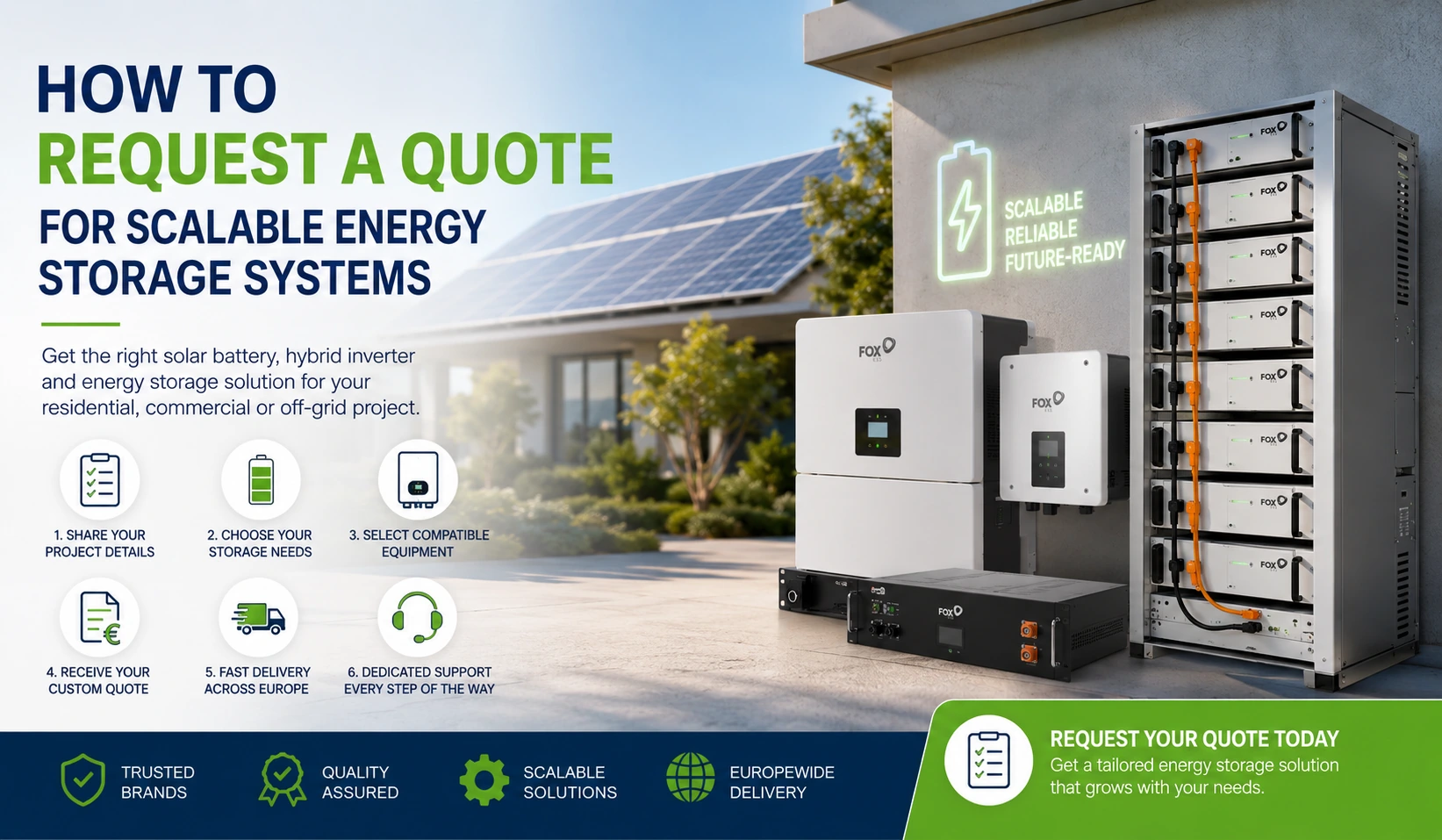
For professional installers and resellers, 3Buy Solar provides access to solar batteries, hybrid solar inverters and complete solar PV kits.
Product pricing, stock and delivery terms should be confirmed for the specific project and purchasing conditions.
How to Size a Solar Battery: 5 kWh, 10 kWh, 15 kWh or 20 kWh?
The appropriate solar battery capacity depends on electricity consumption, solar generation, tariff structure, required backup duration and operating strategy.
There is no reliable rule that every household with a 5 kW inverter needs a 10 kWh battery.
An installer should begin with the site’s actual demand profile.
Example: Residential PV System With Evening Electricity Consumption
Assume a home consumes approximately 8 kWh between sunset and the following morning.
A 10 kWh nominal battery allowing 90% DoD provides approximately 9 kWh usable battery energy under the stated calculation conditions.
That may be sufficient to cover much of the overnight demand on favourable days, subject to conversion losses, reserve settings and the amount of solar energy available to charge the battery.
However, if the same property requires several hours of high-power backup, the battery’s continuous discharge capability may become the controlling factor.
For example, a 10 kWh battery with a 5 kW maximum supported discharge power cannot supply an 8 kW load continuously from the battery alone.
Battery Backup Runtime Calculation
A simplified runtime estimate is:
Backup runtime (hours) ≈ Usable battery energy (kWh) × system discharge efficiency ÷ average backup load (kW)
If a hypothetical installation provides 9.2 kWh usable battery energy, achieves 90% efficiency across the assumed discharge path and supports an average 1 kW load, the estimated runtime is approximately 8.3 hours.
Actual runtime varies with battery reserve settings, inverter standby consumption, temperature, ageing and load behaviour.
For a more detailed discussion, read our guide to solar battery backup vs battery storage.
Why Solar Inverter Compatibility Comes Before Battery Selection
An excellent solar battery is of little use if it cannot communicate correctly with the selected inverter.
Battery compatibility is not determined by nominal voltage alone.
For a correct inverter-battery pairing, installers must verify the supported battery protocol, operating-voltage range, charge/discharge current, firmware, BMS revision and approved module configuration.
It is also important to establish whether the inverter manufacturer supports the exact battery product in the intended country.
Common Compatibility Mistakes
One common problem is assuming that a 51.2V battery will automatically work with every hybrid inverter supporting a nominal 48V battery connection.
It may not.
Even where voltage and current limits appear suitable, the inverter may require an approved communication protocol or a specific battery firmware version.
Another mistake is assuming that two batteries belonging to the same manufacturer’s product family can always be mixed or expanded without additional equipment.
This is particularly relevant for HV battery towers using dedicated controllers, series-connected modules or manufacturer-specific parallel boxes.
Before purchasing any energy storage system, consult the 3Buy Solar PV inverter and battery compatibility resource.
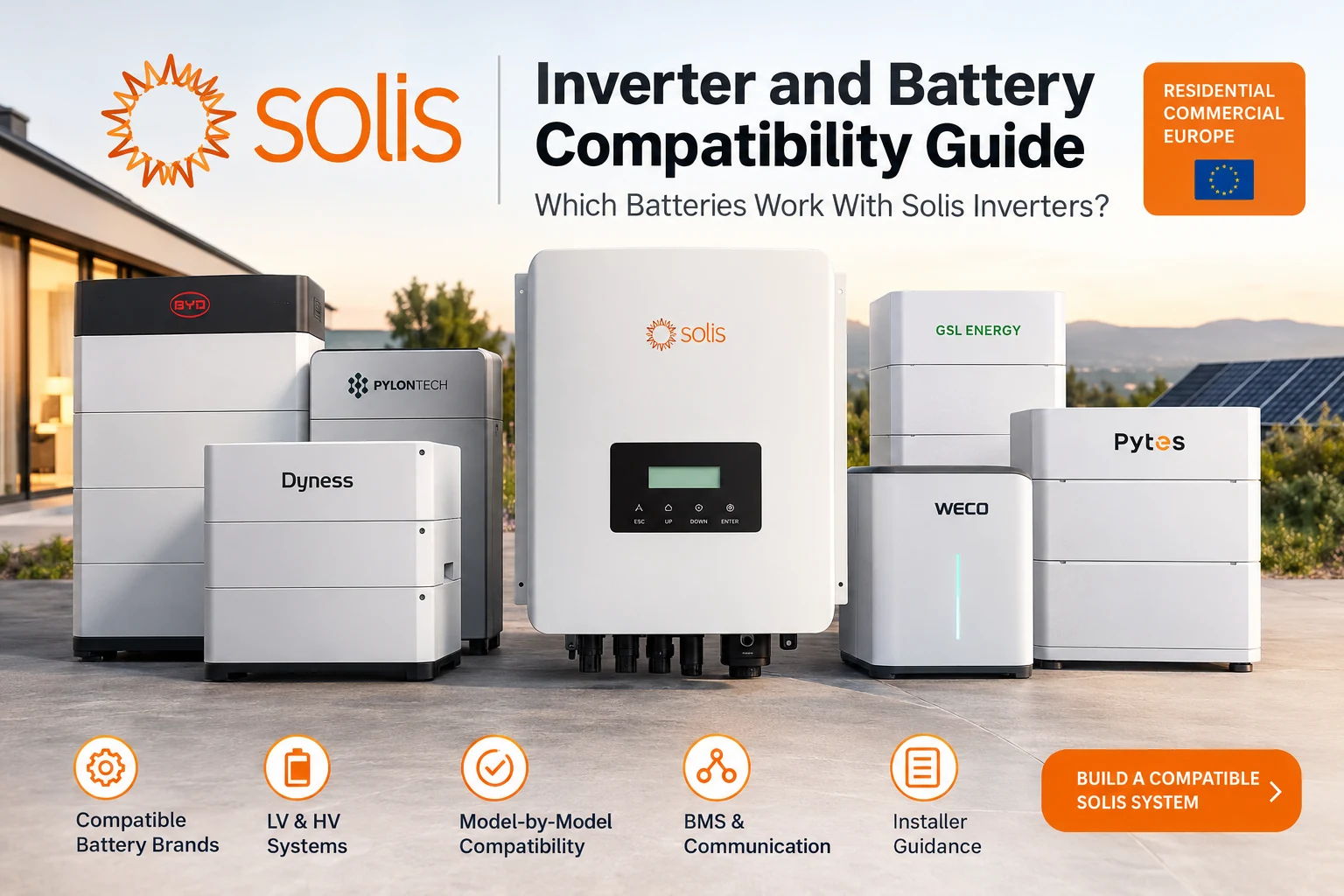
Installers using Solis equipment can also read our Solis inverter and battery compatibility guide.
Cold-Climate Solar Batteries: Heating and IP Protection
Low-temperature operation is a particularly important consideration for residential energy storage across Northern and Central Europe.
Many LFP batteries restrict charging at low cell temperatures, commonly around freezing, unless adequate thermal management is provided.
A battery installed in an unheated garage in Austria, Germany, Poland, Hungary, Czechia or Scandinavia may experience very different operating conditions from one located inside a temperature-controlled utility room.
This makes integrated battery heating a useful specification, but it is not a substitute for following the manufacturer’s installation temperature limits.
IP20 vs IP65 vs IP66
The IP rating indicates enclosure resistance to solid-object and water ingress under defined test conditions.
| IP rating | General meaning | Installer consideration |
|---|---|---|
| IP20 | Protection against fingers and similarly sized solid objects; no water protection | Protected indoor technical location |
| IP21 | Basic protection against vertically falling water drops | Protected indoor location |
| IP55 | Dust-protected and protected against water jets | Potentially suitable for more demanding environments |
| IP65 | Dust-tight and protected against water jets | Indoor or manufacturer-approved outdoor use |
| IP66 | Dust-tight and protected against powerful water jets | Strong enclosure protection for demanding environments |
IP ratings are not universal permission for outdoor installation.
Solar battery manufacturers may additionally require weather protection, minimum clearance distances, suitable foundations, specified mounting positions and protection against direct environmental exposure.
An IP66 battery should not be assumed suitable for flooding, immersion or an installation outside its published operating conditions.
Battery Fire Suppression Is Not the Same as Fire Safety Certification
Several systems in the comparison list integrated fire-suppression features.
Such features can form part of a manufacturer’s battery safety strategy, but their presence should not be interpreted as a guarantee that thermal runaway or fire cannot occur.
Professional installers must review the manufacturer’s safety documentation, electrical installation instructions and applicable local requirements.
What About Solar Batteries Not Included in the 59-System Comparison?
The reference dataset was developed around products submitted for Hungary’s 2026 residential energy storage programme.
It does not represent every solar battery manufacturer or energy storage platform available in Europe.
For example, newer equipment from NEOVOLT, which is available through the 3Buy Solar distribution portfolio, should be evaluated separately using its current datasheets, warranty conditions, inverter architecture and system accessories.
Likewise, larger commercial battery systems, AC-coupled storage platforms and integrated energy storage products may require a different set of comparison criteria from conventional residential DC-coupled battery towers.
Browse NEOVOLT solar batteries and hybrid energy storage systems for additional product options.
The purpose of this comparison is not to claim that all products outside the table are inferior. It is to provide a documented basis for choosing among the reviewed products while identifying the additional checks required for a real installation.
Solar Battery Procurement Checklist for European Installers
Before ordering a solar battery or a complete energy storage system, the following information should be confirmed.
- Exact product identification. Record manufacturer, complete model number, battery generation and required controller part number.
- Approved solar inverter compatibility. Check inverter model, battery communication protocol, firmware and approved configuration.
- Nominal and usable battery energy. Compare the actual kWh available to the system, not only the product’s nominal capacity.
- Continuous charging and discharging power. Confirm both battery and inverter power limits, including any temperature-dependent restrictions.
- Installation environment. Verify IP rating, permitted mounting location, ventilation, temperature and heating requirements.
- Complete warranty conditions. Review warranty duration, energy throughput, SOH, registration and operating restrictions.
- Future expansion. Confirm whether modules of different ages or revisions can be combined and whether additional BMS equipment is required.
- Complete equipment bill of materials. Include BMS, controller, bases, cabling, protection, meters, backup equipment and any system-specific accessories.
- Documentation and compliance. Obtain the applicable EU Declaration of Conformity, technical documentation, transport documentation and country-specific approvals where relevant.
- Commercial terms and availability. Confirm stock, lead time, delivery, replacement-part availability and the applicable warranty-support route.
These details are especially important for EPC companies, electrical contractors and solar wholesalers purchasing equipment for multiple installations.
Solar Battery Storage and Hungary’s 2026 Home Energy Storage Programme
The Hungarian Battery Association’s comparison was created in connection with Hungary’s Otthoni Energiatároló Program, or Home Energy Storage Programme.
The programme was introduced to support residential battery storage, including the integration of new energy storage systems with existing or newly installed solar PV.
The associated comparison provides a useful technical reference beyond Hungary because many of the same solar battery manufacturers supply equipment throughout Europe.
However, the product comparison should not be confused with a current programme eligibility certificate.
Battery eligibility, installer requirements, subsidy conditions and reimbursement rules must be checked against the current official programme documentation before quotation or contracting.
The practical lesson for European installers is that battery procurement should begin with verified system compatibility and a complete, eligible bill of materials — not simply the headline battery price.
Frequently Asked Questions About Solar Batteries in 2026
What is the best solar battery for a home in 2026?
There is no universal best solar battery. A suitable home energy storage system must match the hybrid inverter, required usable kWh, charge/discharge power, installation conditions, backup requirements and budget. Huawei, Fronius, SolaX, Deye, BYD, Dyness, Solplanet and Sigenergy offer different technical approaches that may suit different applications.
Which solar battery has the most favourable warranty figure in this comparison?
The Huawei LUNA2000-5/10/15-S1 records the lowest calculated warranty degradation index in the association’s supplied dataset. This indicates a favourable relationship between its stated warranty throughput and guaranteed remaining capacity, not proof of superior measured battery lifespan.
Is a 10 kWh solar battery enough for a household?
It can be, depending on daily electricity consumption, evening demand, usable DoD, solar generation and the intended operating strategy. Backup requirements may also require a battery with greater power capability even where 10 kWh of capacity is sufficient.
Is a high-voltage solar battery better than a low-voltage battery?
Not necessarily. HV architecture can reduce current for a given power and is commonly used in modern grid-connected hybrid systems. LV architecture remains useful for suitable high-current backup and off-grid installations. The correct selection depends primarily on inverter compatibility and system requirements.
What is the difference between battery capacity and battery power?
Battery capacity in kWh describes stored energy. Battery power in kW describes the rate at which energy can be delivered or absorbed. Two 10 kWh batteries may provide different continuous power outputs.
What is the difference between nominal and usable battery capacity?
Nominal capacity describes the manufacturer’s stated storage capacity, while usable capacity is the energy available within the permitted operating window. Usable capacity may be limited by DoD, reserve settings and other operating restrictions.
What does SOH mean in a solar battery warranty?
State of Health (SOH) indicates remaining battery capacity relative to a defined original reference. A warranty specifying 70% SOH provides a defined capacity-retention threshold subject to its applicable operating and throughput conditions.
Can an IP65 or IP66 solar battery be installed outdoors?
Potentially, but the manufacturer must explicitly permit the proposed installation conditions. IP protection alone does not establish suitability for every outdoor environment, temperature or mounting arrangement.
Do solar batteries work during a power cut?
Only when the complete system supports approved backup operation. A solar battery connected to a hybrid inverter does not automatically guarantee power during a grid outage. Backup functionality depends on the inverter, switching equipment, protection, configuration and supported loads.
Can I connect a battery from one manufacturer to a different inverter brand?
Sometimes. Cross-brand compatibility requires official support for the exact battery model and inverter generation, including communication protocol, voltage, current, firmware and configuration limits.
How do I compare solar battery prices fairly?
Compare the total cost of the complete required battery equipment against usable kWh and supported kW. Include mandatory controllers and accessories, then account separately for installation, commissioning and backup components when comparing installed systems.
Which battery chemistry is commonly used for residential solar energy storage?
Lithium iron phosphate (LFP) is widely used for stationary residential storage. Its thermal-stability and cycle-life characteristics make it suitable for regular charging and discharging, but complete-system safety and installation quality remain essential.
3Buy Solar’s Final Assessment: Choose the System, Not Just the Battery
The 59 systems reviewed in this comparison show just how different two residential solar batteries can be, even when they appear similar in capacity or advertised warranty period.
Some products prioritise high-voltage architecture and integrated inverter ecosystems. Others offer the flexibility of low-voltage battery banks. Several incorporate enhanced environmental protection, battery heating, modular expansion or integrated safety features.
There is also a considerable difference between a battery with attractive standalone specifications and one that fits a complete solar PV installation without unnecessary cost or compatibility risk.
For professional installers and system designers, the most useful buying decision comes from matching five things:
The right battery architecture, the required usable energy, sufficient continuous power, verified inverter compatibility and a complete installed-system cost.
A solar battery comparison should help you identify which products deserve further investigation. It should not replace the engineering required to select, install and commission the complete system.
At 3Buy Solar, we supply solar batteries, hybrid solar inverters, solar panels, energy storage equipment and complete solar PV kits for professional installers, EPC contractors, resellers and technical buyers across Europe.
Our approach is based on sourcing the equipment required for the actual project, checking technical documentation and evaluating the full system rather than treating every battery as an interchangeable product.
For product availability, project quotations and technical sourcing, visit the 3Buy Solar B2B Installer Shop or contact our team.
Installers looking for practical video resources can also visit the 3Buy Solar YouTube channel for product demonstrations, installation content and energy storage discussions.
3Buy Solar — Pro-ready. Simple for all. Always 3Buy.
Technical Sources and Manufacturer Documentation
The following resources provide primary manufacturer information and the reference methodology used for this comparison:
- Hungarian Battery Association — Original 2026 Battery Comparison
- Huawei — LUNA2000-S1 Official Specifications
- Fronius — Reserva Pro Product Specifications
- SolaX — T-BAT-SYS-HV-S3.6 Documentation
- BYD — Official Battery-Box Downloads and Compatibility Lists
- Dyness — Tower Pro Technical Information
- Solplanet — Ai-HB G2 Battery Documentation
- Solplanet — Ai-HB G2-E Battery Documentation
- Sigenergy — SigenStor Manufacturer Documentation
- Deye — Manufacturer Technical Resources
- FOX ESS — Manufacturer Documentation
- Sungrow — European Battery and Inverter Compatibility Guidance
Editorial and technical disclosure: This article combines published manufacturer specifications, the Hungarian Battery Association’s reference comparison and 3Buy Solar’s desk-based installer and procurement assessment. It does not claim independent laboratory testing or universal compatibility of the listed systems. Specifications, warranty conditions, compatibility and product availability should be reconfirmed for the exact model and destination market before purchase.
Image note: Product illustrations are representative. Actual equipment appearance, configuration and accessories may vary by manufacturer, product revision and market.