EV Accessories and Mounting


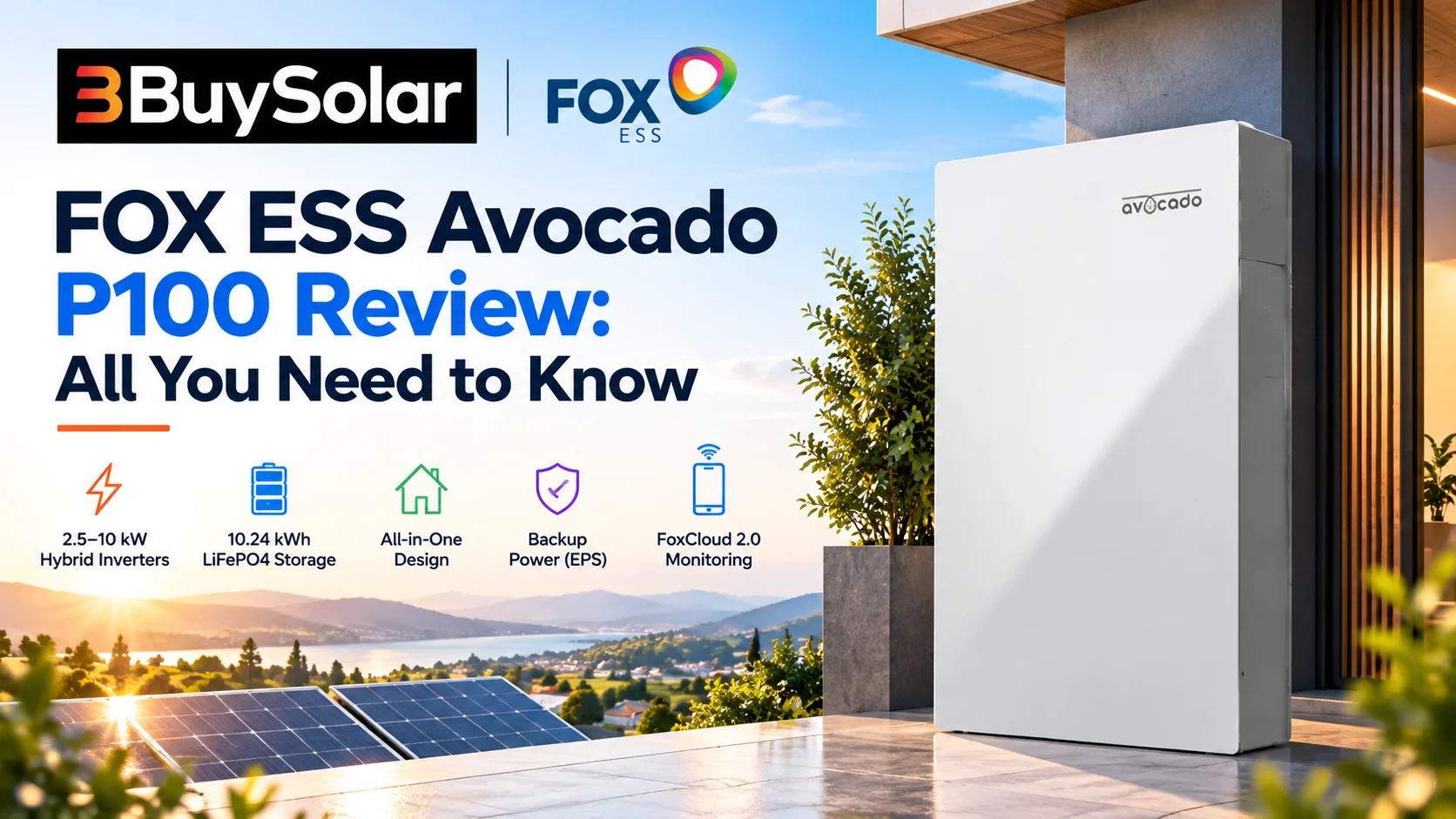

The FOX ESS Avocado P100 is a fully integrated residential energy storage system combining a single-phase hybrid solar inverter and a 10.24 kWh LiFePO4 battery in one compact cabinet. With inverter ratings starting at 2.5 kW and extending to 10 kW, the Avocado P100 offers different power configurations while maintaining an integrated battery storage architecture.
Designed for residential solar PV installations, the FOX ESS Avocado brings together photovoltaic conversion, battery energy storage, intelligent energy management, backup power and remote monitoring.
But is the FOX ESS Avocado a good solar battery system? How do the 2.5 kW, 3 kW, 4 kW, 5 kW and 6 kW models compare? What makes its integrated design different from conventional hybrid inverters and separate solar batteries, and what should professional installers check before purchasing?
In this comprehensive FOX ESS Avocado P100 review for 2026, we examine the manufacturer’s published specifications, energy storage capacity, inverter performance, backup capabilities, PV compatibility, installation requirements, warranty and purchasing considerations for European markets.
What Is the FOX ESS Avocado P100?
The FOX ESS Avocado P100 is an all-in-one battery energy storage system developed by FOX ESS, a manufacturer of solar inverters, energy storage batteries and intelligent energy management solutions.
Unlike conventional hybrid solar installations, where the inverter and battery modules are purchased and installed separately, the Avocado P100 incorporates the inverter/charger and a 10.24 kWh LiFePO4 battery within a single enclosure.
Its integrated design provides several practical advantages for suitable installations:
- A coordinated hybrid inverter and battery storage architecture.
- Fewer separate major equipment enclosures.
- Integrated battery management and communication.
- Reduced external inverter-to-battery wiring complexity.
- Intelligent solar electricity management and self-consumption optimisation.
- EPS backup capability for appropriately configured essential loads.
- FoxCloud 2.0 monitoring and diagnostics.
The P100 is intended for residential solar PV and energy storage applications where a compact, integrated solution can simplify equipment selection and installation planning.
It should not be confused with the smaller FOX ESS S22/AVO22 or AVO28 micro-storage systems designed primarily for balcony solar applications.
FOX ESS Avocado P100 Models: 2.5 kW to 10 kW
The manufacturer’s February 2026 P100 V1.2 datasheet identifies nine single-phase hybrid inverter configurations.
The available rated AC output determines how much continuous electrical power the inverter can deliver under specified conditions, while the integrated battery capacity remains 10.24 kWh per unit.
FOX ESS Avocado Inverter Model Comparison
| Model | Rated AC power | Integrated battery | MPPT trackers |
|---|---|---|---|
| P100-2.5-H | 2.5 kW | 10.24 kWh | 2 |
| P100-3-H | 3 kW | 10.24 kWh | 2 |
| P100-4-H | 4 kW | 10.24 kWh | 2 |
| P100-5-H | 5 kW | 10.24 kWh | 2 |
| P100-6-H | 6 kW | 10.24 kWh | 2 |
| P100-7-H | 7 kW | 10.24 kWh | 3 |
| P100-8-H | 8 kW | 10.24 kWh | 3 |
| P100-9-H | 9 kW | 10.24 kWh | 3 |
| P100-10-H | 10 kW | 10.24 kWh | 3 |
This distinction is particularly important for professional installers: inverter power in kW and battery capacity in kWh are different parameters.
For example, both the P100-2.5-H and P100-5-H contain a nominal 10.24 kWh battery, but their rated AC outputs are 2.5 kW and 5 kW respectively.
A higher inverter rating allows greater electrical power delivery, subject to battery and system limits, but does not automatically provide more stored energy.
Which P100 Model Is Suitable for Your Project?
P100-2.5-H — 2.5 kW
Designed for consideration in smaller single-phase installations where electrical demand and permitted inverter output are relatively modest, while approximately 10 kWh of battery capacity is required.
P100-3-H — 3 kW
An option for residential systems with moderate electrical loads and a preference for an integrated inverter and battery package.
P100-4-H — 4 kW
Provides additional inverter output for homes with higher simultaneous consumption or larger photovoltaic installations.
P100-5-H — 5 kW
An attractive configuration to evaluate for conventional single-phase residential hybrid PV projects requiring 5 kW rated output and 10.24 kWh nominal battery storage.
P100-6-H — 6 kW
Provides higher continuous AC power for suitable single-phase residential installations, subject to local grid-connection and electrical distribution requirements.
The 7–10 kW versions extend the range into higher-power single-phase applications and include three MPPT trackers in the published V1.2 datasheet.
FOX ESS Avocado Battery Capacity: 10.24 kWh LiFePO4 Storage
The integrated 10.24 kWh solar battery is one of the P100’s defining characteristics.
The manufacturer specifies lithium iron phosphate (LiFePO4) chemistry, commonly called LFP.
LiFePO4 is widely used in stationary battery energy storage because of its thermal stability and suitability for repeated charging and discharging.
Nominal vs Usable Battery Capacity
The P100 datasheet specifies:
- Nominal battery energy: 10.24 kWh.
- Depth of discharge: 95%.
- Published cycle-life rating: 6,000 cycles.
A 95% depth of discharge corresponds mathematically to approximately 9.73 kWh of accessible battery energy from the nominal 10.24 kWh capacity, before conversion losses and any additional operational reserves.
This is an important distinction when evaluating the cost per usable kWh and comparing the P100 with other energy storage systems.
Actual delivered AC electricity will also depend on conversion efficiency, operating conditions and battery management restrictions.
How Long Can a 10.24 kWh Avocado Battery Supply a Home?
The answer depends on electrical consumption and inverter output.
A household consuming an average of 500 W would theoretically use 4 kWh over eight hours.
A household with an average 2 kW load would consume the same amount of stored energy much faster.
For installers, the correct design should consider both available battery energy and instantaneous AC power requirements.
A 10.24 kWh battery does not mean every appliance can be supplied simultaneously, especially when paired with a 2.5 kW inverter.
FOX ESS Avocado Solar PV Input and MPPT Specifications
The P100 is designed to operate as a hybrid solar inverter and energy storage system.
According to the February 2026 technical documentation, the hybrid configurations offer the following photovoltaic input characteristics.
| PV parameter | Published specification |
|---|---|
| Maximum DC input voltage | 600 V |
| Start-up voltage | 75 V |
| Rated PV voltage | 360 V |
| MPPT voltage range | 80–550 V |
| Maximum current per MPPT | 20 A |
| Maximum short-circuit current per MPPT | 25 A |
| MPPT trackers, 2.5–6 kW | 2 |
| MPPT trackers, 7–10 kW | 3 |
| Strings per MPPT | 1 |
The manufacturer’s table also specifies a maximum PV array rating of 16,000 Wp for the 2.5–6 kW models and 20,000 Wp for the 7–10 kW models.
These are maximum published array figures, not general recommendations to install such large PV arrays on every P100. Array sizing must also account for inverter input-power limits, clipping, current and voltage requirements, local grid regulations and the customer’s load profile.
Why MPPT Configuration Matters
An MPPT tracker adjusts the operating point of the connected photovoltaic array to optimise electricity generation.
Multiple independent trackers can improve system design flexibility where panels are installed on different roof orientations or operate under different solar conditions.
For example, a residential PV installation with east-facing and west-facing solar panels may benefit from separate MPPT inputs, provided the module strings meet the inverter’s voltage and current requirements.
Installers should verify module open-circuit voltage at the lowest expected site temperature, operating string voltage, short-circuit current and input limits before approving a PV design.
FOX ESS Avocado Efficiency and Energy Performance
The P100 V1.2 datasheet gives model-dependent maximum conversion efficiency figures, with published values reaching approximately 97.6%.
It is important to distinguish inverter conversion efficiency from complete battery-system round-trip efficiency.
Inverter conversion efficiency describes the effectiveness of converting electrical power under defined test conditions.
Round-trip efficiency considers losses associated with storing electricity in the battery and discharging it again.
These are not interchangeable specifications.
For an accurate project assessment, professional installers should evaluate the complete energy flow from the PV modules through the inverter and battery to the final electrical loads.
The overall financial benefit depends on actual self-consumption, storage losses, electricity tariffs and system operating strategy.
FOX ESS Avocado Backup Power and EPS Function
One of the P100’s important technical features is its Emergency Power Supply (EPS) functionality.
The manufacturer specifies a transfer time of less than 4 milliseconds under its published conditions, together with short-duration overload capability.
For example, the P100-5-H datasheet specifies a 5,000 VA EPS output rating and a peak overload rating of 10,000 VA for 10 seconds.
These figures are relevant when evaluating essential-load backup circuits and the starting demands of suitable electrical equipment.
What Can the FOX ESS Avocado Power During an Outage?
Depending on the selected inverter model, remaining battery charge and installation design, a P100 system may supply suitable essential loads such as lighting, internet equipment, refrigeration and selected household appliances.
However, backup functionality must be correctly engineered.
Installers need to evaluate the EPS wiring arrangement, load separation, neutral and earthing requirements, transfer behaviour, protective devices and permitted load ratings.
A 2.5 kW P100 is not equivalent to a 10 kW inverter merely because it contains the same nominal battery energy.
Parallel Operation
The datasheet indicates support for up to three compatible P100 units in parallel, according to the manufacturer’s approved design.
This can create additional inverter and energy storage capacity.
Three complete units, each with 10.24 kWh nominal storage, would provide 30.72 kWh combined nominal battery capacity.
Parallel expansion should not be confused with freely adding separate third-party battery modules to a single integrated cabinet.
Permitted combinations, communication, backup configuration and electrical protection must be confirmed using the current manufacturer installation manual.
Is the FOX ESS Avocado Battery Expandable?
The P100 platform supports system-level expansion through approved parallel configurations.
This is different from some conventional solar battery platforms that allow installers to add independent battery modules to an existing external hybrid inverter.
The integrated P100 architecture keeps the battery and inverter functions closely coordinated.
For projects where future capacity expansion is important, installers should determine whether an additional complete P100 system or a separate modular battery solution provides the more suitable technical and economic arrangement.
The chosen approach will depend on required AC output, storage capacity, available installation space and manufacturer-supported connection methods.
IP66 Protection and Outdoor Installation
The FOX ESS Avocado P100 features an IP66-rated enclosure, according to the manufacturer.
The stated environmental specifications include an operating temperature range from −20°C to +55°C.
IP66 protection provides a high level of resistance to dust ingress and powerful water jets under applicable test conditions.
This can offer installation flexibility, but it does not eliminate the need for proper mounting, temperature management, electrical safety and maintenance access.
Dimensions and Weight
The manufacturer’s technical documentation specifies:
| Installation parameter | Specification |
|---|---|
| Width | 584 mm |
| Height | 1,009 mm |
| Depth | 197 mm |
| Weight | 113 kg |
| Mounting | Floor or wall |
| Cooling | Intelligent air cooling |
| Average noise level | Under 45 dB, as specified |
| Protection | IP66 |
At approximately 113 kg, the P100 is a substantial integrated energy storage product.
Professional installers must consider safe handling, transport, mounting-surface strength and installation clearances.
Some European product listings describe heated Avocado configurations. The presence and operating conditions of active battery heating must be confirmed for the exact supplied model and hardware revision rather than assumed from the general operating temperature range.
FoxCloud 2.0: Monitoring and Intelligent Energy Management
The FOX ESS Avocado P100 supports FoxCloud 2.0, the manufacturer’s monitoring platform.
The published connectivity options include Wi-Fi, LAN and optional 4G, together with interfaces for energy management, metering and battery communication.
These functions allow suitable monitoring and system management through the manufacturer’s supported software ecosystem.
For professional solar installers, remote access and system diagnostics can support commissioning, troubleshooting and subsequent maintenance.
Smart metering and load monitoring are also relevant for managing solar self-consumption and controlling electricity exchanged with the grid.
Installers must ensure that the correct meter, communication interface and configuration are used for the destination market and selected system.
FOX ESS Avocado Installation: What European Solar Installers Must Check
Although the Avocado P100 integrates many major system components, it remains a grid-connected hybrid solar inverter and battery storage installation requiring professional design.
The compact cabinet does not eliminate the need for appropriate protection, compliant wiring and commissioning.
Before specifying a P100, installers should verify the exact inverter model, battery and hardware revision, PV input configuration, required protection devices, grid-connection approval, backup circuit requirements and manufacturer documentation.
Grid Compliance
The manufacturer’s datasheet references standards and grid requirements including EN 50549-1, G99 and CEI 0-21.
However, compliance references in a general datasheet should not be treated as proof that every inverter configuration is approved for connection in every European country.
The exact model and approved grid settings must be verified against the relevant national and distribution-system requirements.
Single-Phase Installation
The P100 models discussed here are single-phase configurations.
This makes them relevant for many residential installations, but does not automatically make them suitable for three-phase loads or properties requiring three-phase backup.
Where the project involves significant three-phase consumption, installers should evaluate the available three-phase Hybrid Inverters and compatible Energy Storage Systems.
Installation and Commissioning
Commissioning should include verification of PV string parameters, AC wiring, protective devices, metering, operating settings, communication, battery status and EPS operation where applicable.
Manufacturer registration and the applicable warranty documentation should also be completed as part of professional handover.
FOX ESS Avocado Warranty and Battery Lifespan
The P100 datasheet specifies a battery cycle-life rating of 6,000 cycles.
This is a manufacturer performance specification, not a guarantee of 6,000 cycles under every operating condition.
Actual battery ageing depends on temperature, charge and discharge rates, cycling frequency, depth of discharge and calendar ageing.
Warranty Conditions
The FOX ESS European warranty policy includes provisions for the P100 family.
Its published policy specifies a standard inverter/charger product warranty of 60 months, subject to the applicable conditions.
It also describes a 10-year battery performance warranty for specified P100 models, subject to capacity-retention and energy-throughput limits.
For the P100-5-H through P100-10-H models identified in the policy, the manufacturer lists 10.24 kWh nominal energy and a 45.51 MWh battery energy-throughput threshold, with a 70% nominal-energy retention condition.
Importantly, the reviewed warranty policy does not explicitly list the newer P100-2.5-H, P100-3-H and P100-4-H variants in that battery-performance table.
Professional buyers should request written warranty confirmation for these lower-power variants before placing orders.
Warranty terms should also be checked for installation country, registration obligations, permitted operating conditions and available service procedures.
FOX ESS Avocado Price in Europe: What Does It Cost?
FOX ESS Avocado pricing depends on the inverter model, quantity, destination market and commercial purchasing terms.
For professional buyers, the important consideration is the total system cost, not simply the purchase price of a conventional solar battery.
Because the P100 integrates the inverter and storage battery in one enclosure, comparison with separate-component systems should include the cost of both major devices.
Relevant procurement costs include:
- Integrated P100 system.
- Smart meter and required accessories.
- Electrical protection and installation materials.
- Transport and handling.
- Installation and commissioning.
- Warranty and service requirements.
Comparing the Cost per Usable kWh
With 10.24 kWh nominal battery capacity and 95% specified depth of discharge, the theoretically accessible battery energy is approximately 9.73 kWh before conversion losses.
The cost per usable kWh can therefore be estimated by dividing the total applicable battery-system cost by the corresponding usable capacity.
However, a P100 system also includes an inverter. Comparing its complete purchase price directly against the price of a standalone battery module would be misleading.
A more meaningful procurement evaluation compares the Avocado P100 against the full cost of a separate hybrid inverter, compatible LiFePO4 battery, BMS, necessary accessories and installation.
Professional buyers can enquire through the FOX ESS brand page at 3Buy Solar for commercial information and relevant product availability.
FOX ESS Avocado vs Separate Hybrid Inverter and Solar Battery
| Comparison | FOX ESS Avocado P100 | Separate inverter and battery |
|---|---|---|
| Architecture | Integrated cabinet | Separate major components |
| Inverter selection | P100 model-dependent | Wider manufacturer and model choice |
| Base battery | 10.24 kWh nominal | Depends on selected battery |
| Compatibility | Manufacturer-integrated architecture | Must confirm inverter/battery compatibility |
| External DC cabling | Less between major integrated components | Separate battery connections required |
| Installation flexibility | Compact integrated product | More flexible component placement |
| Storage expansion | Approved parallel system arrangements | Model-dependent modular battery expansion |
| Maintenance | Integrated system architecture | Separate devices may be individually serviceable |
| Procurement | Coordinated system purchase | Multiple components and compatibility requirements |
Neither architecture is automatically preferable for every installation.
For a new residential system where the required output and storage capacity match the P100 specifications, an integrated solution can simplify equipment selection.
For projects requiring highly customised battery expansion, unusual inverter ratings or complex three-phase electrical integration, a separate hybrid inverter and battery solution may offer greater flexibility.
Explore alternative Solar Batteries and Solar Inverters through the 3Buy Solar B2B webshop.
FOX ESS Avocado Advantages and Limitations
Main Advantages
Integrated hybrid inverter and battery
The P100 combines the two major energy storage components within one coordinated system.
10.24 kWh LiFePO4 storage
Provides a substantial residential battery capacity with a published 95% depth of discharge.
Multiple inverter ratings
The 2.5–10 kW family offers different continuous power configurations for suitable single-phase installations.
Backup power capability
EPS functionality, rapid transfer and short-duration overload capacity offer useful options for correctly designed backup circuits.
High ingress protection
The IP66 enclosure supports flexible placement under approved installation conditions.
Intelligent monitoring
FoxCloud 2.0 and the available communication interfaces support connected energy management.
Parallel system capability
Approved parallel configurations offer a route to larger combined inverter and storage capacity.
Potential Limitations
Integrated battery capacity
Unlike systems with freely interchangeable external battery modules, a single P100 is built around a defined integrated battery arrangement.
Single-phase architecture
The reviewed P100 models are not conventional three-phase hybrid inverters.
Weight and handling
A 113 kg unit requires appropriate installation planning and handling equipment.
Model-specific approvals
The exact national grid approval, warranty and operating configuration must be confirmed.
Backup capability requires system design
EPS features do not automatically provide whole-home backup under every load condition.
Is the FOX ESS Avocado Worth Buying in 2026?
The FOX ESS Avocado P100 is a strong candidate for evaluation in residential solar PV and battery energy storage projects where a compact integrated system matches the required power and storage capacity.
Its 10.24 kWh LiFePO4 battery, 2.5–10 kW inverter range, intelligent monitoring and EPS functionality provide useful options for professional solar installers.
The P100-2.5-H, P100-3-H and P100-4-H configurations may be relevant where lower rated AC output is required but approximately 10 kWh nominal storage remains desirable.
The P100-5-H and P100-6-H options offer higher single-phase output for suitable homes with greater electrical demands.
For larger installations, the higher-power models and approved parallel configurations provide further design possibilities.
However, selecting the correct system requires more than comparing headline specifications.
Installers must verify the exact inverter output, photovoltaic input limits, battery capacity, backup requirements, installation country, applicable grid compliance and warranty.
Our assessment: The FOX ESS Avocado P100 offers a practical integrated solution for residential solar energy storage. Its principal strengths are system integration, compact packaging and a range of inverter output ratings around a substantial LiFePO4 battery platform.
This assessment is based on published manufacturer technical documentation and installation considerations, not independent long-term laboratory testing.
Frequently Asked Questions About FOX ESS Avocado P100
What is the FOX ESS Avocado P100?
The FOX ESS Avocado P100 is an all-in-one residential energy storage system combining a single-phase hybrid inverter, integrated 10.24 kWh LiFePO4 battery, energy management and backup functionality.
Does FOX ESS Avocado start at 2.5 kW?
Yes. The P100 V1.2 datasheet dated February 2026 lists the P100-2.5-H as the lowest-rated inverter version, followed by 3, 4, 5, 6, 7, 8, 9 and 10 kW variants.
How much battery storage does FOX ESS Avocado have?
The reviewed P100 models incorporate 10.24 kWh nominal battery capacity per unit, with a manufacturer-specified depth of discharge of 95%.
What is the difference between P100-2.5-H and P100-5-H?
Both have 10.24 kWh nominal battery capacity, but the P100-2.5-H provides 2.5 kW rated AC output while the P100-5-H provides 5 kW. The maximum permitted operating power and relevant electrical requirements differ.
Is FOX ESS Avocado a hybrid inverter?
Yes. The P100-H models combine hybrid inverter functionality with integrated battery energy storage.
Can FOX ESS Avocado operate during a power outage?
Selected P100 configurations support EPS operation with a published transfer time below 4 ms. Backup loads must be connected and protected according to the manufacturer’s approved installation arrangement.
Can FOX ESS Avocado be expanded?
The manufacturer documents support for up to three compatible units in parallel. The arrangement must follow the approved system configuration and installation requirements.
Can FOX ESS Avocado be installed outside?
The P100 has an IP66-rated enclosure and published operating temperature range from −20°C to +55°C. Outdoor placement must still comply with manufacturer instructions, including mounting, environmental and service-clearance requirements.
How long does the FOX ESS Avocado battery last?
The manufacturer specifies a 6,000-cycle battery rating. Actual service life depends on operating conditions, and the cycle rating is not equivalent to a guaranteed number of years.
Does FOX ESS Avocado have a 10-year warranty?
The European warranty policy describes a 10-year battery performance provision for specified P100 models, subject to capacity and throughput conditions. The standard hardware warranty and applicable model-specific terms should be checked separately, especially for the 2.5–4 kW variants.
Is FOX ESS Avocado suitable for a three-phase home?
The reviewed P100 models are single-phase systems. Suitability for a property with a three-phase supply depends on the proposed electrical architecture, load distribution and local regulations. It should not be assumed to provide three-phase backup.
Where can I buy FOX ESS Avocado in Europe?
Professional solar installers, electricians, EPC contractors and resellers can enquire about FOX ESS products through 3Buy Solar’s European B2B webshop.
Final Verdict: FOX ESS Avocado P100 Review
The FOX ESS Avocado P100 is more than a standalone solar battery.
It is a fully integrated residential energy storage system designed to combine photovoltaic conversion, LiFePO4 battery storage, energy management and backup functionality in a compact enclosure.
Its principal advantage is the combination of 2.5–10 kW single-phase hybrid inverter options and 10.24 kWh integrated battery storage within one coordinated product family.
For European solar installers, it provides an additional option when specifying complete residential PV and energy storage systems.
The correct inverter model should be selected according to the building’s electrical requirements, installed solar capacity, backup loads and approved grid connection.
FOX ESS Avocado and Energy Storage Procurement at 3Buy Solar
3Buy Solar serves European solar installers, EPC contractors, electrical contractors, renewable energy resellers and professional B2B equipment buyers.
Our webshop provides access to solar panels, hybrid inverters, solar batteries, energy storage systems, installation equipment and complete solar PV kits.
For FOX ESS Avocado P100 enquiries, professional buyers should provide their preferred inverter rating, required quantity, installation country and any project-specific technical requirements.
Explore FOX ESS Batteries and Inverters at 3Buy Solar
Compare Hybrid Solar Inverters
B2B Sales: sales@3buy.solar
Manufacturer Technical Resources
- FOX ESS P100 Official Product Page
- FOX ESS Technical Downloads
- FOX ESS European Inverter and Charger Warranty Policy
Technical basis: FOX ESS P100 Datasheet V1.2, dated 2 February 2026, together with the manufacturer’s P100 product documentation and published European warranty policy. Product availability, approved configurations and warranty terms should be confirmed for the exact model and destination country before procurement.
3Buy Solar – Pro-ready. Simple for all. Always 3Buy.