EV Accessories and Mounting



SolaX Hybrid Inverter and Battery Compatibility Guide: Which SolaX Batteries Work With Which Inverters?
Choosing the correct SolaX hybrid inverter and SolaX battery combination is one of the most important steps when designing a residential, commercial or industrial solar energy storage system. Compatibility is not determined only by battery capacity. The inverter generation, battery voltage, BMS version, number of modules, battery port configuration, firmware version and any required parallel or expansion hardware must all be considered.
This guide covers compatibility between the main SolaX hybrid inverter platforms and SolaX high-voltage solar battery families, including:
- SolaX X1-HYBRID-G4 / X1-FIT G4
- SolaX X3-HYBRID G3
- SolaX X3-HYBRID G4 / FIT
- SolaX X3-HYB-G4 PRO
- SolaX X3-ULTRA
- SolaX X3-AELIO
- SolaX X3-IES / X3-IES-P
- SolaX T58
- SolaX T30
- SolaX T-BAT S2.5
- SolaX T-BAT S3.6
- SolaX HS51 and HS51-O
- SolaX HS50E
- SolaX HR140
- BMS Parallel Box II and BMS Parallel Box II G2
- TCBox-70
For professional solar installers, EPC contractors, solar wholesalers and solar distributors, understanding these combinations before ordering equipment can prevent incorrect battery sizing, unnecessary installation changes and commissioning problems.
SolaX inverter and battery compatibility at a glance
The following table provides a practical overview of the principal direct battery configurations. A quantity such as 3–13 refers to the number of battery modules connected in the relevant battery string or port unless otherwise stated.
| SolaX battery | X1-HYBRID-G4 / FIT | X3-HYBRID G3* | X3-HYBRID G4 / FIT | X3-HYB-G4 PRO | X3-ULTRA | X3-AELIO | X3-IES / IES-P |
|---|---|---|---|---|---|---|---|
| T58 | 1–3 | 2–4 | 2–4 | 2–4 per port / up to 8 total** | 2–4 per port / up to 8 total | — | — |
| T30 | 1–4 | 2–4 | 2–4 | 2–4 per port / up to 8 total** | 2–4 per port / up to 8 total | — | — |
| S2.5 / HS25 | 2–8 | 4–13* | 3–13 | 3–13 per port / up to 26 total** | 4–13 per port / up to 26 total | — | — |
| S3.6 / HS36 | 2–8 | 4–13* | 3–13 | 3–13 per port / up to 26 total** | 4–13 per port / up to 26 total | — | — |
| HS51 | 2–8* | — | 3–13* | 3–13 per port / up to 26 total** | 3–13 per port / up to 26 total | 5–13 per port / up to 26 total | — |
| HS51-O | 2–8* | — | 3–13* | 3–13 per port / up to 26 total** | 3–13 per port / up to 26 total | 5–13 per port / up to 26 total | — |
| HS50E | — | — | — | — | — | — | 2–6 |
| HR140 | — | — | — | — | — | 7–14 per port / up to 28 total | — |
* Certain legacy/G3 entries follow the supplied compatibility matrix and should be checked against the exact inverter hardware revision and current SolaX documentation before procurement.
** The X3-HYB-G4 PRO has two independent battery ports. SolaX specifies a battery operating range of 120–800 V and up to 25 A per battery port when two independent batteries are used. A single battery port can operate at up to 30 A, while a supported 2-in-1 arrangement can provide up to 50 A.
Important X3-ULTRA compatibility update
Current SolaX technical documentation specifies:
- S2.5 / HS25: 4–13 modules per port
- S3.6 / HS36: 4–13 modules per port
- HS51: 3–13 modules per port
- T58: 2–4 modules per port
- T30: 2–4 modules per port
The X3-ULTRA has two independent battery ports, allowing two battery strings to be connected. SolaX lists a maximum charge/discharge current of 30 A × 2 for this architecture.
This is why older compatibility tables showing 3–13 S2.5 or S3.6 modules on X3-ULTRA should not automatically be used for new installations.
Understanding SolaX battery compatibility
A battery being manufactured by SolaX does not automatically mean that every SolaX solar inverter can operate with it.
Several parameters must match.
1. Battery operating voltage
Hybrid solar inverters have a defined DC battery voltage window. A battery stack must reach the minimum operating voltage without exceeding the maximum voltage permitted by the inverter.
For example, the current X3-HYB-G4 PRO specifies a 120–800 V DC battery voltage range. SolaX also notes that although three HS modules may technically be compatible, if their total battery voltage is below 127 V and there is no PV input, the inverter may not be able to start.
The X3-ULTRA uses a higher-voltage battery architecture and SolaX currently specifies the relevant HS25/HS36 minimum as four modules per battery port.
Therefore, battery module count is partly a capacity decision and partly an electrical requirement.
2. Battery BMS compatibility
Every SolaX high-voltage solar battery system uses a battery management system that communicates with the solar inverter.
The BMS monitors parameters including:
- battery voltage
- state of charge
- battery current
- module temperatures
- allowable charging current
- allowable discharge current
- alarms and protection status
Correct CAN or RS485 communication is therefore essential. Simply reaching the correct DC voltage is not sufficient.
3. Inverter battery port architecture
Older SolaX hybrid inverter generations typically use a simpler single-battery-port architecture.
Newer platforms such as the X3-HYB-G4 PRO and X3-ULTRA provide two battery ports, substantially increasing energy storage scalability.
This distinction is critical when reading a compatibility table.
For example:
3–13 batteries per port does not necessarily mean the inverter is limited to 13 modules.
With two compatible battery ports, the theoretical system configuration can become:
3–13 modules × 2 battery ports = up to 26 modules
provided the relevant SolaX battery family and configuration are officially supported.
SolaX T58 battery compatibility
The SolaX T-BAT H 5.8, commonly referred to as T58, is one of the established SolaX high-voltage battery families.
For the X1 Hybrid G4, SolaX documentation specifies 1–3 T58 batteries in a standard configuration. For the X3 Hybrid G4, the normal configuration increases to 2–4 T58 batteries.
T58 compatibility
| Inverter | Standard T58 configuration |
|---|---|
| X1-HYBRID-G4 | 1–3 |
| X3-HYBRID G3 | 2–4* |
| X3-HYBRID-G4 | 2–4 |
| X3-HYB-G4 PRO | 2–4 per port** |
| X3-ULTRA | 2–4 per port |
| X3-AELIO | Not listed |
| X3-IES | Not listed |
For X3 Hybrid G4, SolaX specifies 2–4 standard T58 modules, corresponding to approximately 11.5–23.0 kWh nominal battery capacity.
T58 with BMS Parallel Box II G2
The battery capacity can be increased using the appropriate SolaX BMS Parallel Box.
With BMS Parallel Box II G2, the typical supported T58 arrangements include:
- X1 Hybrid G4: 2, 4 or 6 batteries
- X3 Hybrid G4: 4, 6 or 8 batteries
- X3-HYB-G4 PRO: up to 8, 12 or 16 batteries according to the applicable dual-port arrangement
- X3-ULTRA: corresponding multi-string configurations subject to the selected architecture
For X3 Hybrid G4 specifically, SolaX documents 4, 6 or 8 T58 batteries using BMS Parallel Box II G2.
Installers should also pay close attention to the T58 battery generation. Parallel-box documentation can specifically reference T58 V1/V2 arrangements, while newer T58 versions have their own specifications and expansion limits. The current T-BAT H 5.8 V3 family, for example, supports a different scalability architecture and up to 34.6 kWh in a single cluster.
Do not assume that accessories designed for one T58 generation are automatically interchangeable with another.
SolaX T30 battery compatibility
The SolaX T-BAT H 3.0 / T30 is another established high-voltage LFP solar battery platform.
A standard T30 module provides approximately 3.1 kWh nominal energy. The battery family supports systems ranging from approximately 3.1 kWh to 12.3 kWh in standard configurations and uses CAN/RS485 communication. Current SolaX documentation specifies 6000 cycles under the stated test conditions and IP65 protection.
T30 compatibility
| Inverter | T30 modules |
|---|---|
| X1-HYBRID-G4 | 1–4 |
| X3-HYBRID G3 | 2–4* |
| X3-HYBRID-G4 | 2–4 |
| X3-HYB-G4 PRO | 2–4 per port** |
| X3-ULTRA | 2–4 per port |
| X3-AELIO | — |
| X3-IES | — |
SolaX confirms a 1–4 T30 module standard configuration for X1 Hybrid G4 and 2–4 modules for X3 Hybrid G4.
For X3 Hybrid G4, the 2–4 module arrangement represents approximately 6.1–12.3 kWh of nominal energy storage.
T30 with BMS Parallel Box II G2
Using BMS Parallel Box II G2 considerably expands T30 capacity.
SolaX documents:
- X1 Hybrid G4: 2, 4, 6 or 8 T30 modules
- X3 Hybrid G4: 4, 6 or 8 T30 modules
The two battery strings connected through the parallel box must follow the supported symmetrical arrangement.
This makes T30 useful for both smaller residential solar battery projects and installations where future energy storage expansion is anticipated.
SolaX S2.5 / HS25 battery compatibility
The SolaX T-BAT-SYS-HV-S2.5, also referred to as HS25 in SolaX documentation, is a modular high-voltage LFP solar battery platform.
The current battery family supports up to 13 modules in a battery system, with approximately 5.1–33.2 kWh nominal energy, depending on module count. SolaX lists up to 50 A charge/discharge current, more than 6000 cycles under specified test conditions, IP65 ingress protection and support for expanded battery architectures using accessories such as TCBox-70.
S2.5 compatibility
| Inverter | S2.5 / HS25 configuration |
|---|---|
| X1-HYBRID-G4 | 2–8 |
| X3-HYBRID G3 | 4–13* |
| X3-HYBRID-G4 | 3–13 |
| X3-HYB-G4 PRO | 3–13 per port** |
| X3-ULTRA | 4–13 per port |
| X3-AELIO | — |
| X3-IES | — |
For X1 Hybrid G4, official SolaX guidance specifies 2–8 HS25 modules, while X3 Hybrid G4 supports 3–13 modules.
For X3-ULTRA, the currently published guidance increases the minimum to 4 HS25 modules per battery port.
This distinction should be checked carefully when replacing a G4 inverter with an X3-ULTRA or designing a complete solar kit around an existing battery stack.
SolaX S3.6 / HS36 battery compatibility
The T-BAT-SYS-HV-S3.6 is the higher-energy sibling of the S2.5 platform.
SolaX specifies approximately 7.3–47.9 kWh nominal energy across 2–13 battery modules. The platform uses LFP cells, CAN/RS485 communication and supports up to 50 A charge/discharge current depending on the inverter and operating conditions.
S3.6 compatibility
| Inverter | S3.6 / HS36 configuration |
|---|---|
| X1-HYBRID-G4 | 2–8 |
| X3-HYBRID G3 | 4–13* |
| X3-HYBRID-G4 | 3–13 |
| X3-HYB-G4 PRO | 3–13 per port** |
| X3-ULTRA | 4–13 per port |
| X3-AELIO | — |
| X3-IES | — |
SolaX’s X1/X3 Hybrid G4 guidance confirms 2–8 HS36 modules for X1 Hybrid G4 and 3–13 for X3 Hybrid G4.
For the X3-ULTRA, however, current guidance specifies 4–13 HS36 modules per battery port.
At 13 modules, the S3.6 battery system reaches approximately 47.9 kWh nominal capacity, making it particularly relevant for large residential solar PV systems, heat-pump applications, EV charging and light-commercial energy storage.
SolaX HS51 and HS51-O battery compatibility
The SolaX HS51 represents a newer high-voltage battery platform built around 5.1 kWh LFP battery modules.
Current SolaX specifications cover approximately 10.2–66.5 kWh per battery system, depending on configuration. The battery supports up to 70 A charging/discharging current under applicable conditions, more than 6000 cycles under specified test conditions, IP66 protection and CAN/RS485 communication.
HS51 compatibility
| Inverter | HS51 configuration |
|---|---|
| X1-HYBRID-G4 | 2–8* |
| X3-HYBRID G3 | — |
| X3-HYBRID-G4 | 3–13* |
| X3-HYB-G4 PRO | 3–13 per port |
| X3-ULTRA | 3–13 per port |
| X3-AELIO | 5–13 per port |
| X3-IES | — |
The X3-ULTRA supports 3–13 HS51 modules per battery port and can use two independent battery ports. SolaX also documents a supported 2-in-1 configuration capable of higher battery current for compatible HS systems.
What is HS51-O?
HS51-O is the optimizer-equipped version of the HS51 platform.
SolaX describes optimizer functionality that can support better balancing and expansion behaviour, including the ability to accommodate new and older compatible battery modules within the supported optimizer architecture. SolaX also references rapid equalization functionality under laboratory conditions.
Where a compatibility matrix specifies a firmware requirement for HS51-O equalization, installers should ensure that the inverter, BMS and battery firmware versions are approved for the intended configuration before commissioning.
Firmware is especially important when:
- expanding an existing solar battery system;
- adding new modules to an older stack;
- commissioning HS51-O optimizer batteries;
- using dual battery ports;
- introducing a TCBox or parallel accessory;
- replacing an inverter while retaining an existing battery.
SolaX X3-HYB-G4 PRO battery compatibility
The SolaX X3-HYB-G4 PRO significantly changes battery system design because it provides two independent battery ports.
The inverter currently specifies:
- battery voltage range: 120–800 V DC
- two independent battery ports
- up to 25 A per port with separate battery strings
- up to 30 A on a single battery port
- up to 50 A when using the supported 2-in-1 battery configuration
- minimum three HS-series batteries, subject to sufficient startup voltage.
This allows considerably more flexibility than a traditional single-port SolaX hybrid inverter.
What does “3–26 batteries total” mean?
For an HS battery family supporting 3–13 modules per battery port:
Battery port 1: 3–13 modules
Battery port 2: 3–13 modules
A fully expanded configuration can therefore reach:
13 + 13 = 26 battery modules
However, that does not mean every quantity between 3 and 26 can simply be installed in any wiring arrangement.
The number of modules on each port must remain within the allowable voltage range and follow the relevant SolaX installation and BMS requirements.
SolaX X3-ULTRA battery compatibility
The X3-ULTRA is one of the most flexible SolaX hybrid inverter platforms for larger residential and light-commercial energy storage projects.
It uses two independent battery ports and SolaX currently lists a maximum charge/discharge current of 30 A × 2.
Current direct battery compatibility includes:
| Battery | Modules per X3-ULTRA battery port |
|---|---|
| T58 | 2–4 |
| T30 | 2–4 |
| S2.5 / HS25 | 4–13 |
| S3.6 / HS36 | 4–13 |
| HS51 | 3–13 |
This makes the X3-ULTRA especially relevant where the solar battery must provide both substantial usable energy and significant charge/discharge power.
2-in-1 battery configuration
SolaX also supports a 2-in-1 battery connection on X3-ULTRA for selected HS battery systems.
According to SolaX’s current battery selection guidance, the 2-in-1 configuration allows both inverter battery inputs to work with a single supported battery system, increasing available battery current.
SolaX lists up to:
- 45 A with S2.5
- 50 A with S3.6
- 60 A with HS51
for the respective documented 2-in-1 arrangements.
This can matter when battery power is just as important as battery capacity, for example when supplying large backup loads, heat pumps, EV chargers or high instantaneous household demand.
TCBox-70 battery expansion with X3-ULTRA
For larger energy storage projects, SolaX provides the TCBox-70 expansion architecture.
Current SolaX documentation describes TCBox-70 configurations supporting up to three battery strings for each applicable inverter battery port, providing as many as six battery strings across the two X3-ULTRA battery ports.
For S2.5/S3.6 batteries, current X3-ULTRA guidance specifies 4–13 modules per string rather than a generic 3–78 module range.
The practical architecture can therefore be expressed as:
4–13 modules × up to 3 strings × 2 battery ports
This creates a theoretical maximum of:
13 × 3 × 2 = 78 modules
for the applicable configuration.
The key procurement point is that 78 is the system maximum, not a single battery stack.
This distinction is essential when preparing a bill of materials for a complete solar kit because the project may also require:
- TCBox-70 hardware;
- separate BMS equipment;
- Series Box components where specified;
- battery expansion cables;
- communications cabling;
- correct DC battery cables;
- mounting accessories;
- compatible firmware.
SolaX X3-AELIO battery compatibility
The SolaX X3-AELIO is positioned for commercial and industrial energy storage applications rather than conventional residential battery systems.
Current X3-AELIO specifications include a battery operating range of approximately 180–820 V and up to 160 A battery charge/discharge current, configured as 80 A × 2.
Two important SolaX battery platforms for X3-AELIO are HS51 and HR140.
X3-AELIO with HS51
The HS51 configuration uses:
5–13 modules per battery port
With two battery ports, this creates configurations of up to:
26 HS51 modules
SolaX’s AELIO + HS51 documentation covers storage configurations from approximately 25.6 kWh to 133 kWh.
This architecture is well suited to commercial solar PV installations requiring peak shaving, increased self-consumption, backup operation or demand management.
X3-AELIO with HR140
The HR140 is a substantially larger commercial and industrial battery module.
Each HR140 module provides approximately 14.3 kWh nominal capacity, and SolaX specifies 7–14 modules per battery string, corresponding to approximately:
- 7 modules: 100.1 kWh
- 8 modules: 114.4 kWh
- 9 modules: 128.7 kWh
- 10 modules: 143.0 kWh
- 11 modules: 157.3 kWh
- 12 modules: 171.6 kWh
- 13 modules: 185.9 kWh
- 14 modules: 200.2 kWh
With the supported dual-battery architecture, the AELIO + HR140 solution can reach approximately 400.4 kWh.
This moves X3-AELIO firmly into the C&I solar battery and energy storage market.
SolaX X3-IES and HS50E compatibility
The SolaX X3-IES / X3-IES-P follows a different approach from the modular battery compatibility of X3-ULTRA or G4 Pro.
SolaX currently specifies HS50E as the compatible battery for the IES platform.
For the three-phase X3-IES:
2–6 HS50E battery modules are supported.
Each module provides approximately 5.1 kWh, producing a system range of approximately:
10.2–30.6 kWh.
The current X3-IES-P documentation describes an all-in-one residential energy storage platform combining the three-phase hybrid solar inverter and modular HS50E battery architecture.
This means installers should not treat the X3-IES as another generic SolaX high-voltage inverter capable of accepting T30, T58, HS51 or S3.6 batteries.
The battery platform is part of the IES system architecture.
BMS Parallel Box II vs BMS Parallel Box II G2
This is another area where incorrect component selection can cause procurement problems.
The older BMS Parallel Box II and newer BMS Parallel Box II G2 should not be treated as identical accessories.
SolaX documentation explains that the original Parallel Box II is associated with specific T58 configurations, while the G2 architecture provides compatibility for additional battery configurations including T30.
With parallel boxes, two principles are particularly important.
Equal battery string configuration
For configurations where SolaX requires symmetrical strings, the number of battery modules in the two parallel strings must be equal.
For example:
Valid: 3 + 3 modules
Valid: 4 + 4 modules
Invalid: 3 + 4 modules
when the relevant BMS Parallel Box arrangement requires equal strings.
Battery generation matters
A reference such as:
T58 V1/V2 Slave
is not interchangeable with every later T58 architecture.
When purchasing batteries, BMS units and a BMS Parallel Box as a complete kit, installers and solar wholesalers should therefore verify the exact battery generation and part numbers rather than ordering only by the commercial name “T58”.
How to choose the correct SolaX battery for a hybrid inverter
Compatibility is the first step. Correct sizing comes next.
Step 1: Identify the exact inverter generation
“X3 Hybrid” is not specific enough.
Confirm whether the installation uses:
- X3-HYBRID G3
- X3-HYBRID G4
- X3-HYB-G4 PRO
- X3-ULTRA
- X3-AELIO
- X3-IES
Battery compatibility and expansion architecture can differ substantially.
Step 2: Identify the exact battery family and generation
For example:
- T30 / T-BAT H 3.0
- T58 / T-BAT H 5.8
- S2.5 / HS25
- S3.6 / HS36
- HS51
- HS51-O
- HS50E
- HR140
Do not rely only on nominal kWh capacity.
Step 3: Calculate required usable energy
Battery sizing should be based on the project’s consumption profile rather than simply installing the maximum number of modules.
Consider:
- daily electricity consumption;
- nighttime consumption;
- PV system size;
- expected solar surplus;
- heat-pump demand;
- EV charging;
- backup requirements;
- electricity tariffs;
- peak/off-peak pricing;
- export limitations;
- expected future load growth.
Step 4: Check battery power as well as capacity
A 30 kWh solar battery is not automatically capable of supplying every 30 kW load.
The final charge/discharge capability is limited by the combination of:
- battery current;
- battery voltage;
- BMS limits;
- inverter battery current;
- inverter output power;
- battery temperature;
- battery SOC;
- system configuration.
For larger systems, this is one reason dual-battery-port architectures such as X3-HYB-G4 PRO and X3-ULTRA can be advantageous.
Step 5: Determine whether expansion hardware is required
Depending on the target storage capacity, the project may require:
- BMS Parallel Box II
- BMS Parallel Box II G2
- TCBox-70
- Series Box
- 2-in-1 battery cable
- additional BMS equipment
- expansion cables
These accessories should be included in the original procurement plan.
Step 6: Verify firmware before commissioning
Battery compatibility is partly hardware-dependent and partly firmware-dependent.
This becomes particularly important with:
- HS51-O equalization;
- new battery revisions;
- battery expansion;
- optimizer-equipped batteries;
- dual-port operation;
- new and existing battery modules;
- parallel accessories.
SolaX documentation itself is revision-controlled and states that product information can change without notice, so the installation manual and current compatibility information for the exact inverter and battery revision should always take precedence.
Common SolaX battery compatibility mistakes
Assuming all SolaX batteries work with all SolaX inverters
They do not.
SolaX uses several different battery generations, voltage architectures and BMS platforms.
Looking only at maximum battery count
A specification of “26 batteries maximum” is meaningless without understanding whether this means:
- 26 batteries on one port;
- 13 + 13 across two ports;
- multiple strings through a TCBox;
- or batteries distributed between parallel inverter systems.
Ignoring minimum battery voltage
A battery stack can contain too few modules to provide the inverter’s required operating voltage even if the BMS can communicate with the inverter.
Mixing parallel strings incorrectly
Where equal battery strings are required, unequal module counts can create an unsupported configuration.
Mixing battery generations
T58 V1, V2 and newer T58 generations should not automatically be treated as electrically and mechanically identical.
Ignoring firmware
Firmware can determine support for battery balancing, expansion, optimizer functionality and newer battery revisions.
Confusing kWh with kW
Battery energy capacity in kWh tells you how much energy can be stored.
Battery/inverter power in kW tells you how quickly that energy can be delivered.
Professional energy storage design requires both.
Frequently asked questions about SolaX inverter and battery compatibility
Which battery is compatible with SolaX X1 Hybrid G4?
Common SolaX battery options include T30, T58 and HS25/HS36 architectures. SolaX’s G4 guidance specifies 1–4 T30 modules, 1–3 T58 modules and 2–8 HS25/HS36 modules in the corresponding standard configurations.
Which batteries work with SolaX X3 Hybrid G4?
SolaX documents T30, T58 and HS25/HS36 battery options. Standard arrangements include 2–4 T30, 2–4 T58 and 3–13 HS25/HS36 modules.
Which batteries work with SolaX X3-ULTRA?
Current SolaX documentation lists T58, T30, HS25/S2.5, HS36/S3.6 and HS51 among the supported battery families. Direct configurations are 2–4 T58, 2–4 T30, 4–13 HS25, 4–13 HS36 and 3–13 HS51 modules per battery port.
Can the X3-ULTRA support two batteries?
Yes. X3-ULTRA has two independent battery ports. Each can operate with a supported battery string according to the relevant SolaX configuration requirements.
What is the maximum HS51 battery capacity on X3-ULTRA?
A single 13-module HS51 battery string is approximately 66.5 kWh nominal capacity. With two compatible battery strings, the corresponding dual-port architecture can reach approximately 133 kWh nominal battery capacity.
Which battery works with SolaX X3-IES?
SolaX currently specifies the HS50E battery architecture for X3-IES, with 2–6 battery modules providing approximately 10.2–30.6 kWh.
Which battery works with SolaX X3-AELIO?
Current SolaX documentation includes configurations using HS51 and HR140 batteries. HS51 provides a modular solution starting at approximately 25.6 kWh, while HR140 enables much larger C&I energy storage systems reaching up to approximately 400.4 kWh in the documented dual-battery architecture.
Can SolaX batteries be expanded later?
Several SolaX battery platforms support expansion, but the exact procedure depends on the battery generation, BMS, firmware, battery age and inverter configuration. New batteries should never simply be added to an existing solar battery system without checking the relevant SolaX expansion requirements.
The HS51 optimizer platform specifically introduces functionality intended to improve expansion and balancing behaviour.
Can a SolaX Hybrid G4 inverter operate before the battery is installed?
SolaX states that the latest Hybrid G4 generation can initially operate without batteries, effectively operating as a PV inverter until the battery is connected.
Final recommendation for SolaX battery system design
SolaX now offers a broad energy storage ecosystem ranging from compact residential solar battery systems to several-hundred-kWh commercial energy storage installations.
The most important principle is to design the inverter and battery as one complete system.
For a professional solar installer, EPC contractor, solar wholesaler or solar distributor, the procurement sequence should therefore be:
Exact inverter model → battery family → module quantity → BMS → battery port architecture → expansion hardware → cables → firmware compatibility → usable capacity and power validation.
For smaller residential installations, T30, T58, S2.5 and S3.6 remain relevant depending on the selected SolaX hybrid inverter generation.
For newer high-performance residential and light-commercial installations, HS51 combined with X3-HYB-G4 PRO or X3-ULTRA provides significantly greater scalability through dual battery ports.
For integrated residential energy storage, X3-IES with HS50E offers a dedicated all-in-one architecture.
For commercial and industrial solar PV projects, X3-AELIO with HS51 or HR140 extends the SolaX energy storage platform into much larger capacity ranges.
Most importantly, never select a solar battery solely because its voltage or capacity appears suitable. The precise SolaX inverter, battery model, BMS generation, module quantity, firmware and expansion architecture must all be compatible.
That approach produces a solar PV and energy storage system that is easier to procure, simpler to commission and correctly engineered for the required storage capacity, charging power, backup operation and future expansion.
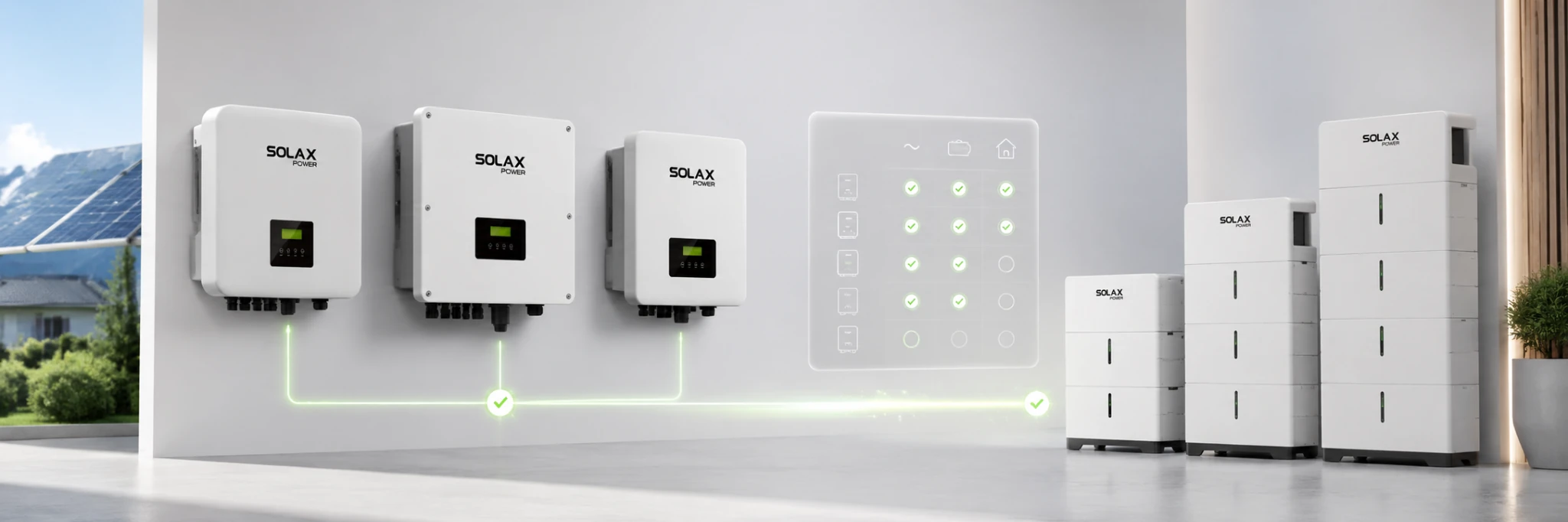
NOTE: The uploaded image is for illustrative purposes. Product appearance may differ from actual equipment.