EV Accessories and Mounting



Tesla’s Solar Roof appears to have reached the end of the road.
According to reports published in August 2026, Tesla has informed certified third-party installers that it will no longer supply its photovoltaic Solar Roof tiles for new projects and will instead concentrate on conventional solar panels. One installer source cited by Electrek said Tesla had concluded that the Solar Roof was not financially viable.
There is also visible evidence of the change on Tesla’s own website. The former tesla.com/solarroof address now redirects visitors to Tesla’s conventional solar panels page. Tesla has not, however, issued a formal public announcement confirming the discontinuation, so the most accurate description is that the Solar Roof has been withdrawn from new sales based on installer communications and Tesla’s current product positioning.
For the solar industry, the important part of the story is not simply that one high-profile product has disappeared.
It is what the decision says about the economics of rooftop solar.
Tesla attempted to combine the roofing material and photovoltaic generator into one premium product. Almost ten years later, the market is showing that conventional solar panels, solar inverters and solar battery systems remain extremely difficult to beat when installation cost, system flexibility, maintenance and long-term return on investment are considered together.
What Was the Tesla Solar Roof?
Tesla introduced Solar Roof in 2016 with a straightforward but ambitious idea: instead of installing photovoltaic modules over an existing roof, the roof itself would generate electricity.
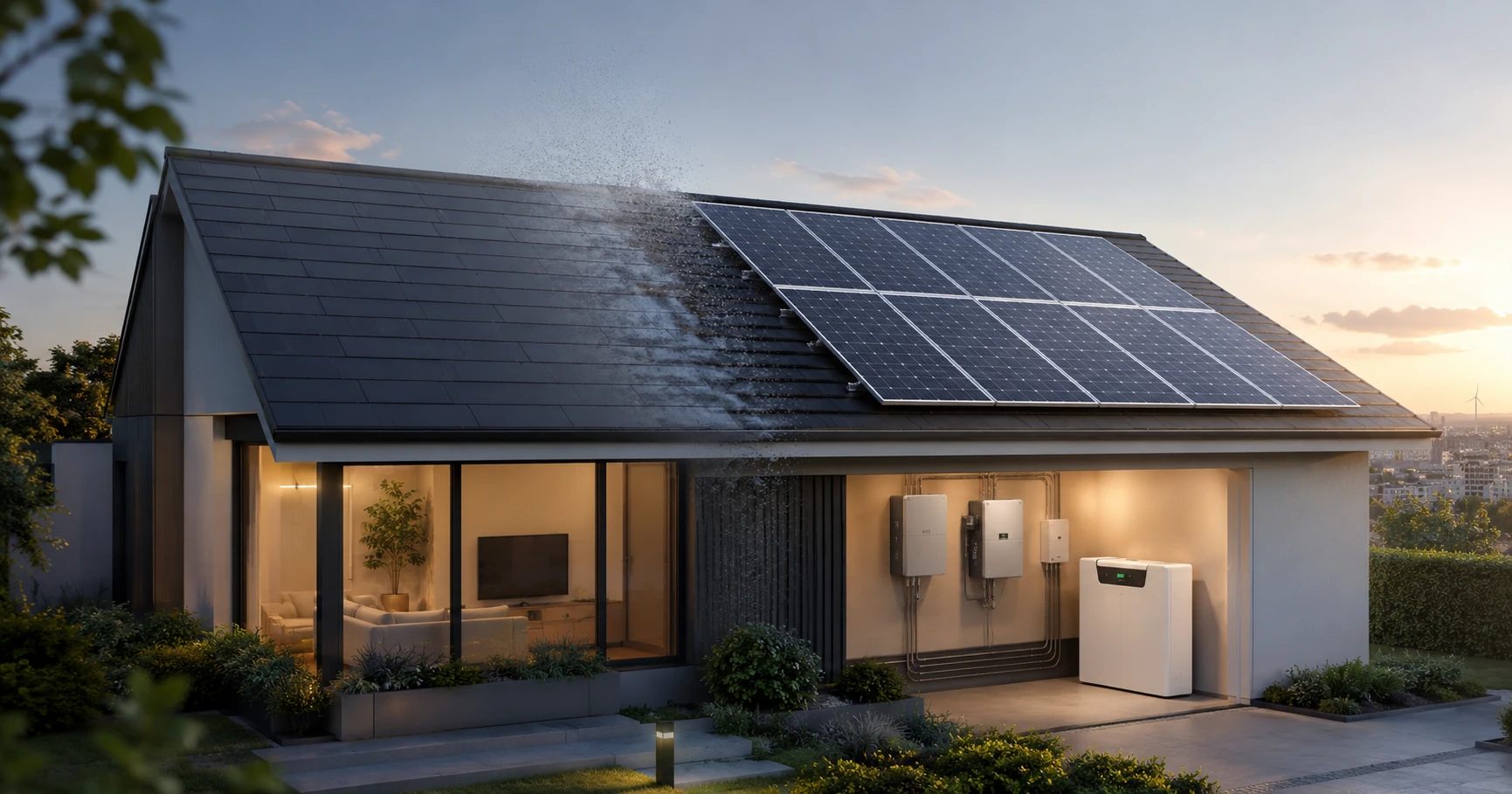
Solar Roof replaced conventional roofing materials with a combination of electricity-producing glass solar tiles and visually matching non-producing roofing tiles.
The result was designed to look more like a premium tiled roof than a traditional rooftop solar PV installation.
From an architectural point of view, the concept was attractive. Homeowners could potentially have a roof, solar generator and eventually battery energy storage incorporated into a single energy system without conventional framed solar panels being visible above the roof surface.
Tesla described the system as combining solar generation with Powerwall energy storage, allowing electricity generated during the day to be stored and used later. The company’s installation documentation also showed that the solar tiles were electrically connected into strings and ultimately connected to a solar inverter in much the same fundamental way as a conventional photovoltaic system.
The difficulty was not proving that solar roof tiles could generate electricity.
The difficulty was making them economically competitive.
Why Has Tesla Apparently Discontinued Solar Roof?
The reported explanation is simple: the economics did not work at sufficient scale.
Electrek reported on 20 August 2026 that Tesla had told third-party installers it would stop supplying Solar Roof tiles. A source close to the programme said the product was regarded internally as financially unviable.
That conclusion makes more sense when Solar Roof is considered as an installation product rather than simply a piece of photovoltaic technology.
A normal rooftop solar PV installation is built from highly standardised components.
An installer can select solar panels, mounting equipment, DC protection, a solar inverter and a compatible solar battery according to the requirements of the property. Individual components can be sourced competitively, substituted when necessary and serviced separately over the lifetime of the system.
An integrated solar roof is different.
The photovoltaic system also becomes part of the building envelope.
That means Tesla was effectively manufacturing and installing two products simultaneously: a roof and a power plant.
That distinction has major consequences for project economics.
1. Solar Roof Installation Was More Complex Than Installing Standard Solar Panels
Conventional solar panels are modular.
Installers work with repeatable dimensions, mounting rails, roof hooks, clamps, connectors and electrical layouts. Although every roof requires engineering and planning, much of the installation process can be standardised.
Solar Roof required significantly greater integration with the structure of the building.
Tesla’s own installation documentation described removing the existing roof down to the decking before installing waterproofing, active solar tiles, non-producing roof tiles and associated electrical components.
That creates considerably more labour exposure than mounting a conventional solar PV array onto a suitable existing roof.
For a homeowner already planning a complete roof replacement, that approach can make architectural sense.
For the wider residential solar market, however, most customers do not need to replace their entire roof simply because they want solar electricity.
That immediately reduces the potential market.
2. Standard Solar Panels Became Cheaper While Solar Roof Remained Complex
Solar Roof did not compete in a static market.
During the years Tesla was trying to commercialise the product, conventional photovoltaic technology continued developing rapidly.
Solar panels became more powerful.
Module efficiency improved.
Higher-output residential and commercial panels reduced the number of modules required for a given system capacity.
Solar inverter technology improved.
Hybrid solar inverters made it easier to combine PV generation with a solar battery.
Energy storage became increasingly mainstream.
Smart meters, energy management systems, EV chargers, backup outputs and dynamic electricity tariffs created new ways of optimising a standard solar PV installation.
This matters because every improvement in conventional solar PV increased the economic hurdle that an integrated solar roof had to overcome.
The question was no longer simply:
“Does a solar roof look better than solar panels?”
The real purchasing question became:
“Does the additional architectural value justify the additional installed cost, project complexity and servicing requirements?”
For most projects, apparently not.
3. Tesla Never Reached the Installation Volumes Originally Expected
Scale was another major problem.
Tesla previously targeted production and eventually installation volumes of around 1,000 Solar Roof systems per week.
Independent research suggested actual deployment was nowhere close.
Wood Mackenzie estimated in 2023 that approximately 3,000 Tesla Solar Roof systems, representing almost 30 MWdc, had been installed across the United States since the product’s introduction.
Its research estimated average installations of only 21 systems per week during 2022, with the strongest quarter reaching approximately 32 installations per week.
Those figures were estimates rather than Tesla-reported deployment numbers, but the gap between the company’s original ambitions and observed market penetration was substantial.
Without installation volume, manufacturing costs are harder to reduce.
Without lower manufacturing and installation costs, demand is harder to increase.
It is a difficult cycle for any specialist building-integrated photovoltaic product.
4. Every Roof Is Different
This is one of the fundamental economic advantages conventional solar panels have over solar roofing.
A PV module is essentially a standardised energy-generating component.
It can be installed on thousands of different buildings using different mounting systems.
Solar tiles must interact much more closely with the specific geometry of the roof.
Dormers, chimneys, valleys, ridges, ventilation outlets, skylights and changes in pitch all affect the installation.
A complicated roof therefore creates both roofing work and photovoltaic design work.
Some areas need active photovoltaic tiles.
Others need visually matching passive tiles.
Cable routing has to work with the roofing layout.
Waterproofing remains critical throughout the entire structure.
That makes engineering, installation and eventually servicing more site-specific.
Standard solar panels largely avoid this problem because the roofing system and photovoltaic system remain separate.
5. Serviceability Matters More Than It First Appears
The purchase price of a solar PV system is only one part of its lifetime cost.
Professional solar installers and EPC contractors also consider:
- availability of replacement components;
- solar inverter compatibility;
- battery compatibility;
- module replacement;
- warranty processing;
- access to electrical components;
- monitoring;
- troubleshooting;
- installation labour;
- future system expansion;
- spare-part availability.
This is an area where modular solar PV architecture has a major advantage.
If a conventional solar inverter fails, it can normally be replaced without replacing the roof.
If a solar battery reaches the end of its service life, the battery can be replaced.
If additional battery capacity is required, many modern energy storage platforms can be expanded.
If a solar panel becomes damaged, the affected module can normally be removed and replaced.
Separating the building envelope from the electricity-generating equipment therefore provides considerable lifecycle flexibility.
For professional installers, that flexibility has commercial value.
Solar Roof Versus Conventional Solar Panels
The difference becomes clearer when the two approaches are compared from a project and procurement perspective.
| Project consideration | Integrated solar roof / BIPV | Conventional solar panels |
|---|---|---|
| Roofing and PV integration | Fully integrated | Separate systems |
| Installation complexity | High | Generally lower |
| Component standardisation | Limited | High |
| Installer availability | Specialist | Widely available |
| Module sourcing | Proprietary or system-specific | Multi-manufacturer |
| Inverter selection | More restricted by system design | Broad selection |
| Solar battery integration | System-dependent | Wide range of hybrid solutions |
| Replacement of PV components | Potentially complex | Relatively straightforward |
| System expansion | More difficult | Usually easier |
| Architectural appearance | Excellent | Depends on module and mounting design |
| Procurement flexibility | Low to moderate | High |
| Suitability for roof replacement | Potentially attractive | Separate roofing project required |
| Suitability for existing good roof | Often difficult to justify | Very strong |
| Competition between suppliers | Limited | Extensive |
This does not mean building-integrated photovoltaics have no future.
It means they need to justify their additional complexity.
Does the Failure of Tesla Solar Roof Mean Solar Roof Tiles Are a Bad Idea?
No.
The distinction is important.
The reported discontinuation of Tesla Solar Roof does not mean building-integrated photovoltaics are technically flawed, nor does it suggest that rooftop solar itself is becoming less viable.
They are two very different markets.
Solar tiles and other BIPV products can make sense where architecture is a major project requirement.
Examples include:
- premium residential construction;
- new-build properties;
- complete roof renovations;
- architect-led developments;
- buildings where conventional modules are aesthetically unacceptable;
- projects where building materials and photovoltaic generation can be budgeted together.
There may therefore continue to be a market for solar roofing.
But that is different from saying it will replace conventional solar panels.
For mainstream residential, commercial and industrial installations, standard solar modules currently offer something extremely valuable: modularity.
Conventional Solar PV Has Become an Energy Platform
This is perhaps the larger lesson from Tesla’s decision.
Modern rooftop solar is no longer simply a set of panels connected to the grid.
A well-designed system can combine:
Solar panels
Generate electricity from available roof or ground area.
Hybrid solar inverter
Controls PV generation, grid interaction and battery charging.
Solar battery
Stores surplus electricity for evening use, backup operation or tariff optimisation.
Energy management system
Controls loads, batteries, EV charging and grid import/export.
Backup or EPS supply
Maintains selected loads when grid supply is unavailable, depending on system configuration.
EV charging
Uses surplus photovoltaic generation to charge electric vehicles.
Smart loads
Heat pumps, water heating, HVAC and other controllable loads can increasingly respond to available solar generation.
That modular approach lets installers configure each project according to the customer’s actual energy requirements.
A solar roof tile cannot escape those system-level requirements. It still needs electrical conversion, protection, control and—increasingly—energy storage.
The question is therefore whether integrating the solar cells into the roofing material creates enough additional value to compensate for the cost and complexity it introduces.
Tesla’s reported decision suggests that, at least for Solar Roof, the answer was no.
Tesla Is Not Leaving Solar
Another important point: Tesla has not abandoned solar energy.
The company introduced a new conventional residential solar panel in March 2026, manufactured at Gigafactory New York. Tesla describes the panels as designed to integrate with its wider residential energy ecosystem.
Its energy business also continues to centre heavily on battery energy storage through Powerwall for residential applications and Megapack for larger projects. Tesla’s current Energy website prominently presents Powerwall and Megapack alongside its solar offering.
So the strategic shift is significant.
Tesla is not moving away from solar electricity.
It appears to be moving away from turning the roof itself into the solar module.
That is an important difference.
What Solar Installers Can Learn From Tesla Solar Roof
For professional solar installers, EPC companies and procurement teams, there are several practical lessons.
Standardisation Still Matters
The European solar PV market depends heavily on interchangeable, scalable components.
Solar installers need products that can be quoted quickly, delivered reliably and installed repeatedly.
That is one reason conventional solar panels and standardised mounting systems remain so effective.
Multi-Brand Compatibility Reduces Project Risk
A system built around widely supported electrical standards gives installers more procurement options.
Solar panels, solar inverters, solar batteries, protection equipment and mounting components can be selected according to project requirements rather than being locked into a single architectural product.
That can become especially important years after commissioning.
Installation Time Is Part of the Product Cost
Procurement price alone never tells the whole story.
A component that costs slightly more but saves several installer-hours may deliver a lower installed cost.
Likewise, a visually attractive product that requires substantially more roof preparation, engineering and specialist labour can become expensive even before the equipment cost itself is considered.
Professional system costing therefore needs to include:
equipment + logistics + labour + commissioning + servicing + warranty risk.
Long-Term Serviceability Should Be Designed In
A residential or commercial solar PV system may operate for decades.
During that period, solar inverters may be replaced, solar battery capacity may be expanded and electrical loads may change.
The easiest systems to maintain are normally those where major components can be serviced independently.
This is one of the strengths of conventional modular PV.
What Does Tesla Solar Roof’s Discontinuation Mean for Europe?
Tesla Solar Roof itself was primarily a North American product, but the commercial lesson applies directly to the European solar market.
Across Europe, demand is increasingly moving from simple grid-connected photovoltaic installations toward complete energy systems.
Customers are asking for:
- solar panels;
- hybrid solar inverters;
- solar battery storage;
- backup capability;
- energy management;
- EV charging;
- smart consumption;
- higher self-consumption;
- reduced grid dependence.
For solar installers and solar distributors, this shifts procurement toward integrated but modular energy systems.
The distinction matters.
Integrated does not have to mean proprietary.
A complete solar PV and energy storage installation can operate as one coordinated system while still being assembled from serviceable components.
That gives installers the ability to select the correct solar panels, inverter capacity, solar battery capacity and mounting system for each project.
It also lets a solar wholesaler or solar distributor maintain alternative products when availability or project requirements change.
That is difficult to achieve with a highly proprietary roofing product.
Solar Panels Plus Battery Storage Are Becoming the Practical Route to Energy Independence
The goal Tesla promoted with Solar Roof remains relevant.
Generate electricity locally.
Store excess solar production.
Reduce electricity purchased from the grid.
Maintain essential loads during outages where backup functionality is available.
What has changed is the most economical way of achieving it.
For most projects, the practical solution is increasingly:
high-efficiency solar panels + hybrid solar inverter + solar battery + intelligent energy management.
This combination can be configured for a small residential installation, a larger home with substantial battery capacity, or commercial and industrial energy storage.
It can also be expanded as electricity consumption changes.
That matters as households and businesses add EV chargers, heat pumps, air conditioning, electric water heating and other electrified loads.
Instead of making the photovoltaic generator part of the roof itself, installers can concentrate on optimising the complete energy system.
A Good Idea Is Not Always a Good Product
Tesla Solar Roof is an interesting example of the difference between technical innovation and commercial viability.
The concept remains appealing.
A roof capable of generating electricity without visibly mounted solar panels sounds like a natural evolution of photovoltaic technology.
But a product still has to compete on manufacturing cost, installation time, energy yield, reliability, servicing and supply-chain efficiency.
According to Wood Mackenzie’s 2023 estimates, deployment remained dramatically below Tesla’s earlier ambitions. By August 2026, Tesla’s former Solar Roof web address was redirecting customers toward standard solar panels, while installer sources reported that new Solar Roof tiles would no longer be supplied.
That tells the industry something useful.
The winning solar product is not necessarily the one with the most radical design.
It is often the one that installers can source, design, install, commission, maintain and replace economically for thousands of different projects.
For now, conventional solar panels still hold that advantage.
And when they are combined with modern solar inverters and scalable solar battery storage, they can deliver most of the energy-independence benefits that Solar Roof was originally intended to provide—without requiring the photovoltaic system to become the roof itself.
What Should Homeowners Planning a New Solar System Consider?
Anyone planning a rooftop solar installation should compare the complete lifetime economics rather than focusing on appearance or panel price alone.
The system should be sized around:
- annual electricity consumption;
- daytime and evening load profile;
- available roof area;
- roof orientation and shading;
- solar inverter capacity;
- future electrification;
- required solar battery capacity;
- backup requirements;
- local grid regulations;
- installation cost;
- expected self-consumption;
- future maintenance and component availability.
For properties requiring a new roof, BIPV or solar roofing may still deserve consideration if suitable products are available.
For a structurally sound existing roof, however, conventional solar panels will generally offer far greater choice in modules, solar inverters, solar batteries and mounting systems.
The Bigger Picture: Solar Is Moving Toward Complete Energy Systems
The end of Tesla Solar Roof should not be interpreted as a failure of rooftop solar.
If anything, it highlights where the market is becoming stronger.
Solar PV is increasingly combined with energy storage rather than being treated as a standalone electricity generator.
That means the important procurement decision is no longer simply which solar panel produces the most watts.
Professional installers increasingly need to consider the complete system:
PV generation, inverter architecture, battery chemistry, usable battery capacity, charge and discharge power, backup capability, energy management, communication, protection and future expansion.
This is also why complete solar kits are becoming increasingly relevant.
A properly engineered solar kit can bring together compatible solar panels, solar inverter, solar battery, mounting system and electrical components while still allowing the installer to work with standard, replaceable equipment.
For professional solar installers, that combination of compatibility and flexibility is considerably more valuable than architectural integration alone.
Frequently Asked Questions
Has Tesla discontinued Solar Roof?
According to reporting published by Electrek in August 2026, Tesla informed certified third-party installers that it would no longer supply Solar Roof tiles for new orders. Tesla has not issued a formal public discontinuation announcement, but its former Solar Roof URL now redirects to its standard solar panels page.
Why did Tesla discontinue Solar Roof tiles?
A source cited by Electrek said Tesla considered the product financially unviable. Solar Roof also faced complex installation requirements, low deployment volumes and difficulty competing economically with conventional solar panels.
Can you still buy a Tesla Solar Roof?
New Solar Roof tile orders appear to have been discontinued. Some installers may still be completing projects already contracted or using existing product availability, so customers with an active project should contact their Tesla-certified installer directly. Recent reporting indicates availability can depend on the status and timing of individual projects.
Is Tesla stopping its solar business?
No. Tesla continues to offer conventional solar panels and residential energy storage through Powerwall. It introduced a new Tesla Solar Panel product in March 2026 and continues to operate a major battery energy storage business.
Are solar roof tiles the same as solar panels?
No. Conventional solar panels are mounted onto a roof or other supporting structure. Solar roof tiles are a form of building-integrated photovoltaics, or BIPV, in which photovoltaic components form part of the roof covering itself.
Are conventional solar panels cheaper than solar roof tiles?
In most projects, conventional solar panels benefit from greater manufacturing scale, standardised installation methods, wider supplier competition and easier servicing. Actual project cost depends on the property, roof condition, system size, labour and equipment selected.
What is the alternative to a Tesla Solar Roof?
For most residential projects, the practical alternative is a conventional rooftop solar PV system consisting of high-efficiency solar panels, a solar inverter or hybrid solar inverter, optional solar battery storage, mounting equipment and the required electrical protection.
Does a solar battery make rooftop solar more useful?
A solar battery allows excess daytime photovoltaic generation to be stored instead of immediately exported to the grid. The stored electricity can then be used later, such as during the evening, during higher electricity-price periods or for backup operation where the inverter and electrical installation support it.
Are solar tiles and BIPV finished as a technology?
No. Building-integrated photovoltaics can still be attractive for new construction, premium architectural projects and complete roof renovations. Tesla Solar Roof’s reported discontinuation reflects the economics and deployment of one particular product rather than the technical viability of BIPV as a whole.
Our final takeaway
Tesla Solar Roof promised something genuinely attractive: a roof that could protect a building, generate electricity and integrate with battery energy storage without looking like a conventional photovoltaic installation.
The problem was turning that idea into a repeatable, economically competitive product.
Nearly a decade after its introduction, Tesla has reportedly stopped supplying Solar Roof tiles and redirected its solar business toward conventional solar panels and energy storage.
For the solar industry, the message is bigger than Tesla.
The strongest solar PV solutions are increasingly those that combine high-efficiency solar panels, a compatible solar inverter, scalable solar battery storage and intelligent energy management using components that installers can source, install and service efficiently.
Architecture matters.
But so do installation time, spare parts, compatibility, lifecycle cost and return on investment.
That is why modular solar PV continues to dominate—and why conventional solar panels combined with modern energy storage are likely to remain at the centre of residential and commercial energy independence for years to come.
NOTE: The uploaded image is for illustrative purposes. Product appearance may differ from actual equipment.