EV Accessories and Mounting


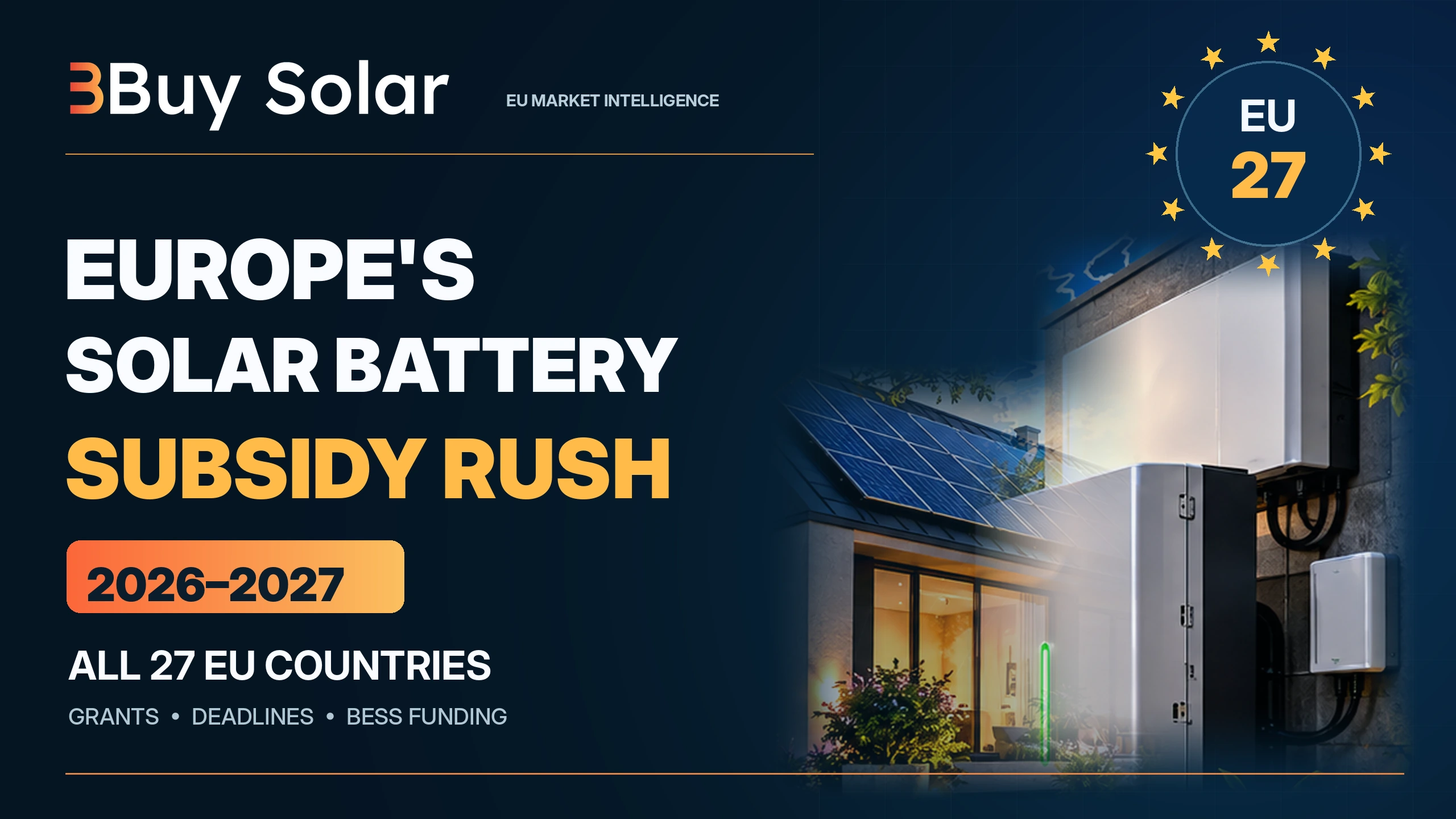

Europe’s Solar Battery Subsidy Rush: 27 EU Countries, New 2027 Grants and the Deadlines You Can’t Afford to Miss
The Complete European Solar Battery Subsidy Guide for 2026–2027
Updated: 10 October 2026 | Covers all 27 EU member states | Residential, commercial and industrial battery energy storage
Europe is entering a new phase of the energy storage revolution — and government funding is helping accelerate it.
Poland is preparing to distribute PLN 1 billion in residential battery support. Greece has announced €200 million for battery storage investments in 2027–2028. Romania has launched major commercial energy storage funding schemes, while countries including Austria, Slovenia, Ireland, Latvia and Luxembourg are supporting households that want to store more of their solar electricity.
For homeowners, this could mean a lower upfront investment in solar batteries. For professional solar installers, EPC contractors, solar distributors and wholesalers, it creates opportunities to supply battery energy storage systems, hybrid solar inverters and complete solar PV kits.
But there’s a catch.
Some of Europe’s most attractive solar battery subsidies are already closed, others will open within days, and several of the biggest 2027 programmes have not yet published their final rules.
Buying a battery before obtaining approval, choosing the wrong storage capacity or overlooking a national inverter requirement could make an otherwise suitable installation ineligible for funding.
This guide explains what is genuinely available, what’s coming in 2027, which programmes have closed and how buyers and installers can prepare.
Solar Battery Subsidies in Europe: The Biggest Opportunities at a Glance
There is no single EU-wide rebate that automatically applies to every household purchasing a solar battery. Each country — and sometimes each region — sets its own eligibility requirements, technical standards and application deadlines.
Here are some of the most relevant programmes identified for October 2026 through 2027.
| Country | Battery subsidy or programme | Application status |
|---|---|---|
| Poland | Up to PLN 16,000 for an eligible residential battery under net-billing | Opens 20 October 2026 |
| Romania | Up to RON 15,000 for eligible residential battery retrofits | Approved; opening pending |
| Austria | €150/kWh for eligible storage installed with solar PV | Open until 22 October 2026 |
| Slovenia | €275/kWh for eligible residential battery retrofits | Published application programme |
| Hungary | Up to HUF 2.5 million for residential energy storage | First application phase closed |
| Croatia | Up to €5,600 under the household battery grant | Temporarily closed |
| Ireland | €600 for qualifying batteries of at least 5 kWh | Applications available |
| Latvia | Up to €2,500 for qualifying household batteries | Established funding framework |
| Luxembourg | Up to €2,250 under Klimabonus 2026 | Current incentive |
| Malta | Up to €6,000 under its 2026 battery scheme | 2026 call closed |
| Netherlands — Flevoland | €750–€1,250 for eligible household batteries | 2026 allocation exhausted; new 2027 round expected |
| Sweden | 50% green technology tax reduction for eligible batteries | Standing tax incentive |
| Germany — Berlin | Up to €4,750 for qualifying residential storage | 2026 SolarPLUS programme |
| Greece | €200 million battery storage funding programme | Announced for 2027–2028 |
Important: A maximum grant is not a guaranteed payment. Funding depends on the applicant, installation, eligible costs, budget availability and programme rules. Tax deductions, loans and renovation grants are not directly comparable with battery-specific cash grants.
1. Poland: A PLN 1 Billion Solar Battery Programme Opening in October 2026
Poland is one of the clearest new residential battery funding opportunities in Europe.
The National Fund for Environmental Protection and Water Management (NFOŚiGW) has announced a PLN 1 billion programme for household energy storage, with applications opening on 20 October 2026.
The scheduled application deadline is 1 October 2027, unless the allocation is exhausted sooner.
How much can Polish households receive?
Under the published programme rules:
- Households operating under net-billing can receive up to PLN 16,000 for qualifying battery storage.
- Households operating under net-metering can receive up to PLN 8,000.
- Funding is limited to 30% of eligible costs and a maximum of PLN 800 per nominal kWh of battery capacity.
- Additional support may apply for qualifying heat storage or specified EU-manufactured battery-and-inverter combinations.
Which battery systems qualify?
The technical requirements are particularly important for installers supplying solar battery kits.
A qualifying electrical battery must have at least 10 kWh of nominal storage capacity. Its nominal battery capacity must also be at least twice the connected solar PV system’s rated capacity, expressed in kWp.
For example:
| Installed solar PV capacity | Minimum nominal battery capacity |
|---|---|
| 5 kWp | 10 kWh |
| 6 kWp | 12 kWh |
| 8 kWp | 16 kWh |
| 10 kWp | 20 kWh |
| 12 kWp | 24 kWh |
The scheme also requires energy management and backup or island-operation capability.
This makes compatible hybrid solar inverters, modular LFP batteries, backup switching equipment and energy management systems particularly relevant.
Installer tip: A 10 kWh battery does not automatically qualify for PLN 16,000. At PLN 800 per nominal kWh, a 10 kWh battery has a battery-specific ceiling of PLN 8,000, before applying the 30% eligible-cost limit.
Official programme: NFOŚiGW – Household Energy Storage
2. Romania: Residential Solar Batteries and Major Commercial BESS Funding
Romania is developing opportunities across several energy storage segments, from household battery retrofits to large grid-connected BESS installations.
Residential battery subsidies
The Romanian Ministry of Environment has finalised the rules for a residential battery programme with a RON 400 million budget.
Eligible existing prosumers may receive up to RON 15,000, covering a maximum of 75% of eligible costs.
Unlike a subsidy tied exclusively to the purchase of new solar panels, this programme is aimed at households that already generate photovoltaic electricity and want to add storage.
That could create demand for:
- Compatible battery modules for existing PV systems.
- Hybrid inverter upgrades.
- AC-coupled battery storage solutions where permitted.
- Energy management and monitoring equipment.
- Retrofit installation and commissioning services.
Status: The rules have been published, but an official application-opening date had not been confirmed as of 10 October 2026.
Commercial and utility-scale storage
Romania also has substantially larger funding programmes:
| Programme | Published funding allocation | Deadline |
|---|---|---|
| Private standalone BESS | €150 million | 30 October 2026 |
| Public-sector renewable generation with integrated storage | €500 million | 20 November 2026 |
| Public-sector renewable battery storage | €150 million | 20 November 2026 |
The private standalone BESS programme targets new grid-connected battery systems of at least 1 MW with a minimum two-hour duration. Published support limits include €69,000/MWh and a maximum of €15 million per qualifying company.
The public-sector programmes have different eligibility rules and funding caps. They should not be treated as interchangeable battery grants.
Early demand has been substantial, meaning a published application deadline does not guarantee remaining budget availability.
For European BESS suppliers and EPC contractors, Romanian procurement opportunities extend well beyond household 5–20 kWh battery kits.
Official sources: Romanian Ministry of Environment and AFIR Modernisation Fund.
3. Austria: €150/kWh Now — and a Potentially Important Battery Reform in 2027
Austria’s existing EAG funding mechanism supports photovoltaic systems and associated battery storage.
The October 2026 application round runs from 8 to 22 October.
Eligible battery storage receives a fixed €150 per kWh, subject to programme rules and installation alongside qualifying PV generation.
For illustration, a 10 kWh eligible battery could attract €1,500 in storage-specific support before applying all other project conditions.
What’s changing in 2027?
On 6 October 2026, Austria’s federal government announced plans to redesign its solar investment subsidy model.
The proposed direction places greater emphasis on intelligent energy storage, energy management systems and grid-supportive operation.
Of particular importance is the proposed inclusion of battery installations added to existing solar PV systems.
If enacted as described, that would create opportunities for Austrian solar battery retrofits as well as new solar PV complete kits.
However, the 2027 programme’s final grant amounts, legal requirements and application timetable remain pending.
Official sources: EAG funding application round and Austrian Ministry – Proposed PV Funding Reform.
4. Slovenia: Grants for New Solar PV Systems and Existing Battery Retrofits
Slovenia offers separate support routes for households installing new solar generation and existing prosumers adding batteries.
New solar PV with battery storage — JP-SO-02
Qualifying residential photovoltaic installations combined with battery storage can receive €675 per kW of solar PV capacity, capped at 40% of eligible investment costs.
The support is calculated primarily against installed PV capacity, rather than simply providing €675 for each battery kWh.
Battery retrofits — JP-SO-03
Households adding a qualifying energy storage system to an existing solar installation may receive €275 per kWh, capped at 40% of eligible expenditure.
For example, a qualifying 10 kWh retrofit produces a nominal grant calculation of €2,750. The actual payment cannot exceed the programme’s eligible-cost limit.
The scheme includes capacity-sizing conditions, and not all oversized battery configurations are eligible.
Commercial PV with energy storage — JP-OVE-05
Businesses can also apply for support for eligible new photovoltaic installations combined with energy storage. The published funding structure includes solar generation and storage-specific support, subject to combined aid limits.
These separate funding routes make Slovenia relevant to both residential solar battery retrofits and commercial energy storage projects.
Official source: Borzen – Renewable Energy and Battery Subsidies.
5. Hungary: Residential Storage and a Major Business Battery Programme
Hungary has two important but separate energy storage subsidy markets.
Residential: Otthoni Energiatároló Program
The residential programme introduced support of up to HUF 2.5 million for qualifying household energy storage investments.
Its first application phase has closed, so the headline grant should not be advertised as continuously available to new applicants.
However, approved projects can continue generating procurement and installation demand.
Commercial: Vállalkozói Energiatároló Program
Hungary also established a HUF 50 billion business energy storage programme.
Published grant values range from HUF 10 million to HUF 1 billion per eligible enterprise, depending on the project, with specific support intensity rules.
For qualifying smaller enterprises, support may cover up to 50% of eligible investment costs.
The programme opened in February 2026 and provides a project implementation horizon extending to 31 December 2028, subject to the approved funding terms.
For commercial solar installers, this is relevant to businesses seeking to increase self-consumption, integrate renewable generation and manage electricity demand through battery storage.
Official source: Hungarian Government – Business Energy Storage Programme.
6. Croatia: One of Europe’s Fastest-Moving Household Battery Grant Markets
Croatia’s 2026 household renewable-energy support programme introduced funding for residential battery storage.
The scheme offers up to 50% of eligible investment costs, with a maximum battery-specific subsidy of approximately €5,600, based on the published capacity-related limits.
Higher support may apply to qualifying energy-poor households.
The €38 million funding programme opened on 2 September 2026.
Just two days later, Croatia’s Environmental Protection and Energy Efficiency Fund temporarily suspended applications after receiving 9,320 submissions, including approximately 1,460 involving battery storage.
The speed of that response demonstrates substantial interest in grant-supported household energy systems. It does not, however, establish how many battery projects will ultimately be approved or installed.
Status: Temporarily closed. A new application round or reopening must be confirmed before installers advertise available grants.
Official source: Croatian Environmental Protection and Energy Efficiency Fund.
7. Slovakia: Up to €50,000 for Eligible SME Solar PV and Storage Projects
Slovakia’s Zelená podnikom programme supports qualifying renewable-energy investments by micro, small and medium-sized enterprises.
Businesses can receive vouchers of up to €50,000, subject to eligible costs, available funding and programme conditions.
New solar PV installations may include qualifying battery energy storage.
The storage-sizing formula is especially important: eligible battery capacity is generally limited to 0.25–1.00 kWh per kW of installed renewable generation.
A 30 kW PV installation could therefore include up to 30 kWh of battery capacity within the published upper sizing ratio, subject to the project’s energy audit and other conditions.
A critical restriction: This programme is not a general grant for adding a standalone battery to an existing PV installation. Storage must form part of the eligible new renewable-energy investment.
The next application phase should be confirmed with the Slovak Innovation and Energy Agency before advising customers to apply.
Official source: Zelená podnikom – Eligible Technologies.
8. Ireland, Latvia and Luxembourg: Three Important Residential Battery Markets
Ireland: €600 for Home Batteries from 5 kWh
The Sustainable Energy Authority of Ireland (SEAI) offers a €600 grant for qualifying home battery installations of at least 5 kWh.
Eligible applicants can install a battery together with new solar PV or apply to retrofit storage to an existing system.
A crucial requirement is to receive the grant offer before installation starts.
Installations must meet SEAI technical and contractor requirements. A grid connection notification and other commissioning documentation may be necessary.
Official source: SEAI Battery Energy Storage System Grant.
Latvia: Up to €2,500 for Eligible Batteries
Latvia’s EKII household renewable-energy support framework includes battery storage.
Under the updated 2026 rules, qualifying batteries generally require at least 10 kWh nominal capacity.
Battery-specific support can reach €2,500, with broader combined-project funding subject to the programme’s limits.
The published framework extends beyond 2027, although individual grants remain dependent on the available budget and qualifying project conditions.
Official source: Latvian Environmental Investment Fund.
Luxembourg: Up to €2,250 under Klimabonus 2026
Luxembourg’s Klimabonus programme includes financial assistance for qualifying home battery installations, including eligible storage retrofits.
Battery-specific support reaches €2,250, depending on the system and programme conditions.
A new prefinancing arrangement is scheduled for 2027 for eligible new PV-plus-storage investments. Battery retrofits are treated differently, so applicants should verify the applicable reimbursement procedure.
Official source: Guichet.lu – Klimabonus 2026.
9. Greece: A €200 Million Battery Storage Programme Planned for 2027–2028
Greece has announced €200 million in new battery-related subsidies for 2027 and 2028.
The government’s stated investment areas include battery storage integrated with renewable generation, self-consumption projects and standalone battery systems.
This is an important development for installers, solar developers and commercial energy storage suppliers.
However, the announcement does not yet establish which residential systems, commercial projects or utility-scale developments will receive which rates of financial support.
Status: Officially announced, but detailed funding calls, eligibility requirements and submission dates remain pending.
Official source: Greek Government – 2027–2028 Energy Measures.
10. Every EU Country: Solar Battery Subsidies and Incentives for 2026–2027
Beyond the major programmes above, the remaining EU member states have different combinations of regional grants, renewable-energy financing, tax deductions, closed schemes and proposed funding.
The following matrix covers all 27 European Union countries.
| EU country | Identified battery-related incentive or funding position | What applicants should know |
|---|---|---|
| Austria | EAG PV + storage support; proposed 2027 intelligent-storage reform | October 2026 round open until 22 October; 2027 changes pending |
| Belgium | No verified nationwide residential battery cash grant | Flanders’ previous home battery premium has ended; check regional rules |
| Bulgaria | Previous household renewable PV + battery schemes and larger renewable-energy funding | No confirmed new nationwide household battery application round for 2027 |
| Croatia | FZOEU residential battery grants | September 2026 application period temporarily closed |
| Cyprus | Save–Upgrade Homes 2026 can support storage within qualifying renovations | Opens 20 October 2026; whole-renovation grant, not battery-specific |
| Czechia | NZÚ renovation financing; RES+ agricultural PV and storage funding | Agricultural RES+ call scheduled through 30 June 2027 |
| Denmark | Home improvement tax deduction for eligible solar installation labour | Solar PV with storage may qualify; battery-only installation excluded under the identified measure |
| Estonia | Tax exemption for qualifying small-scale battery participation in balancing markets | Operating-income incentive rather than installation grant |
| Finland | Project-specific business energy and innovation funding | No general nationwide household battery purchase grant confirmed |
| France | PV generation incentives and selected industrial or regional funding routes | No nationwide standalone residential battery cash grant confirmed |
| Germany | Berlin SolarPLUS storage grants; KfW renewable-energy financing | Berlin’s current rules apply in 2026; 2027 regional funding needs confirmation |
| Greece | €200 million battery programme announced | Planned for 2027–2028; application details pending |
| Hungary | Residential storage programme and separate enterprise energy storage grants | First household application phase closed; business project pipeline remains important |
| Ireland | SEAI €600 home battery grant | Minimum 5 kWh; prior approval and registered installer required |
| Italy | Qualifying renovation tax deductions; selected regional PV + storage grants | 2027 tax percentages differ from 2026; regional schemes vary |
| Latvia | EKII household battery support | Minimum 10 kWh under revised rules; budget-dependent |
| Lithuania | Previous APVA PV + battery grants | Identified 2026 application period closed; new 2027 call not verified |
| Luxembourg | Klimabonus residential PV and storage assistance | Battery support up to €2,250; changes to prefinancing from 2027 |
| Malta | 2026 RES battery grants | Application period closed; 2027 replacement not yet confirmed |
| Netherlands | Flevoland household battery grant; separate business EV-charging storage support | Flevoland’s 2026 allocation exhausted, new 2027 round expected |
| Poland | PLN 1 billion household energy storage programme | Applications open 20 October 2026 |
| Portugal | Previously awarded commercial renewable-linked BESS funding | Identified 2026 application round closed; awarded projects may progress in 2027 |
| Romania | Residential battery programme plus private and public-sector BESS funding | Residential opening pending; commercial deadlines in October–November 2026 |
| Slovakia | Zelená podnikom business PV + storage vouchers | Up to €50,000; new installation and energy audit rules apply |
| Slovenia | Separate PV + battery and battery retrofit grants | Residential programmes distinguish new installations from retrofits |
| Spain | 2026 renewable self-consumption tax deductions, including eligible storage | Current identified tax measure is for 2026; 2027 extension unconfirmed |
| Sweden | 50% green technology tax deduction for qualifying batteries | Tax reduction rather than a direct cash grant |
This is a complete EU-27 country overview, not a claim that all 27 governments currently offer an open direct solar battery subsidy.
Important regional opportunities
A national subsidy search alone can miss relevant funding.
Germany — Berlin: SolarPLUS provides battery storage support under its current 2026 programme, including grants up to €4,750 for certain residential installations and larger allowances for qualifying multifamily or commercial-property systems. Official IBB programme.
Netherlands — Flevoland: The provincial scheme covers 25% of eligible costs, from €750 to €1,250, for qualifying household batteries of 5–20 kWh. The province confirmed that its 2026 allocation was exhausted on 1 October 2026 and that new applications are expected in early 2027. Official provincial grant.
Italy — Friuli Venezia Giulia: Regional incentives support eligible condominium photovoltaic and battery storage investments, with published funding arrangements extending into 2027 and 2028. Official regional information.
Czech Republic: The RES+ 6/2025 agricultural photovoltaic funding programme includes qualifying storage and has a published application period extending to 30 June 2027. Official Modernisation Fund call.
Cyprus: The €20 million Save–Upgrade Homes programme opens on 20 October 2026. Grants can reach €24,000 or €32,000, depending on the whole-home renovation category. These amounts must not be misrepresented as battery-only subsidies. Official Cyprus funding announcement.
11. How Much Can a Solar Battery Subsidy Actually Save?
Published grant caps can be misleading without applying the eligibility formula.
Consider four simplified examples:
| Country and example | Indicative subsidy calculation | Critical limitation |
|---|---|---|
| Poland: 10 kWh battery, net-billing | Up to PLN 8,000 based on PLN 800/kWh | Also capped at 30% of eligible costs; PV sizing applies |
| Austria: 10 kWh eligible storage | €1,500 at €150/kWh | Must satisfy the relevant PV-linked programme conditions |
| Slovenia: 10 kWh eligible retrofit | €2,750 at €275/kWh | Cannot exceed 40% of eligible costs |
| Ireland: qualifying 5 kWh battery | €600 | Flat grant; advance approval and contractor requirements apply |
These figures are illustrations of published programme calculations, not quotations, awards or guarantees of eligibility.
A solar battery purchase decision should also consider installed cost, electricity tariffs, export compensation, charge-discharge efficiency, warranty and expected annual battery usage.
A higher subsidy does not automatically make a battery system economically superior.
12. Which Solar Batteries and Hybrid Inverters Qualify for European Subsidies?
For professional solar installers and distributors, grant eligibility increasingly depends on the complete system rather than the battery’s headline capacity alone.
Battery capacity: nominal versus usable kWh
Some schemes calculate aid using nominal battery capacity, while other technical or grant requirements rely on usable capacity.
A battery advertised as 10 kWh may have a lower usable energy capacity because of battery management settings and operating limits.
Installers should confirm the exact manufacturer-declared capacity and the programme’s preferred measurement before specifying equipment.
Single-phase and three-phase compatibility
A residential 5 kW single-phase hybrid inverter and a 10 kW three-phase hybrid inverter are not interchangeable simply because both can connect to a 10 kWh battery.
National distribution-network rules, connection approvals, phase imbalance limits and backup requirements must all be considered.
LFP battery chemistry and compliance
Lithium iron phosphate (LFP) batteries are widely used in residential and commercial energy storage.
For procurement and grant documentation, installers should request the relevant manufacturer’s technical datasheet, EU Declaration of Conformity, applicable safety certifications, battery transport documents and installation manual.
Depending on the system and programme, relevant evidence may include IEC 62619, UN 38.3 and the applicable national grid-connection standards. A CE mark alone does not establish eligibility for every grant.
Energy management and backup operation
A battery with an internet-connected monitoring app does not automatically meet a subsidy programme’s energy management requirements.
An eligible system may need to support self-consumption optimisation, export limitation, time-of-use control, grid-supportive operation or defined backup functions.
Similarly, a hybrid solar inverter does not necessarily provide uninterrupted power during a grid failure without the required switching arrangement and configured backup output.
Approved inverter–battery combinations
For complete solar battery kits, installers should verify:
- Exact inverter and battery model compatibility.
- Approved BMS communication protocol and firmware versions.
- Nominal and usable battery capacity.
- Continuous charge and discharge power.
- Grid-connection and backup arrangement.
- Required smart meter, CT, EMS or gateway.
- Warranty, commissioning and installer certification conditions.
The important procurement principle is simple: specify the complete compliant energy storage system before quoting the subsidy.
13. Solar Battery Grants: What Changes Between a New Installation and a Retrofit?
One of the most common mistakes is assuming that a solar battery subsidy available for a complete solar PV installation also applies to an existing prosumer.
There are three fundamentally different project types.
New solar PV with battery storage
These projects include solar panels, a compatible solar inverter, battery modules, mounting systems, protection equipment and installation.
Austria’s current EAG call and Slovenia’s new-installation programme are examples where solar generation is directly relevant to storage eligibility.
Battery storage added to existing solar panels
Retrofits can require fewer changes to the PV array but more attention to inverter compatibility.
For example, an existing string inverter may need replacement with a hybrid inverter, or the system may need a qualifying AC-coupled energy storage solution.
Ireland, Slovenia and Luxembourg have identified routes that can support eligible existing-system battery installations.
Standalone commercial BESS
Commercial or grid-connected energy storage systems can involve much larger equipment, including power conversion systems, battery racks or containers, fire protection, remote monitoring, protection relays and energy management systems.
Romania’s standalone BESS funding is an example of a programme that should not be confused with residential solar battery support.
14. Solar Battery Subsidy Deadlines: The 2026–2027 Calendar
| Date | Country | Event |
|---|---|---|
| 16 October 2026 | Slovakia | Published assessment deadline for the identified industrial Modernisation Fund call |
| 20 October 2026 | Poland | New residential energy storage programme opens |
| 20 October 2026 | Cyprus | Save–Upgrade Homes applications open |
| 22 October 2026 | Austria | Current EAG PV + storage funding round closes |
| 30 October 2026 | Romania | Private standalone BESS application deadline |
| 20 November 2026 | Romania | Public-sector storage funding application deadlines |
| 18 December 2026 | Netherlands | Scheduled closing date for the identified SPRILA business EV-charging infrastructure scheme |
| 30 December 2026 | Cyprus | Scheduled end of household energy renovation applications |
| Early 2027 | Netherlands — Flevoland | New household battery application round expected |
| During 2027 | Austria | Proposed intelligent battery storage funding reform |
| During 2027–2028 | Greece | Announced €200 million battery storage programme; calls pending |
| 30 June 2027 | Czechia | Agricultural RES+ PV and storage application deadline |
| 1 October 2027 | Poland | Scheduled end of new residential battery programme |
Application periods may close earlier if the allocated funding is exhausted. The existence of a project completion deadline in 2027 or 2028 does not mean that new applications will remain open until that date.
15. How Homeowners and Solar Installers Can Apply Successfully
Most grant applications become difficult not because the battery itself is unsuitable, but because the installation sequence or supporting documentation does not satisfy the programme rules.
Before ordering equipment, use the following procedure.
- Confirm the applicant’s eligibility. Determine whether the programme supports homeowners, landlords, SMEs, farmers, municipalities, energy communities or another applicant category.
- Identify the correct project category. Establish whether the grant supports new solar PV plus storage, a retrofit battery, standalone storage or a broader renovation project.
- Check the funding window and remaining budget. A formally published closing date does not necessarily mean funding remains available.
- Verify equipment requirements. Check battery sizing, inverter compatibility, EMS functionality, grid approval, certifications and eligible-cost definitions.
- Obtain the necessary approval before installation. Several programmes exclude installations started before a grant offer or formal authorisation.
- Retain complete project documentation. Keep the quotation, invoices, payment evidence, technical datasheets, grid notifications, commissioning reports and any required energy audit.
For professional solar installers, preparing standardised grant-compliant battery packages can reduce technical errors and make proposals easier for customers to compare.
16. What Does Europe’s Battery Subsidy Expansion Mean for Solar Distributors and Installers?
Government funding is creating different types of demand across Europe.
Poland’s large residential scheme places emphasis on correctly sized batteries, compatible solar inverters and defined control functions.
Slovenia’s separate new-PV and retrofit incentives create opportunities to offer different battery configurations to new and existing solar customers.
Romania’s commercial and utility-scale funding requires a much broader procurement approach than residential battery kits, while Hungary’s enterprise programme may support a pipeline of commercial self-consumption projects.
For European solar distributors, the commercial opportunity is therefore not simply to stock more solar batteries. It is to supply complete, technically documented and appropriately configured energy storage systems for each market.
A procurement-ready offer should clearly identify the solar inverter model, battery modules, nominal and usable capacity, compatible BMS, required accessories, certifications, lead time, warranty and commissioning requirements.
For installers and wholesalers operating across several EU countries, a single generic 10 kWh or 20 kWh solar battery kit should not automatically be advertised as subsidy-ready everywhere.
Where will the 2027 opportunities come from?
The most clearly identifiable sources include:
- New national application windows, particularly Poland.
- Existing residential battery retrofit incentives in markets such as Slovenia and Ireland.
- Regional grants, including those in parts of Germany, Italy and the Netherlands.
- Commercial and industrial battery projects already entering the procurement phase.
- Government-announced programmes still awaiting final rules, including Greece’s new funding initiative and Austria’s proposed storage-focused reform.
The challenge for installers is to act on confirmed opportunities while avoiding premature promises about announced programmes.
Frequently Asked Questions About Solar Battery Subsidies in Europe
Which EU country offers the highest solar battery subsidy in 2026–2027?
There is no single answer because residential, commercial and utility-scale grants have different maximum amounts and eligibility requirements. Poland offers up to PLN 16,000 under its qualifying net-billing household battery rules, while much larger grants exist for eligible commercial and industrial storage projects in countries such as Romania and Hungary.
Can I receive a grant for a solar battery without installing new solar panels?
Yes, in some countries. Ireland, Slovenia and Luxembourg have identified funding routes for qualifying battery installations added to existing solar PV systems. Eligibility may depend on the existing inverter and the proposed battery configuration.
Is a 5 kWh solar battery eligible for a European subsidy?
It depends on the country. Ireland’s SEAI battery grant accepts qualifying systems from 5 kWh. Poland’s new programme requires at least 10 kWh nominal battery capacity, together with its PV-to-storage sizing ratio. Latvia’s updated programme also generally requires at least 10 kWh.
Are 10 kWh and 20 kWh batteries eligible for solar subsidies?
Both sizes can qualify under certain programmes, but eligibility depends on the installed solar PV capacity and applicable technical requirements. A 10 kWh battery is not universally subsidy-compliant, and a 20 kWh battery may exceed the eligible capacity under some schemes.
Can I combine a solar battery grant with a solar panel subsidy?
Sometimes. Some programmes expressly cover combined solar PV and energy storage installations; others allow separate support applications. Combining grants may be subject to cumulative state-aid restrictions and project-specific caps.
Does a hybrid inverter qualify for a subsidy?
A hybrid solar inverter may form part of an eligible project, but the programme determines which equipment and installation costs can be funded. Purchasing a hybrid inverter alone does not automatically create entitlement to a battery grant.
Is a solar battery subsidy paid before or after installation?
The payment method varies. Some schemes reimburse eligible expenditure after installation and documentation checks, while others use vouchers or supplier-linked payment arrangements. Approval requirements must be checked before any work begins.
Are commercial battery energy storage systems subsidised in Europe?
Yes. Several countries support eligible commercial or grid-connected storage, including Romania, Hungary, Slovenia and Slovakia. These schemes frequently involve energy audits, minimum project size, renewable-generation integration, grid approvals or competitive funding assessment.
Will new solar battery subsidies become available in 2027?
Some 2027 funding is already scheduled, while other programmes remain announcements. Poland’s residential scheme has a published 2027 application deadline. Greece has announced new battery funding for 2027–2028, and Austria has proposed a revised incentive framework. Their actual application opportunities must be assessed separately.
Can a solar battery operate during a power cut?
Only when the system is designed and installed to provide backup operation. A compatible inverter, correctly configured battery, suitable switching equipment and compliant electrical installation are necessary. Many ordinary grid-connected solar PV systems shut down during a power cut for safety reasons.
Final Thoughts: The Next European Solar Opportunity Is Energy Storage — but the Details Matter
Europe’s solar market is moving beyond simply generating electricity.
Households and businesses increasingly want to control when they consume it, store surplus photovoltaic production, reduce exposure to changing electricity tariffs and improve energy resilience.
Solar batteries are central to that transition.
The subsidy picture for 2026–2027 is substantial but fragmented. Poland is preparing a major residential funding programme; Romania has large commercial BESS tenders; Slovenia already supports battery retrofits; Austria is developing a more storage-oriented approach; and Greece has announced significant new funding.
At the same time, some well-publicised grants in Croatia, Lithuania, Malta and other markets have closed or exhausted their allocations.
The real opportunity is not simply finding the largest advertised subsidy. It is matching a technically compliant solar battery system to an eligible customer, in the right country, during the right funding window.
Looking for Solar Batteries, Hybrid Inverters or Complete Energy Storage Kits?
Whether you are planning a residential battery retrofit, a new solar PV installation or a commercial battery energy storage project, start with the right system specification.
Our solar distribution team can help you evaluate suitable solar batteries, hybrid solar inverters, energy storage components and complete kits for professional installation.
Request a quotation for your next solar battery or energy storage project, including the country of installation, required inverter power, battery capacity and intended application.
Equipment selection and quotations should always be checked against the final national subsidy rules and local grid-connection requirements.
Official Sources and Further Reading
The following public authorities and programme operators provide detailed eligibility criteria, official application documents and scheme updates.
- Poland: NFOŚiGW Household Energy Storage
- Romania: Ministry of Environment and AFIR Modernisation Fund
- Austria: EAG Abwicklungsstelle
- Croatia: FZOEU Environmental Protection and Energy Efficiency Fund
- Hungary: Government Business Energy Storage Programme
- Slovakia: Zelená podnikom
- Slovenia: Borzen Renewable Energy Subsidies
- Ireland: SEAI Battery Grant
- Latvia: Latvian Environmental Investment Fund
- Luxembourg: Guichet.lu Klimabonus
- Malta: REWS Renewable Energy Sources Scheme
- Netherlands: Flevoland Household Battery Grant and RVO Business EV Charging Infrastructure Support
- Germany: Berlin SolarPLUS
- Czechia: State Environmental Fund – RES+
- Cyprus: Ministry of Energy – Save–Upgrade Homes
- Greece: Greek Government – Energy Investment Announcements
- Sweden: Skatteverket – Green Technology Tax Reduction
- Denmark: Danish Tax Agency – Home Improvement Deductions
Editorial note: This guide reflects published information available on 10 October 2026. It distinguishes verified applications, closed or exhausted allocations, tax incentives, and announced future programmes. Funding authorities may amend budgets, technical requirements and application dates. Always consult the latest official call documentation before ordering equipment, signing installation contracts or submitting a grant application.