EV Accessories and Mounting


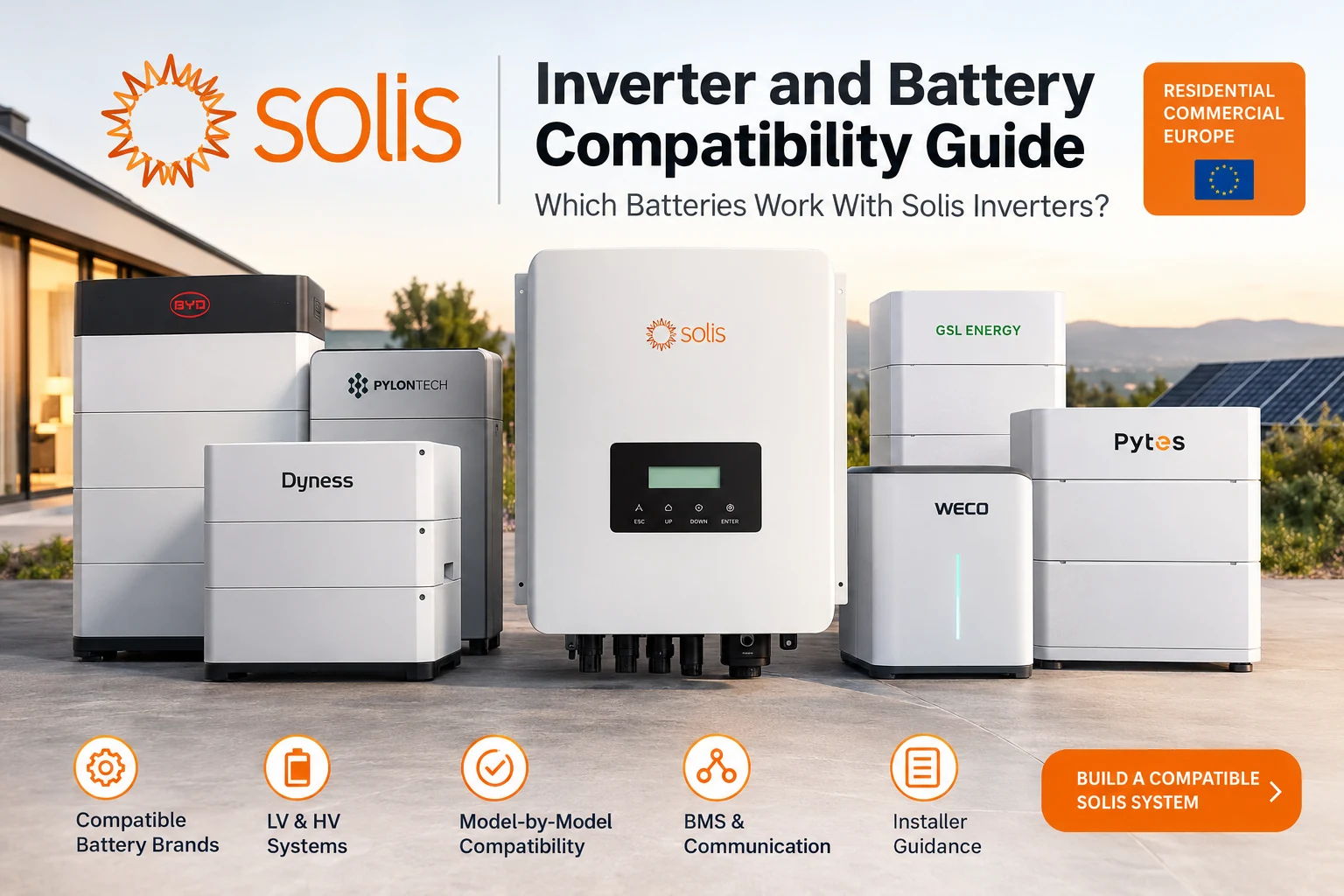

Solis Battery Compatibility Guide for Professional Installers
Updated: August 2026
Which battery works with a Solis inverter?
For a professional installer, the answer cannot be reduced to a battery brand.
Solis hybrid inverters are available with low-voltage and high-voltage battery interfaces, across single-phase, three-phase, residential, AC-coupled and commercial/C&I platforms. Battery compatibility therefore depends on the exact inverter family, battery model, operating-voltage range, BMS protocol, communication interface, firmware and permitted battery configuration.
Solis supports both its own SolisStorage battery ecosystem and a large number of validated third-party battery systems.
The manufacturer’s current strategy is explicitly open rather than closed: Solis offers integrated SolisStorage solutions while continuing to test and validate third-party batteries. Approved combinations are added to the official Solis Battery Matching Document as testing is completed.
That distinction is important.
A battery being:
- lithium
- LiFePO4
- 48 V
- 51.2 V
- high voltage
- CAN-enabled
- RS485-enabled
does not by itself make it compatible with a Solis hybrid inverter.
The correct question is:
Does this exact battery model have an approved communication and operating configuration for this exact Solis inverter family?
This guide is written for solar installers, EPC contractors, electricians, system designers and technical procurement teams working with Solis energy storage systems in Europe.
It covers:
- current Solis S6 hybrid inverter families
- Solis low-voltage battery compatibility
- Solis high-voltage battery compatibility
- commercial and C&I battery matching
- BYD compatibility
- Pylontech compatibility
- Dyness compatibility
- SolisStorage compatibility
- WECO compatibility
- Pytes compatibility
- GSL Energy compatibility
- Fox battery compatibility
- LG Energy Solution compatibility
- Soluna compatibility
- Puredrive compatibility
- UZ Energy compatibility
- dozens of additional matched battery manufacturers
- CAN and BMS communication
- firmware requirements
- retrofit systems
- battery expansion
- commissioning checks
- common compatibility errors
The Most Important Rule: Check the Exact Solis Inverter Model
Do not start battery selection from the Solis brand name alone.
Start with the full inverter model number.
This matters because apparently similar Solis hybrid inverters can use completely different battery architectures.
Examples include:
S6-EH1P(3-6)K-L-EUS6-EH1P(3-10)K-L-PLUSS6-EH1P(9.9-18)K03-NV-YD-LS6-EH3P(8-15)K02-NV-YD-LS6-EH3P(3-12)K-H-EUS6-EH3P(5-10)K2-HS6-EH3P(12-20)K-HS6-EH3P(12-20)K-ND-HS6-EH3P(29.9-50)K-HS6-EH3P(30-60)K04-NV-YD-H
The L, LV, H, HV, NV, ND, K2 and other model identifiers are not cosmetic.
They can indicate different hardware generations, voltage classes, markets or electrical architectures.
Never order a battery from an inverter description such as:
“Solis 10 kW hybrid”
Get the complete model first.
Current Solis Residential Low-Voltage Hybrid Inverter Families
The current Solis global battery matching documentation groups a number of modern residential low-voltage energy storage inverters together, including:
- S6-EH1P(3-6)K-L-EU
- S6-EH1P(3-6)K-L-AU
- S6-EO1P(4-5)K-L
- S6-EO1P(4-5)K-48
- S6-EO1P(4-5)K-48-EU
- S6-EA1P(3.6-6)K-L
- S6-EH1P(3-10)K-L-PLUS
- S6-EH1P(9.9-18)K03-NV-YD-L
- selected S6-EH2P low-voltage models
- S6-EH3P(8-15)K02-NV-YD-L
- S6-EH3P(7-9)K02-LV-YD-L
These are fundamentally low-voltage battery systems, with many installations operating around the familiar 48 V / 51.2 V LiFePO4 architecture.
Current Solis product information for the S6-EH1P(3-6)K-L-EU, for example, states up to 125 A / 6 kW battery charge and discharge capability and compatibility with multiple lithium battery brands.
For these systems, current battery capability is just as important as capacity.
A 51.2 V 10 kWh battery capable of 100 A continuous discharge is not equivalent to another 10 kWh battery capable of 200 A.
The inverter, battery BMS, cables and protection devices must all be specified for the actual current.
Current Solis Low-Voltage Compatible Battery Brands
The current Solis global matching documentation for modern residential LV platforms is extensive.
It includes battery products from manufacturers such as:
AKAIYAI, AlpSolarr, Amararaja, Ampace, Apex, Alpha, AISUN, Averge, BETA+, BETTENERGY, BSLBATT, BYD, Cegasa, CURENTA, CFE, DAHAI, DAH Solar, DAWAM, Discover Energy Systems, DMEGC, Dowell, Duracell, Dyness, EVE, Easyway, EBOX, Ecosolex, ECO-WORTHY, Enerbond, Eenovance, EITAI, EON, ESENER, Exide, FEB, Felicity Solar, FinDreams Battery, Fox, Freedom Won, GETPOWER, Genixgreen, Green Solutions, GREENRICH, GS Energy, GSL Energy, GXCC, Haier, HaiLei, HarveyPow, HD Energy, Highstar, HTES, Hithium, Hoenergy, HomeGrid, Hubble, IES, JA Solar, Juel, KNYEE, Kodak, KIJO, LBSA, Leapton, Leoch, Ledvance, Lithtech, Lithium Valley, LG Energy Solution, LVTOPSUN, Magneto, MENRED ESS, Meritsun, Moura, Modual, Motoma, MK Energy, Nahui, Narada, Nunam, Oliter, PAND, Phylion, powerESS Li.ON, Powerich, Pulze, Puredrive, Pylontech, Pytes, RaysTech, Renon, Rising, Ritar, Rosen, RUIXU, Sec Power, Shoto, Skyline, SolarEast, Solana, Soluna, Steltec, Sunket, Sunwoda, SUEN, Synapse, TAB, Taico, TGPRO, Topband, UCB Power, Uhome, Upower, URAYZERO, UIENERGIES, UZ Energy, Vestwoods, V-TAC, VinFast, WECO, XESS, YelonESS, Yoshopo, Zetara Power and ZRGP.
That is why describing Solis compatibility as merely “BYD, Pylontech and Dyness” seriously understates the platform.
Important
This list identifies brands represented in Solis’ global matching material.
It does not mean that every battery manufactured by every brand above works with every Solis low-voltage inverter.
Compatibility is model-specific and may also vary by European market.
Key Low-Voltage Battery Models Found in Solis Matching Documentation
For installers searching exact battery models, the following are among the more commercially relevant matched families.
BYD Low-Voltage Batteries
Current Solis matching documentation includes products such as:
- BYD PowerLine-5
- Battery-Box LV5.0
- Battery-Box Premium LVS
- Battery-Box Premium LVL
- Battery-Box Pro 2.5–10.0
- Battery-Box Pro 13.8
Do not confuse these with BYD HVS/HVM high-voltage products.
The battery architecture must match the inverter.
Dyness Low-Voltage Batteries
Current Solis matching includes Dyness families such as:
- DL LV Series
- Power LV Series
- A Series
- B Series
- BX LV Series
Current matching material also lists PowerBrick in the LV group.
For Dyness projects, confirm both the exact battery family and the available battery setting in SolisCloud or the inverter interface.
Pylontech Low-Voltage Batteries
Pylontech has one of the broadest histories of Solis compatibility.
Current matching material includes combinations from:
- US2000
- US2000B
- US2000C
- US2000 Plus
- US3000
- US3000A
- US3000C
- US5000
- UP5000
- Phantom-S
- Force L1
- Force L2
- Pelio-L-5.12
This makes searches such as Solis US5000 compatibility, Solis Pylontech US3000C, and Pylontech battery for Solis inverter particularly relevant installer queries.
But older battery families and new Solis inverter generations should still be checked against the latest matching document.
Pytes Low-Voltage Batteries
Current matched Pytes products include:
- E-BOX-48100R
- ESS48-2U-L
- UF5000
- Pelio-L-5.12 in older matching material
Pytes systems are especially relevant where installers are sourcing modular 48 V LiFePO4 battery storage.
Fox Low-Voltage Batteries
Solis compatibility documentation includes selected Fox low-voltage batteries such as:
- LV52
- LV54
- LV5200
The presence of a Fox battery in a Solis matching document does not mean Fox’s complete battery portfolio is compatible.
LG Energy Solution
Referenced LV products include combinations such as:
- RESU3.3
- RESU6.5
- RESU10
- RESU12 / RESU13 depending on inverter generation
Legacy Solis installations using LG RESU systems should be checked carefully because both battery and inverter generations have changed over time.
Puredrive
Solis documentation includes selected Puredrive LV products, including:
- 48V-100Ah platforms
- Shield LVS
- UP-series battery products depending on the matching generation
UZ Energy
Matched LV products include:
- Power Lite L051100-A1
- L051100-A
UZ Energy systems use the required closed-loop communication profile where supported.
WECO Low-Voltage Batteries
Matched families include:
- 4K4PRO
- Dual Voltage 5K3
- Dual Voltage 5K3-XP
- 4K5 Ultra
A particularly important point with WECO is that certain products are dual-voltage platforms.
The installer still has to configure the battery for the correct LV or HV architecture.
Soluna Low-Voltage Batteries
Current and legacy matching material includes:
- Battery Module 4K Pack
- Soluna EOS 5K Pack
Felicity Solar
The newer matching material includes Felicity Solar battery families including:
- LPBA Series
- LPBF Series
Again, check the precise model and Solis inverter before procurement.
GSL Energy Low-Voltage Batteries
Current matching material includes a large GSL Energy LV family, including variants such as:
- GSL5000U
- GSL7000U
- GSL10000U
- GSL-A51100
- GSL-W-15K / 20K
- GSL-ZN-P48100ESA1
- GSL-051100 / 200 / 280 / 320 series
- GS-LV products
The actual BMS profile and permissible current need to be checked for the exact inverter.
Sunwoda and Sunket
Current matching documents also include multiple Sunwoda and Sunket low-voltage storage platforms, including Atrix and SunESS families.
These are examples of why relying on older five-brand compatibility tables can miss a substantial part of the current Solis ecosystem.
Current Solis Residential High-Voltage Hybrid Inverter Families
The current global matching documentation separately identifies modern residential high-voltage platforms including:
- S6-EH3P(5-10)K2-H
- S6-EH3P(3-12)K-H-EU
- S6-EH3P(5-10)K-H-AU
- S6-EH3P(12-20)K-H
- S6-EH3P(12-20)K-ND-H
- selected S6-EH3P(8-12)K-ND variants
- S6-EA3P(5-10)KAA-NV-ND-H
- S6-EA3P(5-10)KAA-NV-YD-H-PRO
These systems require a high-voltage battery architecture.
For an HV installation, battery capacity alone tells very little.
The installer must establish:
- battery module voltage
- total stack voltage
- minimum module count
- maximum module count
- BMS/controller
- inverter battery operating window
- continuous battery current
- CAN protocol
- supported battery profile
- firmware
Adding modules changes the total DC battery voltage.
This is why the minimum and maximum stack configuration must be checked before ordering.
Current Solis High-Voltage Compatible Battery Brands
Current global residential HV matching material includes products from:
Ampace, AKAIYAI, Axitec, Autarco, BMZ, BSLBATT, BYD, Cegasa, CFE, Cospowers, Curenta, Dahai, DMEGC, Duracell, Dyness, Easyway, Ecosolex, Eenovance, Enerlution, Enershare, FEB, Felicity Solar, Genixgreen, Green Solutions, Goldenmate, GS Energy, GSL Energy, Haier, HaiLei, HarveyPow, HighOn, Hoenergy, Hubble, LBSA, Leapton, Lithium Valley, Magneto Renewable Energy, MENRED ESS, Motoma, OMLiKA, Pylontech, Pytes, PomePower, PowerCO, Powerich, RaysTech, Raymond, RPT, Oliter, SecPower, Shoto, Steltec, Soluna, Sunwoda Energy, SunArk, Sunket, URAYZERO, Vestwoods, WECO, YiLink and ZYC.
That is the residential HV group alone.
Important Solis High-Voltage Battery Families
BYD Battery-Box Compatibility With Solis
BYD remains one of the most important Solis HV battery ecosystems.
Current matching material includes:
- Battery-Box Premium HVS
- Battery-Box Premium HVM
- Battery-Box HVS+
- Battery-Box HVB
- selected ESS Grid variants in newer matching material
The inverter may expose a dedicated BYD / B-Box HV battery profile.
For installers, confirm:
- exact BYD family
- minimum number of modules
- maximum number of modules
- BCU generation
- total battery voltage
- Solis inverter family
- CAN cable
- firmware
Never substitute HVS and HVM without checking the permitted configuration.
Dyness High-Voltage Compatibility With Solis
Current Solis HV documentation includes multiple Dyness platforms:
- Tower T7
- Tower T10
- Tower T14
- Tower T17
- Tower Pro TP7
- Tower Pro TP11
- Tower Pro TP15
- Tower Pro TP19
- Tower Pro TP21
- PowerRack HV1
- PowerRack HV2
- PowerRack HV3
- PowerRack HV4
- PowerRack HV4F
- BF100 in newer matching material
This is much broader than simply saying “Dyness Tower is compatible with Solis”.
Exact support depends on inverter generation and battery generation.
For a Solis + Dyness project, check:
- inverter model
- Tower / Tower Pro / PowerRack generation
- BDU/BMS
- number of modules
- CAN protocol
- battery selection in SolisCloud
- firmware
Pylontech High-Voltage Batteries
Current matching documentation contains a significant Pylontech HV range:
- Force H1
- Force H1 V2
- Force H2
- Force H3
- PowerCube XH
- PowerCube XH B Series
- PowerCube M1C
- PowerCube M2
- PowerCube M3A
- PowerCube M5
- PowerCube M7
- HV48100
- Pylontech M1
- H48050 / H48074 in older systems
The important distinction is that Pylontech LV and HV batteries are not interchangeable.
A Solis inverter supporting US5000 does not therefore imply support for Force H3, and vice versa.
Soluna High-Voltage Batteries
Solis HV matching material includes:
- Soluna 10K Pack HV
- Soluna 15K Pack HV
- Soluna 20K Pack HV
- earlier 10K/15K HV module platforms
WECO High-Voltage Compatibility
Current and legacy documentation includes WECO products such as:
- Dual Voltage 5K3
- Dual Voltage 5K3-XP
- WECO 16K0
When using dual-voltage WECO products, verify the battery’s actual configured operating mode.
GSL Energy High-Voltage Batteries
Current matching documentation contains a substantial GSL Energy HV portfolio, including:
- GSL-HV G3–G8 EU
- GSL-HV H2–H8 EU
- GSL-HV51100 families
- GSL-HV51200 families
- GSL-HV51280 families
- GSL-HV51305
- GSL-HV51314
- GSL-HV51320
- GSL-HV51587
- GSL-HV51625
- rack systems extending into much larger storage capacities
Because these families cover widely different voltage and energy ranges, the exact approved configuration is essential.
Duracell HV
Selected Duracell high-voltage battery systems are also represented in Solis matching documentation.
Again, this is model-specific compatibility and not a blanket statement covering the complete Duracell battery range.
Felicity Solar HV
Newer Solis matching material includes Felicity Solar’s HVC high-voltage battery family.
For any relatively new battery platform, firmware status should be treated as part of the compatibility check.
Solis Commercial and C&I Battery Compatibility
Solis’ current global Battery Matching material has a separate C&I inverter class.
Current inverter families include combinations such as:
- S6-EH3P(29.9-50)K-H
- S6-EH3P30K-H-LV
- S6-EH3P(29.9-50)K-H-AU
- S6-EH3P(29.9-50)K-H-ND
- S6-EH3P(15-30)K-H-LV-ND
- S6-EH3P(30-60)K04-NV-YD-H
- S6-EH3P30K03-LV-YD-H
- S6-EH3P(30-60)K04-NV-YD-H-US
For C&I installations, battery compatibility has to be treated as a system-level design issue.
It is no longer enough to ask:
Which battery communicates with this inverter?
The full system can include:
- one or more battery cabinets
- BMS/BCU
- inverter or PCS
- EMS
- metering
- Modbus communication
- fire and safety interfaces
- HVAC
- protection
- site controller
- export limitation
- grid services
- backup functionality
Current C&I Battery Manufacturers Listed With Solis
Current global C&I matching material includes products from manufacturers such as:
Absen, Aespowers, Anhui Zhongyue Energy Storage Technology, Ampace, AISUN, Autarco, Bluesun, BSLBATT, BYD, Cegasa, CNTE, Curenta, Dawnice, Discover Energy Systems, Duracell, Dyness, Easyway, Eenovance, Elecnova, Enershare, ESENER, Freedom Won, Ganfeng, Genforce, Genixgreen, Greenrich, Greensun Solar, GS Energy, GSL Energy, Hithium, HighOn, Hubble, LBSA, Leapton and Lithium Valley, together with the additional matched systems shown in the current C&I Battery Matching document.
Examples of current matched C&I model families include:
- Absen UX-5.1-HPB / GM-32.1-HPB
- Aespowers LCYN-PACK-1P60S
- Ampace BlueStar HV modules
- AISUN SUN-HV platforms
- BSLBATT ESS-GRID and Cubicon
- BYD HVS/HVM/HVS+/HVB platforms where supported
- CNTE STAR Q
- Dawnice 86–215 kWh HV systems
- Discover Energy AES 210HV
- Dyness PowerRack HV and BF100 systems
- Easyway STACK100
- Enershare ECO commercial battery families
- Freedom Won HVB-ES 20–215 kWh
- Ganfeng HVB-GF commercial storage
- Genixgreen Magic Box / HV Tower
- GSL large HV rack systems
- Hithium HeroEE commercial storage
- HighOn HV Business systems
- Lithium Valley commercial HV platforms
The commercial list evolves rapidly, so an installer should always work from the latest Solis matching documentation before committing a project.
SolisStorage Batteries: Solis’ Own Battery Ecosystem
Solis now also operates its own integrated SolisStorage portfolio.
In 2026 this is increasingly important because the company is no longer only an inverter supplier relying on third-party battery ecosystems.
Current Solis documentation refers to residential SolisStorage systems including:
- IntelliHome
- IntelliHouse
- FlexHome-L
- FlexHome-H
Solis’ July 2026 commissioning guidance specifically notes that an existing inverter may need a firmware update when pairing with these newer SolisStorage batteries so that all functions, including detailed monitoring and OTA battery updates, work correctly.
For installers this creates an important new compatibility check:
Is the inverter hardware compatible but running firmware from before the SolisStorage battery protocol was implemented?
If yes, firmware needs to be dealt with before commissioning.
SolisStorage PrimePower and EverCore
Solis also has dedicated C&I SolisStorage systems including:
- PrimePower
- EverCore
These are commercial storage products rather than ordinary residential modular batteries.
Solis requires a formal commissioning workflow for PrimePower and EverCore projects through its service portal.
This is a good example of how C&I battery compatibility extends beyond CAN wiring.
The process also includes:
- approved hardware
- firmware
- configuration
- commissioning
- site data
- documentation
- support workflow
For the S6-EH3P(29.9-60)K-H with PrimePower, Solis has published specific configuration guidance, including the correct battery connection method and battery selection.
Legacy Solis Single-Phase Low-Voltage Inverters
Many European sites still use earlier Solis hybrid inverter generations.
Important legacy families include:
- RHI-(3-5)K-48ES
- RHI-(3-6)K-48ES-5G
- S5-EH1P(3-6)K-L
These older inverters also have extensive compatible battery lists.
Current consolidated Solis documentation references batteries from:
- Ampace
- AISUN
- Autarco
- BYD
- Cegasa
- CFE
- DMEGC
- Dowell
- Duracell
- Dyness
- Exide
- FEB
- Fox
- Freedom Won
- Goldenmate
- GS Energy
- GSL Energy
- Haier
- HD Energy
- Highstar
- Green Solutions
- Kodak
- LG Energy Solution
- Nahui
- PAND
- powerESS Li.ON
- Puredrive
- Pylontech
- Pytes
- RaysTech
- Renon
- Rosen
- Soluna
- Sunwoda
- Topband
- Uhome
- Upower
- UZ Energy
- WECO
- Yolaness
- Yoshopo
- Zetara Power
- ZRGP
This matters for retrofit jobs because installers often encounter an older RHI/S5 inverter and a newly available battery.
Do not assume that a battery on the latest S6 list is automatically supported by an older RHI inverter.
Legacy Solis Three-Phase High-Voltage Inverters
A major older European HV platform is:
RHI-3P(5-10)K-HVES-5G
Solis matching documentation lists selected compatible products from:
- Autarco
- BYD
- Dyness
- GS Energy
- Puredrive
- Pylontech
- RaysTech
- Soluna
- Uhome
- WECO
Relevant families include BYD HVS/HVM, Dyness Tower and PowerRack, Pylontech Force H1/H2/H3 and WECO dual-voltage products.
For an older RHI system, firmware and BMS generation are particularly important.
Solis AC-Coupled Battery Compatibility
Solis also has dedicated AC-coupled storage inverter platforms.
Examples include:
- S5-EA1P3K-L
- S6-EA1P(3.6-6)K-L
- newer three-phase S6-EA3P platforms
AC coupling is particularly useful where an existing grid-tied solar inverter remains in service and battery storage is added afterward.
For the older S5-EA1P3K-L, matching documentation includes selected batteries from:
- BYD
- Dyness
- Fox
- Highstar
- JiaWei
- Kodak
- LG Energy Solution
- PAND
- powerESS Li.ON
- Puredrive
- Pylontech
- Pytes
- Soluna
- Uhome
- UZ Energy
- Yoshopo
- Zetara Power
- ZRGP
In this type of retrofit, the battery must be compatible with the Solis AC-coupled storage inverter, not necessarily with the existing PV inverter.
That distinction is commonly misunderstood.
Can Solis Use Lead-Acid Batteries?
Some low-voltage Solis inverter families also support lead-acid or lead-carbon battery configurations.
Current and legacy matching documentation includes support for lead-acid categories on specified low-voltage and off-grid platforms.
That does not mean every Solis hybrid inverter supports lead-acid batteries.
High-voltage S6 systems are fundamentally different.
Check the exact inverter manual before specifying non-lithium storage.
Solis Battery Communication: CAN, RS485 and BMS Protocols
One of the most common installer mistakes is assuming:
CAN = compatible.
It does not.
CAN is a communication bus.
Compatibility requires the battery BMS and inverter to exchange the correct data using a protocol understood by both devices.
The inverter may need to receive:
- State of Charge
- State of Health
- battery voltage
- battery current
- maximum charge current
- maximum discharge current
- cell temperature
- alarms
- warnings
- charge enable
- discharge enable
Two batteries can use physically identical RJ45 CAN connectors while using different pinouts or data protocols.
The same applies to RS485.
Before connecting:
- Check the correct battery communication port.
- Check the required Solis cable or pinout.
- Select the correct battery profile.
- Verify battery BMS address settings.
- Confirm firmware.
- Power up in the manufacturer-specified sequence.
What Does the Battery Option in SolisCloud Mean?
Many matched batteries use a specific selectable profile in SolisCloud or the inverter interface.
Examples found in matching documentation include profiles such as:
- PYLON_LV
- PYLON_HV
- Dyness LV
- Dyness HV
- BYD / B_BOX_HV
- WECO-LV
- WECO HV
- Soluna-LV
- SOLUNA_HV
- GS Energy LV/HV
- Puredrive profiles
- generic Lithium Battery LV/HV options for certain validated models
Do not select a random manufacturer profile merely because the system begins charging.
The correct profile controls how the inverter interprets BMS data and operating limits.
Firmware Is Now Part of Battery Compatibility
In 2026, installer compatibility checks should include firmware as standard.
Solis has published dedicated firmware-upgrade procedures for residential and C&I hybrid inverters to support the newer SolisStorage battery protocol.
This is especially relevant for:
- an older inverter receiving a newly released battery
- retrofit battery installations
- new battery protocols
- SolisStorage migration
- installations where the correct battery option is missing from the menu
If a matched battery is not available as an expected selection, do not immediately conclude the hardware is incompatible.
Check the required inverter firmware.
What to Record Before Ordering a Battery for an Existing Solis Inverter
For retrofit jobs, record:
- full inverter model
- serial number
- hardware generation
- firmware version
- phase configuration
- battery port type
- current battery model if present
- existing BMS version
- meter/CT type
- SolisCloud logger
- backup configuration
- target battery capacity
This saves considerable time when checking compatibility with technical support.
Solis Meter and CT Compatibility
Battery matching is only one part of an energy storage installation.
A Solis hybrid system can also depend on the correct:
- smart meter
- CT
- logger
- backup interface
- firmware
- communication topology
A battery may therefore be correctly matched while the system still fails to measure grid import/export correctly because the wrong meter or CT has been used.
For a complete compatibility check, think in terms of:
Inverter + battery + BMS + meter/CT + firmware + communications.
Can You Mix Different Battery Brands?
Normally, do not.
If an inverter supports both Pylontech and Dyness, that does not imply you can connect a Pylontech bank and Dyness bank to the same battery interface.
The BMS architecture normally expects one supported battery ecosystem.
Only use mixed-brand configurations where both Solis and the battery manufacturers explicitly approve them.
Can You Mix Different Battery Models?
Again, do not assume so.
Even within one battery brand there may be restrictions involving:
- module capacity
- cell chemistry
- BMS generation
- hardware version
- firmware
- module age
- number of cycles
For example, compatibility of one Dyness Tower generation does not automatically establish compatibility with a later Tower Pro or PowerRack product.
Can You Add New Battery Modules to an Existing Solis System?
Often yes, but battery expansion is governed largely by the battery manufacturer’s rules.
Check:
- maximum modules per tower
- maximum towers per BMS
- parallel limits
- maximum inverter battery voltage
- minimum inverter battery voltage
- maximum battery current
- module age restrictions
- firmware
- SOC balancing requirements
Some manufacturers require new modules and existing modules to be brought to a similar SOC before connection.
Battery Capacity Does Not Equal Inverter Power
Another frequent installer misunderstanding is treating kWh and kW as interchangeable.
A 20 kWh battery may be connected to an inverter able to discharge only 6 kW.
A 100 kWh C&I battery may be paired with a 50 kW PCS.
The battery compatibility check should therefore include:
- usable kWh
- continuous battery current
- continuous power
- inverter battery power
- C-rate
- backup power
Do not sell a larger battery as a higher-power system unless the inverter and BMS actually support the required output.
Solis Backup and EPS Compatibility
Battery compatibility alone does not determine backup capability.
For an installer specifying backup, also check:
- EPS output power
- three-phase backup behaviour
- phase imbalance
- surge capability
- transfer time
- battery SOC reserve
- battery continuous discharge limit
- black-start requirements
- generator interaction where applicable
A compatible battery may store plenty of energy but still be unable to run a particular motor or three-phase load if the inverter backup output is insufficient.
Solis Battery Compatibility for Retrofit PV Systems
For an existing PV installation, there are several possible routes:
Existing Solis Hybrid Inverter
Check the currently approved batteries for that exact inverter generation.
Existing Solis Grid-Tied Inverter
A normal grid-tied inverter cannot usually accept a battery directly.
Possible solutions include:
- AC-coupled storage
- addition of a dedicated storage inverter
- replacement with a Solis hybrid inverter
Existing Non-Solis PV Inverter
An AC-coupled Solis storage system may allow the existing PV inverter to remain in place, depending on system design and local requirements.
The existing PV inverter and new storage inverter then operate on the AC side rather than sharing the battery DC bus.
How to Check Solis Battery Compatibility Before Ordering
For a professional installation, use this sequence:
Step 1: Identify the Exact Inverter
Do not use only the power rating.
Record the entire model designation.
Step 2: Determine LV or HV Architecture
Check the inverter’s battery input specification.
Step 3: Open the Current Battery Matching Document
Solis provides its matching documentation from the inverter’s product/download area.
Step 4: Find the Exact Battery Model
Do not stop at the manufacturer name.
Step 5: Check the Battery Configuration
Verify:
- module count
- BMS
- total voltage
- usable capacity
- charge/discharge current
Step 6: Check Firmware
Especially important for newly approved batteries and SolisStorage products.
Step 7: Check Communication
Confirm:
- CAN/RS485 as specified
- cable
- pinout
- battery profile
- BMS address
Step 8: Check the Battery Manufacturer Documentation
Compatibility is a two-sided relationship.
Solis approval does not replace the battery manufacturer’s installation limits.
Step 9: Check European Market Approval
Solis warns that compatibility can vary by market.
A combination shown in a global document should still be checked for the country where the system will be installed.
Step 10: Confirm Before Procurement
For a project where compatibility is uncertain, obtain confirmation before ordering.
Quick Solis Battery Compatibility Overview
| Solis inverter class | Battery architecture | Typical matched battery families |
|---|---|---|
| S6-EH1P-L residential hybrids | LV / 48–51.2 V class | BYD LVS/LVL, Dyness LV/PowerBrick, Pylontech US/Force L, Pytes, Puredrive, WECO LV, GSL LV, Fox LV and many others |
| S6-EH1P-L-PLUS | LV | Broad current LV matching list including BYD, Dyness, Pylontech, Pytes, GSL, Felicity, Sunwoda, WECO and others |
| S6-EH3P low-voltage families | LV | Current 48/51.2 V matched battery portfolio |
| S6-EH3P-H residential hybrids | HV | BYD HVS/HVM, Dyness Tower/PowerRack, Pylontech Force H/PowerCube, WECO HV, GSL HV, Soluna HV and many others |
| S6-EA3P HV AC-coupled | HV | Current Solis-approved HV battery platforms |
| S6 C&I 30–60 kW hybrids | HV / model dependent | Large C&I cabinet systems from Dyness, GSL, BSLBATT, Discover, Hithium, Freedom Won and others |
| Older RHI single-phase | LV | BYD LVS/LVL, Pylontech US series, Dyness LV, LG RESU, Puredrive, WECO and others |
| Older RHI three-phase | HV | BYD HVS/HVM, Dyness Tower/PowerRack, Pylontech Force H, Soluna, WECO and others |
| SolisStorage residential | Solis-specific LV/HV families | IntelliHome, IntelliHouse, FlexHome-L, FlexHome-H |
| SolisStorage C&I | Commercial storage | PrimePower, EverCore |
This table is a selection guide, not a commissioning approval. Use the latest Solis Battery Matching Document for the exact model before installation.
Most Important Installer Search Questions
Which batteries work with Solis hybrid inverters?
Solis supports a large portfolio of validated third-party batteries plus SolisStorage batteries. The exact compatible products depend on the inverter family, LV/HV architecture, firmware and market.
Is Pylontech compatible with Solis?
Yes, many Pylontech battery families are matched with Solis, including numerous US-series and Force-series batteries. The exact inverter/battery combination must still be checked.
Is Dyness compatible with Solis?
Yes. Solis compatibility documentation includes multiple Dyness LV, Tower, Tower Pro, PowerRack and newer battery families. Compatibility is model-specific.
Does BYD Battery-Box work with Solis?
Selected BYD LVS/LVL and HVS/HVM battery platforms are widely represented in Solis matching documents. Use the correct LV or HV battery for the inverter architecture.
Is Pytes compatible with Solis?
Selected Pytes LV products, including E-BOX and ESS48 platforms, are present in Solis matching documentation, with HV products also represented in newer lists.
Is WECO compatible with Solis?
Yes, selected WECO LV, dual-voltage and HV battery families are matched with Solis inverter platforms.
Is Fox battery compatible with Solis?
Selected Fox low-voltage batteries including LV52/LV54/LV5200 appear in Solis compatibility documentation for appropriate LV inverter families.
Is LG RESU compatible with Solis?
Selected LG Energy Solution RESU products are supported on relevant older and LV Solis platforms. Check generation-specific support before a retrofit.
Does Solis work with GSL Energy batteries?
Current Solis matching documentation includes a substantial range of GSL Energy low- and high-voltage batteries.
Does Solis work with Felicity Solar batteries?
Newer Solis matching material includes selected Felicity Solar LV and HV battery products. Confirm the exact model and inverter firmware before procurement.
Can I use any 51.2 V battery with Solis?
No. Voltage alone does not establish closed-loop BMS compatibility.
Can I use any CAN battery with Solis?
No. CAN hardware is only the communication interface; the inverter and battery must share a supported protocol.
Can I use an unsupported battery?
Solis explicitly advises using validated battery models. The manufacturer warns that using an unverified or incompatible battery can lead to communication problems, reduced performance and inverter warranty consequences.
Why is my compatible battery missing from the Solis menu?
The inverter firmware may not contain the newer battery profile. Check the current Solis firmware requirement before assuming the hardware is incompatible.
Can an old Solis inverter use a new battery?
Sometimes, but not automatically. Check the old inverter model, current matching list, firmware and battery generation.
Can a Solis grid inverter take a battery?
A normal grid-connected PV inverter generally cannot simply have a battery added. A compatible hybrid or AC-coupled storage solution is required.
Can I connect two battery brands to one Solis inverter?
Do not do so unless the configuration is explicitly approved by both Solis and the battery manufacturers.
Which Solis batteries are available from Solis itself?
The current SolisStorage ecosystem includes residential products such as IntelliHome, IntelliHouse, FlexHome-L and FlexHome-H, while C&I products include PrimePower and EverCore.
Solis Battery Compatibility Checklist for Installers
Before ordering, confirm all of the following:
- Full Solis inverter model
- Hardware generation
- Country/market version
- Single-phase or three-phase
- LV or HV battery architecture
- Exact battery manufacturer
- Exact battery model
- Battery BMS/controller
- Number of modules
- Battery operating-voltage range
- Total stack voltage
- Nominal capacity
- Usable capacity
- Maximum charge current
- Maximum discharge current
- Continuous power
- CAN/RS485 requirement
- Communication cable
- Battery profile in SolisCloud
- Inverter firmware
- Battery firmware
- Meter/CT compatibility
- EPS/backup requirements
- Parallel-inverter configuration
- Battery expansion limits
- Manufacturer warranty conditions
- Current Solis Battery Matching approval for the installation market
If one of these is uncertain, resolve it before equipment is purchased.
Common Solis Battery Compatibility Mistakes
Matching Only by Battery Voltage
The battery may fit the voltage window and still fail to communicate.
Checking the Brand but Not the Model
“Dyness compatible” is not enough.
Check the exact Dyness product.
Ignoring Solis Model Suffixes
A different suffix may mean a different battery architecture or inverter generation.
Using an Old Compatibility PDF
Solis continuously adds matched batteries.
Use the current document.
Ignoring Firmware
A newer battery profile may require newer inverter firmware.
Assuming CAN Means Plug-and-Play
CAN wiring and CAN protocol are separate issues.
Ignoring BMS Current Limits
The inverter may be capable of more power than the battery permits.
Adding Modules Without Checking Expansion Rules
More modules change voltage and may also trigger BMS or manufacturer restrictions.
Ignoring Market Differences
Global compatibility does not automatically override country-specific product support.
Treating Battery Compatibility as the Whole System Design
The battery may be compatible while the meter, backup arrangement, grid connection or EMS configuration is not.
Where to Find the Latest Official Solis Compatibility List
Solis recommends using the relevant inverter product page and its download section.
The practical installer workflow is:
- Open the Solis website.
- Select the relevant country/region.
- Find the exact hybrid inverter model.
- Open More Downloads.
- Download the current Compatible Battery / Battery Matching document.
- Find the exact battery model.
- Check the inverter/battery profile and any associated notes.
- Verify firmware before commissioning.
The compatibility list is not static.
That is particularly important in 2026 because Solis is adding both new third-party batteries and its own SolisStorage products.
Buying a Solis-Compatible Battery
When sourcing a battery for an existing inverter, start with the inverter.
When designing a completely new installation, choose the inverter and battery as one system.
Browse solar batteries by capacity, voltage and technical configuration, or compare hybrid inverters when specifying a new energy storage platform.
For an installer quotation, provide:
- exact Solis inverter model
- required usable battery capacity
- current or required battery power
- backup requirement
- installation country
- existing battery if expanding
- preferred battery brand where applicable
This makes it possible to narrow the selection to a compatible system rather than comparing batteries only by kWh and price.
Frequently Asked Questions
Which battery is best for a Solis inverter?
There is no single best battery for every Solis inverter. The correct battery depends on the exact inverter model, LV/HV architecture, required capacity and power, expansion requirements, installation environment and project budget.
Which battery brands are compatible with Solis?
Solis’ current matching documentation includes a very broad third-party ecosystem covering dozens of brands, including BYD, Dyness, Pylontech, Pytes, GSL Energy, WECO, Soluna, Puredrive, Fox, LG Energy Solution, Felicity Solar, Sunwoda, BSLBATT, Duracell and many others, depending on inverter family.
Is Dyness PowerBrick compatible with Solis?
PowerBrick appears in current Solis LV matching material. The exact Solis inverter and current compatibility documentation should still be checked before installation.
Is Dyness Tower T17 compatible with Solis?
Dyness Tower systems, including T-series models, are represented in Solis HV matching documentation. Confirm the exact Solis inverter generation and current approved configuration.
Is Pylontech US5000 compatible with Solis?
US5000 is listed for relevant Solis low-voltage inverter families. Check the exact inverter model, communication cable and firmware.
Is Pylontech Force H2 compatible with Solis?
Force H2 is represented in Solis high-voltage matching documentation for compatible HV inverter families.
Is BYD HVM compatible with Solis?
BYD Battery-Box Premium HVM is widely listed across compatible Solis HV inverter families. Confirm the permitted HVM module configuration for the exact inverter.
Is BYD HVS compatible with Solis?
Yes, on supported high-voltage Solis inverter families. Module count and total voltage still need to be checked.
Can Solis use a 48 V LiFePO4 battery?
Selected Solis low-voltage inverter families support 48/51.2 V lithium batteries, but the battery must also have an approved BMS communication configuration.
Can Solis use a 100 Ah battery?
Amp-hour capacity alone does not determine compatibility. Voltage, BMS, communication and battery current capability all matter.
Does Solis support lead-acid batteries?
Selected low-voltage/off-grid Solis platforms support lead-acid configurations. Check the exact inverter manual before specifying them.
Does Solis use CAN for batteries?
CAN is commonly used for closed-loop lithium battery communication on Solis hybrid systems. The exact protocol and cable depend on the battery.
Can RS485 be used instead?
Only where supported by the specific inverter/battery system. Do not substitute RS485 for CAN without manufacturer documentation.
Do I need the latest Solis firmware?
Not always, but firmware is increasingly important for newly approved batteries and SolisStorage systems. Check before commissioning.
Can I expand the battery later?
Many matched batteries are modular, but the maximum capacity and expansion rules are set by both the inverter and battery manufacturer.
Does adding battery capacity increase backup power?
Not necessarily. Backup power is limited by the inverter, battery discharge capability and system configuration.
Can installers rely on this page instead of the Solis Battery Matching PDF?
No. This guide is designed to help select and understand compatible platforms. Final procurement and commissioning should always be checked against the latest Solis manufacturer documentation for the exact market.
Technical, Compatibility & GPSR Disclaimer
This guide is for general professional technical and procurement information only. Solis inverter firmware, battery compatibility, approved models and product specifications may change. Always verify the exact inverter and battery combination against the latest manufacturer Battery Matching document, datasheet and installation manual before ordering or commissioning.
Installation and commissioning must be carried out by appropriately qualified professionals in accordance with manufacturer instructions and applicable EU, national and local requirements, including Regulation (EU) 2023/988 where applicable.
3Buy Solar does not treat this guide as project-specific engineering approval or guaranteed compatibility.