EV Accessories and Mounting



Felicity Solar Battery Compatibility 2026: 25 Inverter Brands, 9 High-Voltage Options & CAN/RS485 Explained
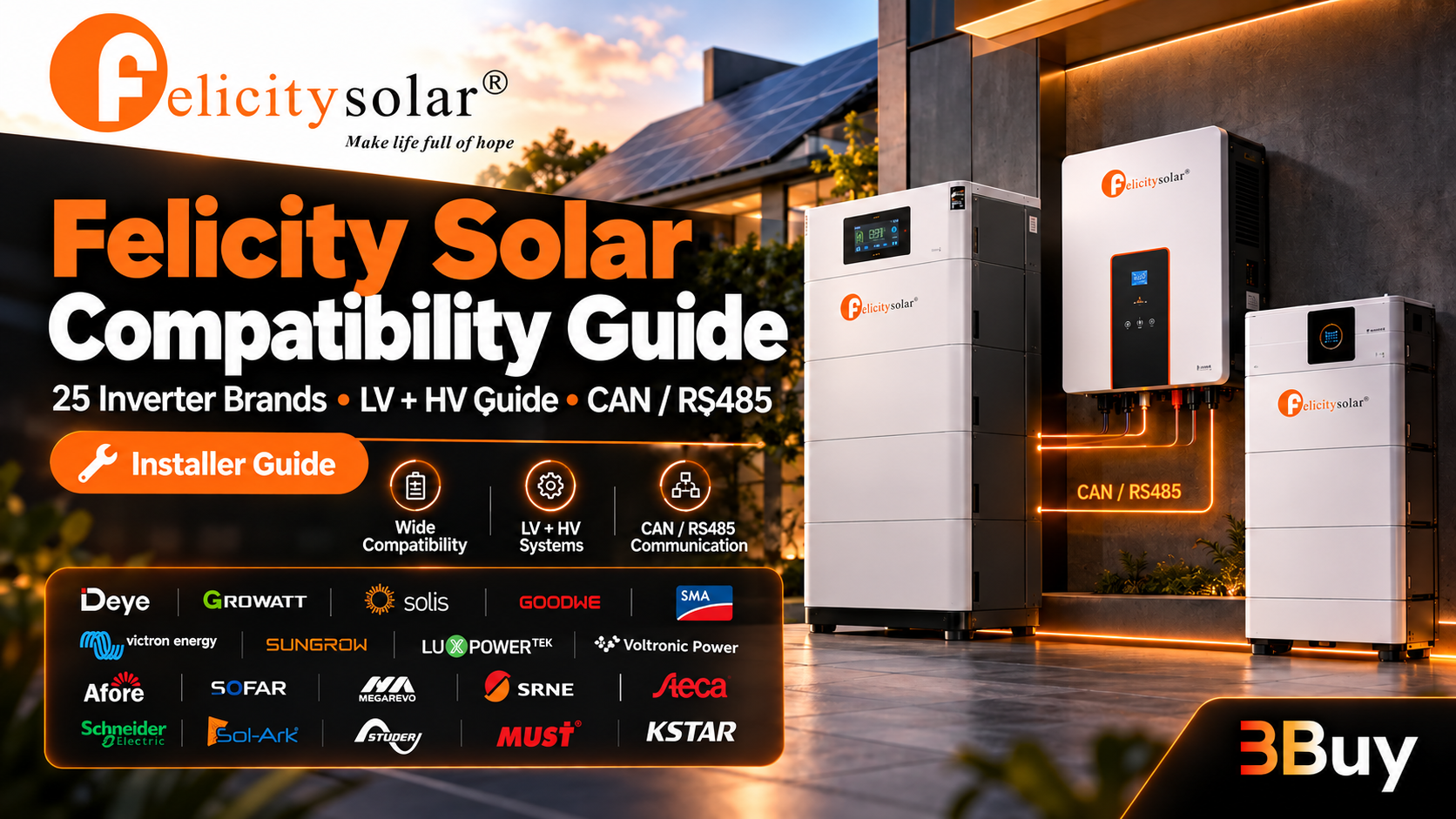
Does your solar inverter work with Felicity Solar batteries? The 2026 manufacturer compatibility list identifies 25 low-voltage inverter brands and nine high-voltage-compatible brands, including Deye, Growatt, Solis, GoodWe, SolaX, Victron, Sungrow, Solplanet and others. Here’s what professional installers need to know before connecting them.
Technical Guide by 3Buy™ Solar | Updated 11 October 2026 | Manufacturer compatibility chart dated 28 July 2026
Choosing a solar battery isn’t just about capacity, price or chemistry. One of the most important questions is whether the battery’s Battery Management System (BMS) can communicate correctly with the selected solar inverter.
A technically impressive 16kWh LiFePO4 battery is of little use in a professional installation if the hybrid inverter cannot correctly exchange battery information, manage charging limits or respond to protection conditions.
That’s why the 2026 Felicity Solar inverter compatibility list is important for installers, EPC contractors, solar wholesalers and battery energy storage buyers across Europe.
Felicity Solar’s manufacturer documentation identifies 25 inverter brands with low-voltage battery compatibility and nine brands with high-voltage battery compatibility, together with supported product families and CAN/RS485 communication requirements.
The list covers a wide range of residential solar storage, hybrid inverter, off-grid and selected commercial energy storage applications.
However, not every inverter from those brands is compatible, and a compatible low-voltage model does not automatically mean its high-voltage counterpart will work.
This guide provides the complete brand overview, named inverter models, battery-series distinctions, communication protocols and essential commissioning considerations.
Looking for equipment? Explore the Felicity Solar batteries and energy storage products available from 3Buy Solar.
Felicity Solar Compatible Inverters 2026: Quick Overview
The manufacturer’s compatibility document separates Felicity Solar battery systems into two main categories.
| Compatibility category | Manufacturer’s 2026 list |
|---|---|
| Low-voltage battery compatibility | 25 inverter brands |
| High-voltage battery compatibility | 9 inverter brands |
| Low-voltage battery families | LPBA, LPBF, FLA, LUX, FLS and FLB |
| High-voltage battery families | LUX-X, LUX-Y, HVC, FLH and FHU |
| Communication protocols | CAN, RS485 or both, depending on the listed inverter |
| Published chart revision date | 28 July 2026 |
| Primary applications | Residential PV storage, hybrid solar systems, off-grid installations and selected commercial BESS projects |
Important: The nine high-voltage inverter brands are also represented in the low-voltage list. This means the document names 25 distinct third-party inverter brands, not 34 separate manufacturers.
The chart establishes manufacturer-declared communication compatibility for specific inverter families. It does not replace model-level electrical checks, battery approval, firmware verification or national installation requirements.
1. Felicity Solar Low-Voltage Battery Compatibility: All 25 Inverter Brands
Felicity Solar’s low-voltage compatibility chart includes inverter manufacturers from residential hybrid, off-grid and battery inverter markets.
These systems generally operate with suitable low-voltage battery architectures such as 48V-class LiFePO4 battery packs.
The manufacturer’s 2026 document covers the following six battery families:
- LPBA Series — specifically identified with BMS V5 versions.
- LPBF Series — specifically identified with BMS V5 versions.
- FLA Series.
- LUX Series low-voltage battery packs.
- FLS Series.
- FLB Series.
The chart provides compatibility indications across these battery families for the specified inverter entries.
Complete Low-Voltage Felicity Solar Inverter Compatibility Table
| Inverter brand | Compatible inverter models or families identified in the chart | Communication |
|---|---|---|
| Voltronic Power | Selected InfiniSolar V IV TWIN and Axpert VM III/IV, MKS III/IV, MAX and MAX II models | RS485 |
| SRNE | Selected HF and HES inverter families listed in the manufacturer chart | RS485 |
| MPP Solar | Selected PIP-MT, PIP-MKX, PIP-MAX, PIP-MGX, PIP-MK and PIP-GK families | RS485 |
| Growatt | SPF 3500–5000 ES, SPF 6000 ES Plus, selected WIT 4–15K-HU and SPH 3–6KTL3 BH-UP models | CAN / RS485 |
| Luxpower | LXP 3.6/4.6/5K Hybrid, LXP 3600 ACS and selected LXP-LB-EU models | CAN / RS485 |
| Deye | Selected SUN-SG03LP1, SG04LP1, SG05LP1, SG04LP3 and SG05LP3 low-voltage hybrid inverter families | CAN / RS485 |
| Sunsynk | Selected SUNSYNK LP-series, SYNK 8/10/12K-SG04LP3 and Sunsynk MAX models | CAN / RS485 |
| Megarevo | Selected R-series low-voltage inverter models, including KLNA, KL1 and KH3 variants | CAN / RS485 |
| Solis | Selected S5-EH1P, S6-EH1P and S6-EH3P low-voltage energy storage inverters | CAN |
| INVT | iMars XD3–6KTL | CAN |
| Afore | AF(1–3.6)K-SL and AF(3–6)K-SL families | CAN |
| SOFAR | HYD 3000–6000-EP | CAN |
| AOHAI | AH-3–6KSL-G2 | CAN |
| Victron Energy | Manufacturer specifies communication via Victron Cerbo GX | CAN |
| CHISAGE ESS | Selected MARS-G1/G2-LE and JUP-G2-LE models | CAN |
| SolaX Power | X1-HYB-LV, X1-LITE-LV, X1-RENO-LV, X3-NEO-LV and identified OG models | CAN |
| Sol-Ark | Sol-Ark 15K-2P-N and selected 12K, 8K and 5K models | CAN |
| Hoymiles | HYS-7.6/9.6/11.5LV-USG1 and selected HIT-L-G3 inverters | CAN |
| Amensolar | N3H-X5/8/10-US | CAN |
| SAJ | H1 3–6kW S2 | CAN |
| Solplanet | ASW H-S2 Series | CAN |
| Shinemann | M5000CH-48BP | CAN |
| Sungrow | MG-5/6/8/10-RL Series | CAN |
| APstorage | ELS 3K/5K, ELT 10K/12K and EZHI families | CAN |
| GoodWe | GW5048D-ES, GW5000-SBP and GW3600-SBP | CAN |
Source: Felicity Solar Inverter Compatibility List, page 2, last updated 28 July 2026. Model references are summarised from the supplied chart; power ratings, regional suffixes and firmware variants must be checked against the complete manufacturer document.
What do these communication classifications mean?
The manufacturer uses three colour-coded indicators:
Red — RS485 only: The chart identifies Voltronic, SRNE and MPP Solar entries in this category.
Green — CAN and RS485: Growatt, Luxpower, Deye, Sunsynk and Megarevo appear with this classification.
Yellow — CAN only: The remaining 17 low-voltage brands, including SolaX, Solis, Victron, GoodWe, Sungrow and Solplanet, are classified under CAN communication.
These distinctions are essential for correct communication-port configuration and BMS integration.
A supported communication protocol does not mean any arbitrary RJ45 cable, inverter firmware or battery profile will work. The actual connector pinout and manufacturer settings must match.
2. Is a Felicity Solar Battery Compatible with Deye Inverters?
Yes. Felicity Solar lists selected Deye low-voltage and high-voltage hybrid inverter families as compatible.
However, the two groups must be considered separately.
Felicity Solar with Deye low-voltage inverters
The low-voltage chart includes several Deye inverter families, including selected:
- SUN-SG03LP1-EU single-phase models.
- SUN-SG04LP1-EU single-phase models.
- SUN-SG05LP1-EU models.
- SUN-SG04LP3-EU three-phase models.
- SUN-SG05LP3-EU-SM2 three-phase models.
These are low-voltage inverter families. They must be connected to a compatible low-voltage battery system using the appropriate manufacturer-supported communication configuration.
For example, a Deye hybrid installation requiring a larger 51.2V battery may be considered alongside compatible products such as the Felicity Solar FLB48314TG1-H 16kWh heated LiFePO4 battery, subject to exact inverter and battery approval.
What about Deye high-voltage systems?
The manufacturer also lists selected Deye SUN-SG01HP3 high-voltage models.
These require a high-voltage battery architecture and cannot be treated as interchangeable with low-voltage Deye LP-series inverters.
Before sourcing a battery for a Deye installation, verify whether the inverter is an LP (low-voltage) or HP (high-voltage) model.
Browse Deye hybrid inverters and energy storage equipment at 3Buy Solar.
3. Felicity Solar and Growatt: Which Inverter Models Are Listed?
Growatt appears in both the low-voltage and high-voltage Felicity Solar compatibility charts.
For low-voltage battery systems, the manufacturer’s list identifies selected Growatt SPF, WIT-HU and SPH BH-UP inverter families.
Examples include:
- SPF 3500–5000 ES.
- SPF 6000 ES Plus.
- Selected WIT 4–15K-HU models.
- SPH 3–6KTL3 BH-UP.
These inverter families are associated with different operating capabilities, installation configurations and markets.
Growatt high-voltage compatibility
For high-voltage batteries, Felicity Solar identifies:
- WIT 50–100K-HU.
- WIT 50–100K-H.
This creates a separate application area for larger commercial and industrial battery energy storage projects.
A Growatt WIT-HU model from the low-voltage chart must not be confused with a WIT-H or WIT-HU high-voltage commercial model simply because the product names look similar.
Review available Growatt inverters and energy storage solutions and confirm the exact model before specifying a Felicity battery.
4. Is Felicity Solar Compatible with SolaX? An Important Model-Level Distinction
Yes, but only specific SolaX low-voltage inverter families are named in the supplied 2026 chart.
The manufacturer identifies:
| SolaX inverter family | Stated power range or rating |
|---|---|
| X1-HYB-LV | 3–6kW |
| X1-LITE-LV | 8–12kW |
| X1-RENO-LV | 8kW |
| X3-NEO-LV | 5–20kW |
| OG | 5kW / 6kW |
These models are listed under the Felicity Solar low-voltage battery compatibility section with CAN communication.
Is Felicity Solar compatible with the SolaX X3-Hybrid G4?
The supplied chart does not identify the SolaX X3-Hybrid G4 as a compatible inverter.
This distinction is important.
The standard X3-Hybrid G4 is a high-voltage battery inverter platform, whereas the SolaX entries shown in Felicity Solar’s low-voltage compatibility matrix concern different inverter families.
Furthermore, SolaX is not among the nine brands named in the document’s high-voltage Felicity Solar table.
That does not prove every possible integration is technically impossible. It means the supplied compatibility documentation does not establish an approved X3-Hybrid G4 combination.
Installers should therefore obtain written confirmation from both manufacturers before specifying a Felicity battery with this particular SolaX inverter.
Explore the SolaX Power inverter and storage catalogue for the relevant manufacturer-approved solutions.
Installer warning: Never substitute an X3-Hybrid G4 for a listed X3-NEO-LV merely because both are SolaX three-phase hybrid inverter products.
5. Felicity Solar with Victron, Solis, GoodWe and Solplanet
Several other popular inverter brands require specific attention.
Felicity Solar and Victron Energy
Victron is included in the low-voltage compatibility table.
Rather than listing a single conventional hybrid inverter model, the chart specifically instructs installers to use a Victron Cerbo GX device to ensure communication with the Felicity battery.
This is a significant implementation detail for installers working with Victron inverter/charger and energy management systems.
A Cerbo GX is a communication and control device, not a universal guarantee that every Victron power-conversion configuration is approved.
Installers should verify the selected Victron inverter/charger, GX software, battery profile, CAN connection and DVCC-related operating requirements.
Felicity Solar and Solis
Solis appears in both manufacturer tables.
Selected Solis S5 and S6 low-voltage energy storage inverter families are listed for low-voltage Felicity batteries.
The high-voltage list separately includes selected S6-EH3P-H-EU and S6-EH3P-ND-H inverter families.
Correct identification of the Solis inverter’s battery voltage class is essential.
Felicity Solar and GoodWe
GoodWe appears in the low-voltage table with models such as GW5048D-ES, GW5000-SBP and GW3600-SBP.
The high-voltage table includes selected GoodWe ET-family models.
These are different battery interfaces and must not be treated as interchangeable.
Felicity Solar and Solplanet
The manufacturer lists the Solplanet ASW H-S2 Series under low-voltage compatibility.
This should not be interpreted as confirmation for every Solplanet ASW hybrid inverter or high-voltage AP-H battery architecture.
Installers must check the exact inverter model and applicable Felicity communication settings.
6. Felicity Solar High-Voltage Compatibility: All 9 Inverter Brands
For larger residential, commercial and industrial solar battery systems, Felicity Solar provides a separate high-voltage compatibility chart.
The 2026 document identifies five high-voltage battery product groups:
- LUX-X-96050HG01.
- LUX-Y-48100HG01.
- HVC96050.
- FLH Series.
- FHU Series.
The manufacturer provides compatibility indicators across the listed high-voltage battery groups and nine inverter brands.
Complete Felicity Solar High-Voltage Inverter Compatibility Table
| Inverter manufacturer | High-voltage inverter models identified by Felicity Solar |
|---|---|
| Growatt | WIT 50–100K-HU; WIT 50–100K-H |
| Deye | SUN-(6–20)K-SG01HP3-EU-AM2; SUN-(25–50)K-SG01HP3-EU-BM2/3/4 |
| Sunsynk | SUNSYNK-30K-SG01HP3-EU-BM3; SUNSYNK-50K-SG01HP3-EU-BM4 |
| Megarevo | R(6–15K)H3 |
| Solis | S6-EH3P(5–10K)-H-EU; S6-EH3P(12–20K)-H-EU; S6-EH3P(12–20K)-ND-H |
| INVT | iMars XD5–12KTR |
| Afore | AF(3–30)K-TH; AF(3–12)K-THP |
| SOFAR | HYD 5–20KTL-3PH |
| GoodWe | GW(5–30)K-ET; GW5/6.5/8/10KN-ET |
Source: Felicity Solar Inverter Compatibility List, page 3, 28 July 2026.
The current chart marks the high-voltage combinations in green, which its legend identifies as RS485/CAN compatibility.
Nevertheless, the exact approved interface, communication settings, cable arrangement and firmware must be confirmed for the chosen inverter and battery model.
Which high-voltage Felicity batteries can installers purchase?
For professional solar PV and C&I storage projects, 3Buy Solar lists several high-voltage FLH-based configurations.
| Battery system | Nominal storage capacity | Nominal system voltage | Installation application |
|---|---|---|---|
| Felicity Solar FLH system | 20.48kWh | 204.8V | Larger residential and small commercial storage |
| Felicity Solar FLH system | 40.96kWh | 409.6V | Commercial and industrial energy storage |
| Felicity Solar FLH system | 61.44kWh | 614.4V | Higher-capacity C&I storage projects |
These systems use multiple Felicity FLH battery modules with the appropriate system-level BMS architecture.
Explore the available configurations:
- Felicity Solar 20.48kWh high-voltage LiFePO4 battery system.
- Felicity Solar 40.96kWh high-voltage commercial battery system.
- Felicity Solar 61.44kWh high-voltage commercial battery system.
Important: The compatibility chart alone does not confirm that every inverter listed can operate with every available FLH battery stack size. Battery operating voltage, minimum module quantity and inverter input limits must be evaluated for the final configuration.
7. CAN vs RS485: Why Battery-Inverter Communication Matters
A compatible battery and hybrid inverter need to exchange more than simple electrical power.
The Battery Management System monitors battery conditions and communicates information required for controlled charging, discharging and fault management.
Depending on the equipment and protocol, this may include:
- Battery state of charge (SOC).
- Battery voltage and current.
- Permitted charging and discharging limits.
- Temperature information.
- Warning and fault conditions.
- Battery availability and operational status.
Two communication interfaces are particularly common in residential and commercial energy storage: CAN and RS485.
CAN communication
CAN is frequently used for communication between lithium battery management systems and hybrid inverters.
It allows equipment to exchange structured messages under a manufacturer-defined communication profile.
However, CAN itself does not establish software compatibility.
Two devices may both have CAN ports but use different message structures or unsupported battery protocols.
RS485 communication
RS485 is a differential serial communication interface used across many power electronics, metering and battery systems.
It can provide reliable communication in correctly engineered installations.
As with CAN, sharing the same electrical interface does not mean two products necessarily support the same higher-level communication protocol.
Which protocol should you choose?
Use the protocol explicitly approved for the battery, inverter, BMS and firmware combination.
For Felicity Solar’s July 2026 chart, the classification is:
| Classification | LV inverter brands |
|---|---|
| RS485 only | Voltronic, SRNE, MPP Solar |
| CAN and RS485 | Growatt, Luxpower, Deye, Sunsynk, Megarevo |
| CAN only | Solis, INVT, Afore, SOFAR, AOHAI, Victron, CHISAGE ESS, SolaX, Sol-Ark, Hoymiles, Amensolar, SAJ, Solplanet, Shinemann, Sungrow, APstorage, GoodWe |
In all cases, confirm the exact communication cable, port allocation and BMS settings using the applicable documentation.
An RJ45 connector is only a physical connector format. The same-looking cable can carry different signals depending on the equipment and pin assignment.
8. Choosing a Felicity Solar Low-Voltage Battery: 5.12kWh to 23.55kWh
For many residential energy storage installations, the low-voltage battery choice depends on energy consumption, required backup duration, inverter battery current and the available installation space.
Different Felicity Solar products offer different nominal capacities and mechanical designs.
Felicity Solar 5.12kWh Battery
The Felicity Solar FLB48100WG1-H 5.12kWh LiFePO4 battery uses a 51.2V nominal low-voltage architecture.
This capacity can be relevant to smaller residential systems or approved expandable battery arrangements.
However, installers should verify whether one battery can deliver the charging and discharging current required by the chosen inverter.
Felicity Solar 11.7kWh Battery
The Felicity Solar FLB48230WG1-H 11.7kWh battery provides approximately 11.7kWh nominal energy within a 51.2V, 230Ah battery pack.
It is relevant to residential projects requiring greater storage capacity without necessarily installing several smaller battery packs.
Felicity Solar 16kWh Battery
The Felicity Solar FLB48314TG1-H 16kWh heated IP65 battery combines 51.2V nominal voltage with a 314Ah nominal capacity.
Its product documentation lists a smart BMS, CAN/RS485 communication and a heated design, making it relevant to appropriately configured residential and light-commercial projects.
Another available option is the Felicity Solar FLA48314-EU 16kWh LiFePO4 battery.
These products share a broadly similar energy-capacity class but should not be treated as technically identical.
Felicity Solar 23.55kWh Battery
For larger residential demand profiles and selected small commercial storage applications, installers can also evaluate the Felicity Solar FLA48460TG2-EU 23.55kWh battery.
Its 51.2V nominal voltage and 460Ah capacity place it in the high-capacity low-voltage battery category.
Although its energy capacity is relatively large, it remains a low-voltage system and must be paired with an appropriate inverter battery interface.
Battery sizing: kWh is not the whole specification
When selecting a battery, compare both energy capacity and power delivery.
A 16kWh battery does not automatically deliver 16kW continuously.
Battery power depends on its voltage, permitted continuous discharge current, BMS limits and operating conditions.
For example, a nominal 51.2V battery operating at 100A corresponds to approximately 5.12kW of DC power at that operating point, before conversion losses.
Installers must therefore consider:
- Nominal and usable battery capacity.
- Continuous and peak charge/discharge current.
- Inverter battery-voltage range.
- Battery quantity and parallel connection limits.
- Required backup autonomy.
- Daily cycling and expected solar surplus.
- Battery heating and installation environment.
- Firmware and BMS compatibility.
Browse the wider low-voltage solar battery category for additional residential storage options.
9. Low-Voltage vs High-Voltage Felicity Solar Batteries: Which Is Better?
Neither voltage architecture is universally superior.
The appropriate choice depends on inverter design, electrical requirements, project scale and the battery manufacturer’s approved configuration.
| Design factor | Low-voltage storage | High-voltage storage |
|---|---|---|
| Typical battery architecture | 48V/51.2V-class systems | Higher-voltage series-connected systems |
| Common applications | Homes, off-grid installations, backup systems | Larger homes, three-phase storage and commercial systems |
| Main procurement concern | High battery current, cabling, busbars and parallel design | Module stacking, BMS coordination, voltage range and HV safety |
| Compatible inverter | Approved LV battery inverter | Approved HV battery inverter |
| Expansion | Model-dependent parallel battery configurations | Model-dependent modular HV stacking or rack configurations |
| Suitable Felicity families in the chart | LPBA, LPBF, FLA, LUX LV, FLS, FLB | LUX-X, LUX-Y, HVC, FLH, FHU |
High-voltage systems can reduce current for a given power level, which may be useful in larger installations.
Low-voltage systems, meanwhile, are common in residential backup and off-grid applications, especially where the selected inverter is designed for a 48V-class battery.
Never connect a 51.2V low-voltage battery pack directly to an inverter requiring a high-voltage battery system.
Also note that an individual 51.2V FLH battery module may form part of a complete high-voltage stack. Its module-level voltage does not make it a standalone low-voltage battery compatible with a 48V hybrid inverter.
For larger projects, review high-voltage solar batteries for professional PV systems.
10. How to Verify Felicity Solar Inverter Compatibility Before Installation
The manufacturer compatibility list should be the beginning of the technical approval process, not the only document used.
A professional installer should confirm the following information before ordering equipment.
Step 1: Identify the exact inverter
Record the complete inverter model number, including any regional suffix and hardware revision.
For example, the Deye SUN-SG04LP3 and SUN-SG01HP3 families are not interchangeable battery platforms.
Step 2: Identify the exact Felicity battery
Record the complete Felicity Solar battery model, product series, nominal capacity and battery voltage.
For LPBA and LPBF batteries, pay particular attention to the BMS version, because the July chart explicitly identifies V5 versions.
Step 3: Confirm the battery voltage window
Compare the inverter’s permitted battery voltage range with the battery system’s full operating voltage range.
Do not rely solely on nominal voltage.
Step 4: Verify the CAN or RS485 communication configuration
Obtain the relevant communication guidance for the exact inverter and battery combination.
Verify the communication port, connector, pinout, supported protocol and settings.
Step 5: Check BMS and inverter firmware
Firmware can influence battery recognition, charging limits, operating modes and alarm handling.
An older system already installed at a customer’s site may need additional verification even where the product family appears in a newer compatibility list.
Step 6: Confirm charging and discharging power
Ensure the battery’s continuous current rating can support the intended inverter operation.
Where several batteries are connected in parallel, use the manufacturer’s approved combiner, busbar, protection and communications architecture.
Step 7: Check backup and grid requirements
Battery communication approval does not by itself establish correct EPS operation or local grid compliance.
Verify transfer switching, protection, neutral and earthing arrangements, metering, export restrictions and applicable distribution-network requirements.
Step 8: Obtain written model-level confirmation
For projects involving unusual battery combinations, existing inverter hardware, older firmware or commercial-scale storage, request written compatibility confirmation from Felicity Solar and the inverter manufacturer.
This is particularly important where the manufacturer’s published tables differ or where a proposed model is not explicitly named.
11. Common Felicity Solar Compatibility Mistakes to Avoid
Mistake 1: Assuming every inverter from a listed brand is compatible
The chart identifies particular inverter models and families. It does not certify the entire catalogue of each manufacturer.
Mistake 2: Confusing low-voltage and high-voltage battery systems
An inverter brand may appear in both lists, but the supported model families and battery architectures are different.
Mistake 3: Using the wrong communications cable
CAN and RS485 interfaces require the correct electrical connections and supported communication settings. An RJ45 connector alone does not guarantee compatibility.
Mistake 4: Ignoring the BMS revision
The manufacturer explicitly references BMS V5 for the LPBA and LPBF series. An earlier BMS version must not automatically be treated as equivalent.
Mistake 5: Confusing nominal capacity with discharge power
Battery energy capacity in kWh and power in kW are different quantities. Both are essential to correct inverter sizing.
Mistake 6: Assuming a listed compatibility pairing guarantees warranty acceptance
A manufacturer compatibility matrix is useful technical evidence, but actual warranty conditions may depend on approved settings, installation practices and product revisions.
Confirm support and warranty terms for the specific pairing before procurement.
Mistake 7: Assuming every combination provides full backup power
Battery communication compatibility does not establish EPS capability, off-grid operation or whole-building backup.
Those functions depend on the inverter, system design and protective equipment.
12. Felicity Solar Battery Procurement for European Installers and EPC Contractors
For professional solar installers, solar wholesalers, solar distributors and EPC contractors, battery compatibility affects the entire procurement process.
An energy storage installation may require much more than the solar battery itself.
Depending on the architecture, the complete bill of materials can include:
- Approved Felicity Solar LiFePO4 battery modules or battery packs.
- A compatible hybrid solar inverter or battery inverter.
- Approved battery management and communications equipment.
- Battery racks, mounting kits and expansion hardware.
- DC circuit protection and battery disconnect arrangements.
- Correctly sized battery cables and terminals.
- Smart meter, CTs and monitoring accessories.
- EPS or backup transfer equipment where required.
- System-level documentation, certificates and commissioning records.
For modular systems, confirm whether the quoted product is a complete battery system or only one battery module.
A high-voltage FLH battery module, for example, should not be confused with a complete FLH storage stack including all required BMS and rack components.
3Buy Solar provides access to Felicity Solar battery storage products, battery BMS and controllers and broader energy storage systems with inverter.
For commercial procurement, request a complete system quotation based on the final inverter model and battery configuration—not simply a battery capacity in kWh.
Frequently Asked Questions About Felicity Solar Battery Compatibility
Which inverter brands are compatible with Felicity Solar batteries?
The July 2026 Felicity Solar document identifies 25 inverter brands in its low-voltage compatibility table. These include Deye, Growatt, GoodWe, Solis, SolaX, Victron, Luxpower, Sunsynk, Solplanet, Sungrow, SOFAR, Hoymiles and others. A separate high-voltage table names nine brands.
Are Felicity Solar batteries compatible with Deye?
Yes, selected Deye low-voltage SG03/SG04/SG05 LP families and selected high-voltage SG01HP3 models appear in the manufacturer document. The exact battery and inverter model combination must still be checked.
Can a Felicity Solar battery work with a Growatt inverter?
Yes, selected Growatt SPF, WIT and SPH models appear in the low-voltage list. Specific Growatt WIT 50–100kW models also appear in the high-voltage list.
Does Felicity Solar work with SolaX hybrid inverters?
The 2026 low-voltage table lists selected X1-HYB-LV, X1-LITE-LV, X1-RENO-LV, X3-NEO-LV and OG models. It does not confirm blanket compatibility with every SolaX hybrid inverter.
Is the SolaX X3-Hybrid G4 compatible with Felicity Solar batteries?
The supplied Felicity Solar compatibility chart does not list the standard SolaX X3-Hybrid G4. Written manufacturer confirmation is required before treating such a combination as approved.
Are Felicity Solar batteries compatible with Victron?
The manufacturer’s low-voltage list includes Victron and specifically identifies the Victron Cerbo GX as necessary for successful communication. The exact inverter/charger, battery profile and GX configuration must be verified.
Which Felicity Solar batteries are low-voltage?
The July 2026 matrix covers LPBA, LPBF, FLA, low-voltage LUX, FLS and FLB battery series. The exact operating voltage depends on the individual battery model.
Which Felicity Solar batteries are high-voltage?
The high-voltage matrix lists LUX-X-96050HG01, LUX-Y-48100HG01, HVC96050, FLH and FHU product groups.
Is Felicity Solar compatible with GoodWe ET inverters?
Selected GoodWe ET high-voltage inverter models appear in the July 2026 list, including the GW(5–30)K-ET family and named residential ET variants. Exact inverter voltage range and firmware compatibility must be verified.
What is the difference between CAN and RS485 battery communication?
CAN and RS485 are different electrical communication interfaces. The inverter and battery must support a compatible higher-level communication protocol, connection pinout and configuration. A shared connector type is not enough.
Can a Felicity Solar battery communicate with an inverter without CAN or RS485?
Some systems may offer alternative operating modes, but the July compatibility chart specifically addresses the indicated communication interfaces. It does not establish approval for an unsupported or open-loop connection.
Can I mix different Felicity Solar battery models in parallel?
Only where the battery manufacturer explicitly permits the combination. Different capacities, BMS generations or product series should not be mixed solely because they have the same nominal voltage.
What documents should installers request before commissioning?
At minimum, obtain the exact inverter and battery datasheets, installation manuals, communication/pinout instructions, the applicable compatibility confirmation, safety and conformity documents, warranty terms and any required national grid-connection evidence.
Is the 2026 Felicity Solar compatibility list valid for every European country?
The chart describes electrical communication compatibility. It does not confirm grid-code approval or installation legality in every country. National electrical rules and distribution-network requirements must be assessed separately.
Final Verdict: Felicity Solar Compatibility Is Broad, but the Exact Inverter Model Matters
The July 2026 Felicity Solar compatibility list provides a useful technical foundation for professional solar battery procurement.
It names 25 inverter brands for low-voltage battery systems and nine brands for high-voltage applications, with clear distinctions between RS485, CAN and dual-protocol support.
This makes the document particularly relevant to installers specifying systems involving Deye, Growatt, Solis, GoodWe, Victron, SolaX, Solplanet and other inverter platforms.
However, the most important conclusion is not the number of supported brands.
A Felicity Solar battery is only a suitable procurement choice when the exact battery, inverter, BMS, firmware and electrical configuration have been verified together.
For residential installations, that may mean selecting a suitable 5.12–23.55kWh low-voltage battery pack and confirming its communication configuration with the chosen hybrid inverter.
For commercial and industrial projects, it may involve a properly engineered high-voltage FLH system, with the required number of modules, suitable BMS architecture, compatible inverter and installation-specific documentation.
Professional installers should use the manufacturer compatibility chart to shortlist options, then complete the model-level checks before placing an order.
Buy Felicity Solar Batteries and Energy Storage Systems from 3Buy Solar
3Buy™ Solar supplies solar batteries, hybrid solar inverters, battery storage components and complete solar PV kits for professional installers, electricians, EPC contractors, resellers and approved trade buyers across Europe.
Our Felicity Solar product range includes low-voltage LiFePO4 batteries, high-voltage storage configurations, battery modules and system accessories.
For an accurate technical quotation, provide:
- Installation country.
- Exact hybrid inverter manufacturer and model.
- Required low-voltage or high-voltage battery architecture.
- Required nominal and usable storage capacity.
- Backup power requirements.
- Existing inverter and battery firmware details, where applicable.
- Required installation accessories and project delivery schedule.
Explore Felicity Solar Batteries and Energy Storage Products at 3Buy Solar
Manufacturer Documentation and Technical Resources
- Felicity Solar Official Download Centre
- Felicity Solar Low-Voltage Inverter Matching List
- Felicity Solar CAN Communication Guidance for SolaX
- Felicity Solar High-Voltage Battery Matching List
- 3Buy Solar Felicity Solar Product Catalogue
Technical source: Felicity Solar, Inverter Compatibility List, three-page chart supplied for this article, last updated 28 July 2026. The model and protocol tables above are based on pages 2–3. The product capacity examples and commercial product links are drawn separately from the corresponding 3Buy Solar product listings.
Editorial disclaimer: This guide reports manufacturer-declared inverter communication compatibility; it does not represent independent system testing or unconditional approval by both equipment manufacturers. Compatibility may depend on exact model, firmware, BMS version, voltage range, communications wiring, battery stack configuration and national installation requirements. Always obtain current written manufacturer confirmation where required.