EV Accessories and Mounting


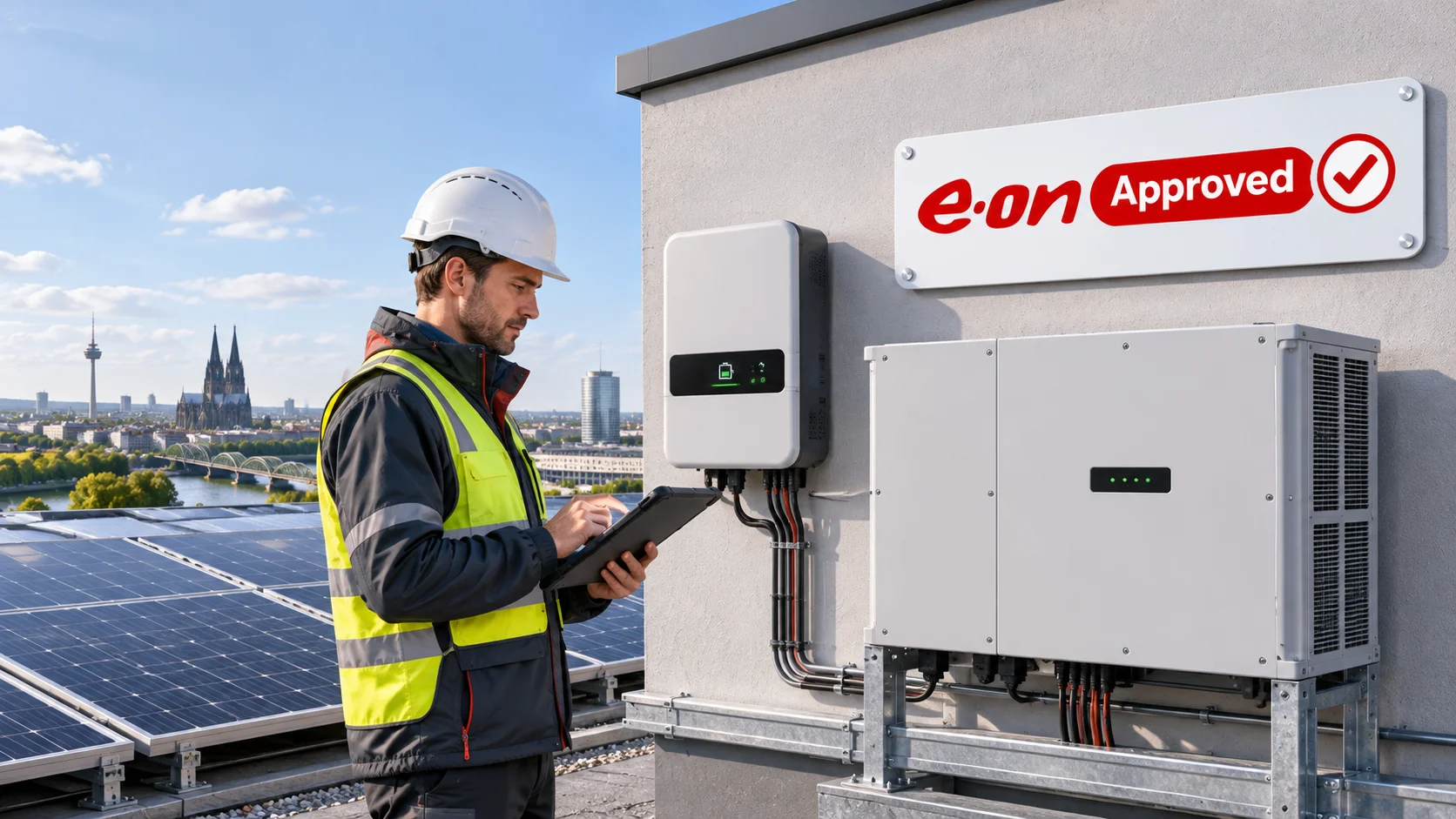

E.ON-Approved Solar Inverters in Europe: Grid-Tied, Hybrid & Commercial Inverter Guide 2026
A technical and procurement guide for solar installers, EPC contractors, electrical engineers and energy storage professionals.
Selecting a solar inverter for a European installation involves more than choosing the correct AC output power, number of MPPTs or battery compatibility. Before an inverter can be connected to the electricity grid, it must satisfy the technical requirements of the relevant country and distribution system operator (DSO).
For installers working on E.ON-connected networks, this often leads to one question:
Which grid-tied, hybrid and commercial solar inverters are approved for E.ON grid connection?
The answer depends on the installation country, network operator, exact inverter model, applicable grid code and connection conditions.
In Hungary, E.ON publishes a list of inverter models applicable to household-scale power generation systems, known as HMKE. In Germany, grid connection relies on technical application rules such as VDE-AR-N 4105 and the relevant network operator’s connection requirements. Other European markets have their own certification and approval procedures.
There is no single E.ON inverter approval that automatically authorises an inverter throughout Europe.
This guide explains how to interpret E.ON inverter acceptance, select suitable equipment, verify manufacturer documentation and procure grid-tied, hybrid and commercial solar inverter systems for European projects.
For equipment selection and B2B procurement, explore the 3Buy Solar inverter wholesale catalogue.
1. What Does “E.ON-Approved Solar Inverter” Actually Mean?
An E.ON-approved solar inverter generally refers to a specific inverter model accepted for connection under the requirements of an applicable E.ON-affiliated electricity distribution network.
However, the meaning of approval is not identical across European countries.
In particular, three different concepts must not be confused:
| Approval or compliance status | What it establishes | What it does not establish |
|---|---|---|
| CE marking and applicable EU product conformity | Manufacturer responsibility for compliance with applicable EU product legislation | Automatic permission to connect to a particular electricity network |
| Grid-code certification | Evidence that the equipment meets specified electrical network requirements | Automatic approval for every installation or country |
| DSO acceptance or connection authorisation | Acceptance under a particular operator’s rules or for a specific installation | Approval by every other European DSO |
An inverter can therefore be CE-marked and supported by an EN 50549 test certificate without automatically being eligible for connection to every E.ON network.
Equally, inclusion on a national inverter list does not remove the requirement to obtain the necessary installation-specific grid connection authorisation.
The difference between an approved inverter and an approved installation
This distinction is particularly important for professional EPC contractors.
Inverter eligibility concerns the equipment itself: its manufacturer, model designation, firmware or configuration where relevant, electrical protection functions and supporting documentation.
Installation approval concerns the actual generating system: the connection point, installed capacity, grid impact, protection arrangement, export limits and compliance with the local network operator’s conditions.
A suitable inverter is a prerequisite for many projects, but not the entire approval process.
2. E.ON-Approved Grid-Tied, Hybrid and Commercial Inverters: Understanding the Differences
The terms grid-tied inverter, hybrid inverter and commercial inverter describe equipment functions and application areas. They do not represent three separate, Europe-wide E.ON approval schemes.
Grid-tied solar inverters
A grid-tied solar inverter, also called a grid-connected or string inverter, converts direct current from solar PV modules into alternating current synchronised with the electricity network.
Its principal functions include:
- Maximum power point tracking (MPPT) for PV generation.
- DC-to-AC power conversion.
- Monitoring of grid voltage and frequency.
- Anti-islanding protection.
- Active and reactive power control where required.
- Export limitation when configured with compatible monitoring or control equipment.
Conventional grid-tied inverters generally disconnect from the network during a grid outage and do not independently supply backup power.
They are widely used for residential installations, agricultural buildings, commercial rooftops and industrial PV projects.
Explore: Grid-tied and string solar inverters at 3Buy Solar.
Hybrid solar inverters
A hybrid solar inverter combines grid-connected PV conversion with functionality for integrating a compatible battery energy storage system.
Depending on the inverter design, it may support battery charging and discharging, self-consumption optimisation, time-of-use operation, export control and backup power.
The presence of battery connections does not automatically mean that full-building backup is available.
The installer must verify:
- Approved battery compatibility.
- Battery voltage range and BMS communication.
- Available backup or EPS output.
- Whether an external backup box, changeover device or isolation arrangement is required.
- Neutral and earthing arrangements during backup operation.
- Maximum backup power and permissible load imbalance.
- Applicable DSO requirements for parallel and island operation.
For E.ON Hungary, the official inverter list includes information distinguishing hybrid functionality and suitability for island operation, including the type of isolation arrangement where applicable.
Explore: Hybrid solar inverters for professional installers.
Commercial and industrial solar inverters
Commercial and industrial (C&I) solar inverters are designed for larger installations, often with higher power ratings, multiple MPPT inputs, expanded monitoring functions and more demanding grid-support requirements.
Typical applications include:
- Warehouses and logistics centres.
- Manufacturing plants.
- Agricultural and food-processing facilities.
- Commercial buildings and retail centres.
- Industrial rooftop PV systems.
- Ground-mounted commercial solar projects.
For commercial projects, the electrical connection design may involve additional studies, external protection relays, power quality assessment, remote control, reactive power requirements and dedicated monitoring infrastructure.
A 100 kW commercial inverter should not be treated as an ordinary residential inverter merely because the manufacturer supplies the same range of grid-compliance certificates.
Explore: Commercial solar inverters for EPC and C&I projects.
Battery power conversion systems (PCS)
Commercial battery energy storage systems may use a dedicated power conversion system rather than a conventional PV hybrid inverter.
A PCS manages energy conversion between the battery system and the AC network. Depending on the system, it may support peak shaving, load shifting, demand management and grid services.
For grid connection, the applicable rules may differ from those governing conventional PV generating units. These requirements must be established for the relevant country and connection point.
Importantly, approval of a PCS does not automatically certify the battery modules, battery management system, enclosure or complete energy storage installation.
3. European Grid-Connection Requirements: Why One Approval Is Not Enough
Europe has a common regulatory framework for grid-connected generation, but implementation remains dependent on national requirements and network operators.
An important legal foundation is Commission Regulation (EU) 2016/631, commonly known as the Requirements for Generators (RfG) network code.
The RfG framework establishes requirements for generating modules connecting to electricity networks. National rules and operator-specific technical conditions define how relevant requirements are implemented.
EN 50549 and inverter grid compliance
EN 50549 is an important European standards series relating to generating plants connected in parallel with distribution networks.
In general:
- EN 50549-1 addresses requirements relevant to generating plants connected to low-voltage distribution networks.
- EN 50549-2 addresses requirements relevant to generating plants connected to medium-voltage distribution networks.
The exact applicable edition, national settings and additional requirements must be checked for each project.
For installers, a document referencing EN 50549 is useful evidence of technical conformity. It is not a substitute for the country-specific certificate or connection approval required by the receiving network operator.
Safety and product compliance
Depending on the equipment and its application, the supporting technical documentation may also reference:
- IEC/EN 62109-1 and IEC/EN 62109-2 for relevant inverter safety requirements.
- Applicable electromagnetic compatibility requirements.
- Anti-islanding testing and protection requirements.
- Grid-code-specific voltage and frequency response characteristics.
- Applicable protection and installation standards.
The manufacturer must provide documentation relevant to the actual model and market.
Installer rule: Always request the certificate for the precise inverter model, not simply a certificate for the manufacturer’s brand or a similar product family.
4. E.ON-Approved Inverters in Hungary: HMKE and FEAK Requirements in 2026
Hungary is one of the most important markets in which installers actively search for an E.ON-approved inverter list.
E.ON Hálózat publishes the official document:
HMKE-kben alkalmazható inverterek listája — List of Inverters Applicable in Household-Scale Power Generation Systems
View the official E.ON Hungary inverter list (PDF)
HMKE is the Hungarian category for household-scale power generation installations, generally covering systems with a nominal capacity of up to 50 kVA under the applicable legal definition.
The E.ON list is particularly relevant when designing residential solar PV installations and smaller eligible commercial or agricultural systems connected under HMKE arrangements.
What information does the E.ON Hungary list contain?
Depending on the current document version, installers can find information including:
| Field | Why installers need it |
|---|---|
| Manufacturer | Identifies the approved equipment manufacturer |
| Exact inverter model | Enables precise product matching |
| Nominal AC apparent power | Supports connection and capacity assessment |
| Number of phases | Indicates single-phase or three-phase connection |
| Nominal phase current | Helps establish electrical design requirements |
| Required connection capacity | Supports the assessment of the available electrical connection |
| Hybrid functionality | Identifies models classified as hybrid |
| Island operation and isolation information | Helps determine supported backup arrangements |
| Time restrictions | Identifies applicable expiry dates or limitations |
E.ON has combined its previously separate lists of conventional and hybrid inverters into a unified document, with specific columns distinguishing their functions.
The major change in 2026: FEAK compliance
In 2026, inverter selection in Hungary became more closely linked to the requirements of the Független Energetikai Adatközpont (FEAK).
FEAK is responsible for the national data-collection arrangements applicable to household-scale electricity generation under Hungarian law.
For manufacturers, the relevant framework includes an obligation to establish the required data connection with FEAK.
The data concerned can include production information and other inverter operating measurements.
From 1 August 2026, inverter models without the required FEAK compliance cannot be used for new HMKE applications or inverter modification applications under the published transition rules.
Applications submitted before the transition deadline may fall under the previous arrangements, while already approved and commissioned installations are not automatically invalidated by the change.
This is why an inverter appearing in an older E.ON-approved inverter list is not sufficient evidence for a new installation in November 2026.
Professional installers should verify the current applicable list and the manufacturer’s FEAK compliance status before issuing a binding quotation or ordering equipment.
Official reference: FEAK information for inverter manufacturers.
How to verify a solar inverter for an E.ON-connected installation in Hungary
- Open the current official E.ON inverter list.
- Check the effective date shown in the document.
- Find the exact manufacturer and model designation.
- Confirm that the model appears in the applicable section, not a section identifying non-compliant or expired equipment.
- Verify the AC apparent power, phase configuration and any stated restrictions.
- For hybrid inverters, review the island-operation and isolation information.
- Confirm FEAK compliance and obtain the documentation required for the application.
- Complete the DSO connection process before commissioning.
Where a product is not clearly identifiable, obtain confirmation from the manufacturer or the responsible network operator before treating it as acceptable.
Does E.ON inverter approval cover the complete solar battery system?
No.
E.ON’s own explanatory material makes an important distinction for integrated energy storage equipment: the assessment concerns the energy-conversion component, such as the inverter, converter or PCS.
That assessment does not automatically extend to the battery cells, battery management system or other parts of an integrated ESS.
For example, when supplying an all-in-one battery energy storage system, an EPC contractor must separately verify battery safety, system compatibility, protection arrangements and all applicable installation requirements.
This matters especially for complete hybrid solar PV kits with backup functionality.
5. E.ON Grid Connection and Inverter Certification Across Europe
When distributing solar inverters across European markets, procurement teams should avoid applying Hungarian inverter-list status to other countries.
The following overview highlights the primary grid-compliance frameworks installers are likely to encounter.
| Country | Main grid-connection framework or verification route | Installer priority |
|---|---|---|
| Hungary | Applicable DSO inverter lists, Hungarian distribution requirements and FEAK compliance for relevant HMKE installations | Verify exact model and current FEAK status |
| Germany | VDE-AR-N 4105:2026-03 for applicable low-voltage generation, other applicable VDE rules, local DSO requirements and ZEREZ documentation | Match certification, registry data and connection design |
| Poland | NC RfG implementation, PTPiREE certification lists and DSO requirements | Check the transition to certification procedures under version 1.3 |
| Sweden | National network requirements and DSO review, supported by Rikta Rätt information | Obtain confirmation from the receiving DSO |
| Czech Republic | National distribution network connection rules and the relevant operator’s procedures | Confirm requirements for the specific distribution area |
| Romania | ANRE framework and applicable distribution operator requirements, including those of Delgaz Grid where relevant | Check national documentation and the actual operator |
| Austria | E-Control’s Technical and Organisational Rules (TOR) and local DSO requirements | Use appropriate Austrian grid settings and proof of conformity |
| Italy | CEI 0-21 or CEI 0-16 as applicable, plus connection operator requirements | Confirm the voltage level and appropriate conformity documents |
| United Kingdom | Engineering Recommendations G98/G99 and the relevant distribution network operator’s process | Confirm G98/G99 applicability and connection permission |
This table is a technical starting point, not a substitute for current national regulations.
Germany: VDE-AR-N 4105:2026-03
Germany introduced a revised version of VDE-AR-N 4105 in 2026.
For suitable low-voltage generating plants and storage equipment, installers must account for the current technical requirements, the corresponding certificate and the receiving network operator’s supplementary connection conditions.
Depending on the installation, ZEREZ registration and the relevant equipment identifiers are also important parts of the certification and connection documentation.
Larger projects and medium-voltage installations may be subject to other technical application rules, including VDE-AR-N 4110 where applicable.
For cross-border solar wholesalers, the critical point is straightforward: a model accepted in Hungary should not automatically be advertised as approved in Germany.
Poland: an important deadline for 2027 projects
Poland is approaching a significant certification transition.
Under the PTPiREE procedure, the transition period for certificates accepted under version 1.2 ends on 31 December 2026.
From 1 January 2027, the applicable new connection processes require certificates under the version 1.3 framework, subject to the specific procedural conditions.
For installers purchasing equipment in late 2026 for projects scheduled in 2027, this is an immediate procurement consideration.
Before ordering large inverter quantities, verify the exact models in the current PTPiREE certified-equipment registers.
Sweden: Rikta Rätt is not formal inverter approval
In Sweden, the Rikta Rätt system helps network companies review inverter information and supporting documentation.
However, inclusion in Rikta Rätt does not constitute formal grid-connection approval.
The receiving DSO remains responsible for the actual connection decision.
The Swedish industry organisation Energiföretagen has also announced changes planned for 2027, including the transition towards Rikta Rätt 2.0.
For distributors selling into Sweden, technical evidence should therefore be presented without implying that inclusion in an industry database amounts to final DSO acceptance.
6. Which Solar Inverter Brands Should European Installers Consider?
European solar installers commonly evaluate equipment from Deye, SolaX, Growatt, Solis, Solplanet, Fronius, Fox ESS and other manufacturers for grid-connected PV and energy storage projects.
The correct choice depends on the installation requirements, technical documentation, availability, local acceptance status and system architecture.
A manufacturer’s presence in the European market is not proof that every product in its portfolio is approved by E.ON or another DSO.
The following products are examples available through the 3Buy Solar catalogue for technical and commercial evaluation.
Inverters for residential and smaller commercial projects
| Product | Configuration | Procurement application |
|---|---|---|
| Deye SUN-5K-SG05LP3-EU-SM2 | 5 kW, three-phase, low-voltage battery-compatible hybrid inverter | Residential PV and battery storage installations |
| Deye SUN-10K-SG05LP3-EU-SM2 | 10 kW, three-phase, low-voltage battery-compatible hybrid inverter | Larger residential and smaller commercial hybrid systems |
| SolaX X3-ULT-15K-P AFCI | 15 kW, three-phase hybrid inverter | Three-phase PV and battery storage projects |
| SolaX X3-ULT-30K AFCI | 30 kW, three-phase hybrid inverter | Larger hybrid and light-commercial energy storage applications |
Important: These are catalogue examples, not a declaration that every model is currently E.ON-approved or FEAK-compliant. The exact inverter must be checked against the applicable DSO requirements before installation.
For additional options, explore the Deye inverter range, SolaX energy storage and inverter range and Growatt solar inverter and battery storage range.
Commercial solar inverters
For commercial rooftop installations, projects often require higher-output string inverters with the appropriate grid support, monitoring and system-protection capabilities.
One example in the 3Buy Solar catalogue is the Solplanet ASW100K-LT three-phase commercial solar inverter.
For a 100 kW-class commercial inverter, project designers must check the actual network connection capacity, required protective devices, grid-code evidence and system-level connection conditions.
A commercial PV project must not rely on a residential HMKE inverter list when the installation falls outside the HMKE connection framework.
Explore the complete 3Buy Solar commercial inverter range for further system selection.
Hybrid and C&I energy storage procurement
For projects requiring battery integration, the inverter is only one element of the system.
A procurement-ready design must also identify:
- The battery manufacturer and exact model.
- Nominal and usable battery capacity.
- Battery voltage and permissible operating range.
- Battery management communication protocol.
- Maximum continuous battery power.
- Applicable backup equipment.
- Metering, current transformers and energy management equipment.
- Relevant safety documentation.
- Installation and commissioning requirements.
Browse solar battery and energy storage solutions and commercial energy storage systems.
7. Technical Specifications Installers Must Check Before Purchasing
Grid acceptance is only one part of professional solar inverter selection.
An inverter may be suitable for the network but unsuitable for the actual PV array, battery configuration or electrical installation.
The following parameters should be reviewed before the final equipment order.
| Technical parameter | Why it matters |
|---|---|
| Nominal AC active power (kW) | Determines continuous real power output |
| Nominal AC apparent power (kVA) | Relevant to grid connection and reactive power capability |
| Single-phase or three-phase output | Must match the approved connection configuration |
| Maximum PV input voltage | Must exceed the calculated maximum cold-weather string voltage |
| MPPT voltage range | Must accommodate the array’s operating voltage |
| Maximum PV input current per MPPT | Must be compatible with the selected PV module and string arrangement |
| Number of MPPTs | Influences design flexibility for different roof orientations and string groups |
| Grid voltage and frequency | Must match the applicable network |
| Grid protection functions | Supports anti-islanding, voltage and frequency protection |
| Reactive power capability | May be needed for local grid support requirements |
| Export limitation | Must support the approved connection arrangement |
| Monitoring and communications | Required for system supervision and, where applicable, national reporting |
| Battery voltage range | Critical for hybrid inverter and battery compatibility |
| Battery charge/discharge power | Determines energy storage performance |
| Backup output rating | Determines available power during permitted island operation |
| Degree of protection | Must suit indoor or outdoor installation conditions |
| Grid-code certificate and firmware | Must correspond to the intended market and equipment configuration |
kW and kVA are not interchangeable
The difference between active power and apparent power is particularly important for network connection design.
An inverter rated at 10 kW active power is not necessarily equivalent to every other inverter described as a 10 kVA unit.
The relationship depends on power factor and the manufacturer’s operating characteristics.
For procurement, verify both values and use the relevant nominal apparent power when required by the DSO application.
Check the exact model suffix
Manufacturers frequently offer several variants within the same inverter family.
Differences may include:
- Single-phase versus three-phase architecture.
- Low-voltage versus high-voltage battery connections.
- Different rated AC output powers.
- Grid-code market variants.
- Backup or EPS configurations.
- Hardware and firmware revisions.
An approval document for one variant should not be attributed to another variant without evidence that the certification covers it.
This is especially important when a solar wholesaler supplies multiple power ratings of the same product family.
8. Hybrid Solar Inverters: Grid Approval Is Not the Same as Backup Approval
A common installation mistake is assuming that an E.ON-accepted hybrid inverter automatically provides full backup power during an outage.
That conclusion is not justified without checking the manufacturer’s design and the applicable electrical connection requirements.
How backup operation differs from grid-connected operation
Under normal operation, a hybrid inverter may supply local consumption, charge a solar battery and export permitted surplus electricity to the grid.
During a power outage, the installation must not energise the disconnected public network.
To operate backup loads safely, the system needs an appropriate isolation and changeover arrangement.
The exact solution depends on the inverter.
Some models provide an integrated arrangement suitable for certain backup configurations. Others require an external backup box, changeover equipment or additional system components.
There is no universal rule that all E.ON-listed hybrid inverters provide whole-house backup without external equipment.
What installers must verify
Before specifying a hybrid solar inverter with backup functionality, confirm:
- Whether the model supports backup or EPS operation.
- Whether backup is limited to dedicated loads or can serve a larger installation.
- Which separation or switching equipment is required.
- Continuous and peak backup output limits.
- Single-phase and three-phase backup behaviour.
- Earthing and neutral arrangements during island operation.
- Supported battery models and minimum required storage capacity.
- Applicable DSO conditions and commissioning procedures.
A correctly designed backup installation requires more than an inverter with a battery terminal.
9. Commercial Solar Inverter Approval: Requirements for EPC Contractors
Commercial inverter procurement creates additional technical and financial exposure.
The selected inverter may be installed on an industrial building with high self-consumption, connected through a private transformer or integrated with a larger energy management system.
In such projects, the network operator may require a detailed assessment of the entire generating plant.
Example: a 100 kW commercial PV installation
Consider a commercial facility planning approximately 100 kWp of solar PV capacity using a 100 kW-class three-phase string inverter.
The EPC contractor should establish:
- The grid connection voltage and available capacity.
- The permitted export power.
- Whether the proposed installation requires a new connection agreement.
- The applicable power-generation category and grid code.
- The required inverter or generating-unit certification.
- Power quality and protection requirements.
- Whether external protection or interface equipment is necessary.
- The required monitoring and remote-control arrangements.
- The system’s reactive power and active power control requirements.
If the operator permits only a limited export capacity, the project may need an appropriate export-limitation system.
The commercial inverter must support the required control strategy, but this alone does not prove that the complete installation will satisfy all grid-connection conditions.
Adding commercial battery storage
Suppose the same facility considers an additional 200 kWh battery energy storage system.
The energy storage design introduces further considerations, including battery PCS power, operating modes, maximum charge/discharge rates, system control, protection coordination and fire-safety requirements.
For such a project, the proper procurement package may consist of:
- Commercial PV inverter.
- Commercial battery system.
- Compatible PCS or battery inverter.
- Energy management system.
- Power meters and CTs.
- AC protection and switching equipment.
- Monitoring and communications infrastructure.
The grid connection application must describe the actual combined installation, not simply the PV inverter in isolation.
For tailored commercial equipment selection, request a quotation from 3Buy Solar.
10. How to Verify an E.ON-Approved Inverter Before Ordering
For professional installers, a repeatable verification process is more valuable than relying on an old downloadable inverter list.
Step 1: Identify the actual network operator
Confirm the DSO responsible for the project’s connection point.
An E.ON energy supply contract does not necessarily mean that E.ON is the relevant distribution network operator.
Step 2: Establish the installation category
Determine whether the project is residential, HMKE, commercial low-voltage generation, medium-voltage generation or another applicable category.
An inverter accepted under a small-generation scheme may not satisfy the requirements for a larger industrial installation.
Step 3: Match the exact inverter model
Record the manufacturer’s complete model designation, including relevant suffixes.
Compare this against the current applicable list, register or certification documents.
Step 4: Review certificates
Request the grid-code certificate and applicable product conformity documentation.
For a three-phase hybrid inverter, confirm that the documents cover its actual hardware and operating modes.
Step 5: Check firmware and grid-code settings
Some certificate or grid-compliance conditions may depend on firmware, configuration or specific national grid settings.
Confirm that the supplied equipment can be configured as required.
Step 6: Verify battery and backup architecture
For hybrid or ESS projects, obtain the approved battery compatibility information and backup installation requirements.
Do not assume that a battery system is approved merely because the inverter is accepted.
Step 7: Confirm connection conditions
Review the DSO’s project-specific approval or connection conditions before installation and commissioning.
Step 8: Retain evidence
Maintain a project record containing the relevant list version, certificates, drawings, commissioning settings and acceptance documentation.
This helps protect the installer if inverter-list eligibility or technical requirements change after procurement.
11. Documents Professional Installers Should Request from a Solar Wholesaler
For B2B procurement, the correct documentation package should be available before finalising the equipment selection.
| Required document or information | Purpose |
|---|---|
| Manufacturer datasheet | Confirms inverter ratings and operating limitations |
| EU Declaration of Conformity, where applicable | Supports product conformity assessment |
| Relevant grid-code certificate | Supports country and operator acceptance |
| Installation manual | Defines electrical, mechanical and commissioning requirements |
| Model identification | Confirms exact equipment supplied |
| Grid-code setting or commissioning information | Supports correct network configuration |
| Battery compatibility documentation | Required for applicable hybrid systems |
| Backup wiring documentation | Identifies isolation and switching requirements |
| Monitoring and communication specifications | Supports EMS, metering and data-reporting requirements |
| Warranty conditions | Supports commercial and after-sales planning |
Always prioritise the documents attached to the exact product page and product family.
For example, 3Buy Solar hosts a Solplanet ASW 15–30 kW TH Series user manual, relevant to that particular hybrid inverter series.
This document should not be used as the installation manual for a different Solplanet inverter family.
If a product page does not contain a required certificate or installation manual, request the correct file before placing the equipment into a final installation design.
12. Common Mistakes When Buying “E.ON-Approved” Inverters
Using outdated inverter approval information
A model may have appeared on a previous approved inverter list but no longer meet current requirements.
Better approach: Use the latest official document, check its effective date and retain evidence of the version used.
Assuming approval applies across Europe
A model accepted in Hungary may still require different certification for Germany, Poland, Italy or another market.
Better approach: Verify the destination country’s grid requirements independently.
Confusing CE marking with grid connection approval
CE marking does not establish that a particular DSO will allow the inverter to be connected.
Better approach: Request appropriate grid-code evidence and local connection approval.
Treating every product in a manufacturer family as equivalent
Differences in model suffix, rated power, hardware or firmware can affect certification applicability.
Better approach: Match the exact product designation.
Assuming hybrid means automatic full backup
Backup capability depends on the inverter, battery, switching equipment and electrical installation.
Better approach: Verify the complete backup architecture.
Assuming a listed PCS certifies the complete battery system
Approval of the grid-conversion element does not necessarily cover batteries, BMS or the full ESS enclosure.
Better approach: Review each applicable system component and the integrated design.
Purchasing commercial equipment before checking grid capacity
A technically suitable 100 kW inverter cannot overcome an inadequate or restricted electricity connection.
Better approach: Review network capacity and required connection authorisation before final procurement.
13. Buying Grid-Tied, Hybrid and Commercial Solar Inverters from a European Wholesaler
For professional buyers, price is only one part of inverter procurement.
Solar installers, resellers and EPC contractors also need reliable product identification, technical documentation, system compatibility and a clear commercial process.
3Buy Solar provides a B2B-oriented catalogue covering:
- Grid-tied and string solar inverters.
- Hybrid solar inverters.
- Commercial and industrial solar inverters.
- Solar battery and energy storage solutions.
- Commercial battery energy storage systems.
Installers sourcing complete solar PV kits or hybrid solar battery packages should verify the grid acceptance of the inverter together with the compatibility and required documentation of the entire system.
What to include in your quotation request
To support accurate B2B equipment selection, provide:
- Destination country and DSO.
- Required inverter manufacturer or preferred brands.
- Single-phase or three-phase installation.
- Required AC inverter power.
- PV array capacity and module type.
- Whether battery storage is required.
- Battery capacity and preferred system architecture.
- Backup requirements.
- Grid export limitations.
- Project delivery location and required quantity.
- Relevant certification or documentation requirements.
For larger projects, it is also helpful to provide the single-line diagram and the available grid connection conditions.
Request a B2B solar inverter and energy storage quotation from 3Buy Solar.
For system design support, read How to Request a Quote for Scalable Energy Storage Systems.
Installation demonstrations and technical product walkthroughs are available on the 3Buy Solar YouTube channel.
Frequently Asked Questions About E.ON-Approved Inverters
Is there one official E.ON-approved inverter list for all European countries?
No. Inverter acceptance depends on the country, applicable grid code and relevant distribution network operator. Hungary has an E.ON inverter list for applicable HMKE installations, but this does not constitute Europe-wide approval.
Where can I download the E.ON-approved inverter list for Hungary?
The official E.ON Hungary document is available here: HMKE-kben alkalmazható inverterek listája. Always check its effective date and the exact inverter model before using it for procurement.
Are hybrid solar inverters accepted by E.ON?
Hybrid inverters can be accepted where the exact model satisfies the relevant requirements. In Hungary, the E.ON HMKE list identifies hybrid models and provides information about island-operation capability and isolation arrangements.
Does an E.ON-approved hybrid inverter provide backup power automatically?
No. Backup availability depends on the inverter design, compatible batteries, switching and isolation arrangements, and the electrical installation. Some systems require additional external backup equipment.
Is a Deye, Growatt, SolaX or Solis inverter automatically E.ON-approved?
No. Acceptance is model-specific and subject to the applicable requirements. A manufacturer’s brand reputation or the availability of European certificates is not sufficient to establish approval for every inverter.
Can a 100 kW commercial inverter be approved through the Hungarian HMKE inverter list?
A 100 kW-class generating installation is outside the normal HMKE capacity category. The applicable commercial generation and DSO connection procedure must be followed instead.
Is EN 50549 certification sufficient for grid connection throughout Europe?
Not necessarily. It provides relevant technical evidence, but countries and DSOs may require specific national settings, certificates, registers or additional documentation.
Why is FEAK compliance important in Hungary in 2026?
FEAK requirements concern the applicable national inverter data-reporting framework. Under the published 2026 transition rules, inverter models without the necessary compliance cannot be used for relevant new HMKE applications submitted from 1 August 2026.
Are commercial battery storage systems automatically covered by inverter approval?
No. Battery storage systems may have additional technical, safety and grid-connection requirements. Acceptance of a PCS or inverter does not automatically approve the complete battery installation.
What should installers check for German projects in 2026?
For applicable low-voltage projects, review VDE-AR-N 4105:2026-03, the relevant certification evidence, ZEREZ information where required, and the connection requirements of the responsible German DSO.
Can an inverter certified for Poland in 2026 still be used for a new project in 2027?
That depends on the certification and the applicable connection process. Poland’s transition to the version 1.3 certification framework makes it essential to verify the latest PTPiREE register before selecting equipment for 2027 projects.
Where can European installers buy grid-tied, hybrid and commercial inverters?
Professional buyers can browse 3Buy Solar’s inverter catalogue and request project-specific quotations for residential, hybrid and commercial PV and energy storage installations.
Choose the Right Inverter, Verify the Right Grid Approval
For professional solar installers, the most important question is not simply whether a solar inverter is described as E.ON-approved.
The correct question is:
Is this exact inverter model, in its intended configuration, acceptable for the project’s network operator, country and connection conditions?
In Hungary, that requires particular attention to the current E.ON HMKE inverter list and FEAK requirements.
In Germany, relevant VDE rules, certificates, registry requirements and DSO conditions must be checked.
For commercial and industrial projects, the assessment expands to the complete generating plant, connection capacity, protection arrangements and operating requirements.
A reliable European solar PV supplier should help installers procure the correct inverter and supporting system components without confusing product certification, model eligibility and project-specific grid approval.
Source the equipment you need for your next project through 3Buy Solar.
Shop Solar Inverters | Explore Hybrid Energy Storage | Request a Professional B2B Quote
Official technical and regulatory references
The following primary sources should be checked when specifying or purchasing equipment:
- E.ON Hungary — Official Applicable HMKE Inverter List
- FEAK — Information for Inverter Manufacturers
- MVM Hálózat — 2026 Inverter Compliance Changes
- European Commission — Regulation (EU) 2016/631
- VDE FNN — VDE-AR-N 4105
- PTPiREE — Polish Certification Register
- Energiföretagen — Swedish Rikta Rätt Inverter Information
Technical notice: Inverter lists, certification validity, grid-code editions and DSO connection requirements may change. Always verify the latest applicable requirements and the exact product model before procurement, installation or commissioning. This guide does not establish or guarantee E.ON approval of any individual product.