EV Accessories and Mounting



EU battery regulation / Residential ESS / Commercial BESS
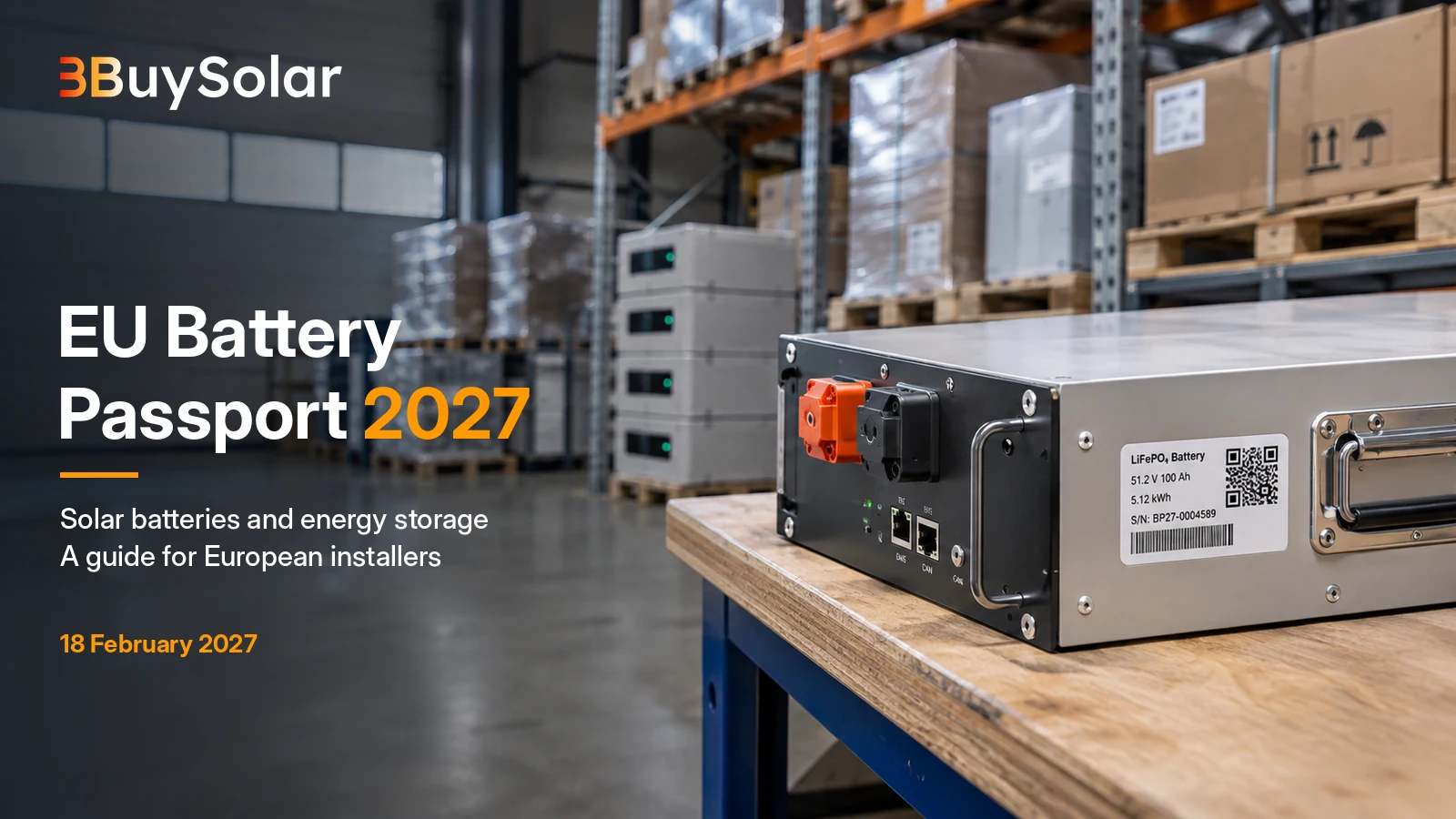
From 18 February 2027, the EU Digital Battery Passport becomes mandatory for industrial batteries with a capacity greater than 2 kWh, electric vehicle batteries and light means of transport (LMT) batteries newly placed on the EU market or put into service. This includes most residential solar batteries and commercial and industrial battery energy storage systems (C&I BESS). The legal basis is Article 77 of Regulation (EU) 2023/1542. [1]
For professional solar installers, EPC contractors and energy storage distributors, the practical questions go well beyond printing a QR code on a battery. A system ordered in 2026 may be delivered in 2027. A high-voltage battery tower may consist of several modules and one BMS. A customer may need to expand an older installation or replace a battery under warranty. In each case, the correct regulatory treatment depends on the individual battery, its configuration and its supply history.
This 3Buy Solar guide explains how to assess battery passport requirements before issuing a purchase order, what to check at goods receipt and commissioning, and where the responsibilities of the manufacturer, importer, wholesaler and installer begin and end.
Regulatory review: . Based on the consolidated EU Batteries Regulation and current Commission implementation material, including the data-point guidance updated on 19 November 2026. Product-specific compliance, stock status and future implementing measures must be checked separately.
Planning solar battery and BESS procurement for 2027?
Review our residential storage, modular battery and commercial BESS portfolio or request a quotation for the exact battery, compatible solar inverter, system accessories and applicable documentation.
Which batteries need an EU Battery Passport from 2027?
The obligation is determined by the battery’s regulatory category and, for industrial batteries, its energy capacity. A stationary battery designed for storing electricity in a home, commercial building or grid-connected storage plant belongs to the industrial battery category under the EU Batteries Regulation. The word industrial does not mean that the battery must be installed in a factory.
| Battery category or application | Passport from 18 February 2027? | Condition |
|---|---|---|
| Residential solar battery (5, 10 or 15 kWh) | Yes | Finished industrial battery above 2 kWh |
| Commercial battery storage / C&I BESS | Yes | Finished industrial battery above 2 kWh |
| Utility-scale and containerised BESS | Yes | Assessment at finished-battery level |
| Off-grid or backup battery storage | Yes, if in scope | Industrial battery above 2 kWh |
| Electric vehicle traction battery | Yes | EV battery classification |
| E-bike, e-moped or e-scooter battery | Yes, if classified as LMT | No industrial 2 kWh threshold |
| Independent industrial battery of exactly 2 kWh or less | No full passport | Separate QR and other requirements may apply |
| Ordinary portable battery or conventional SLI starter battery | No full passport | Separate QR and other requirements apply |
The table assumes first EU market placement or relevant putting into service on or after the application date. See Article 3 for battery categories, Article 13 for labelling and Article 77 for the passport obligation. [1]
Does the regulation apply to LiFePO4, LFP and other solar batteries?
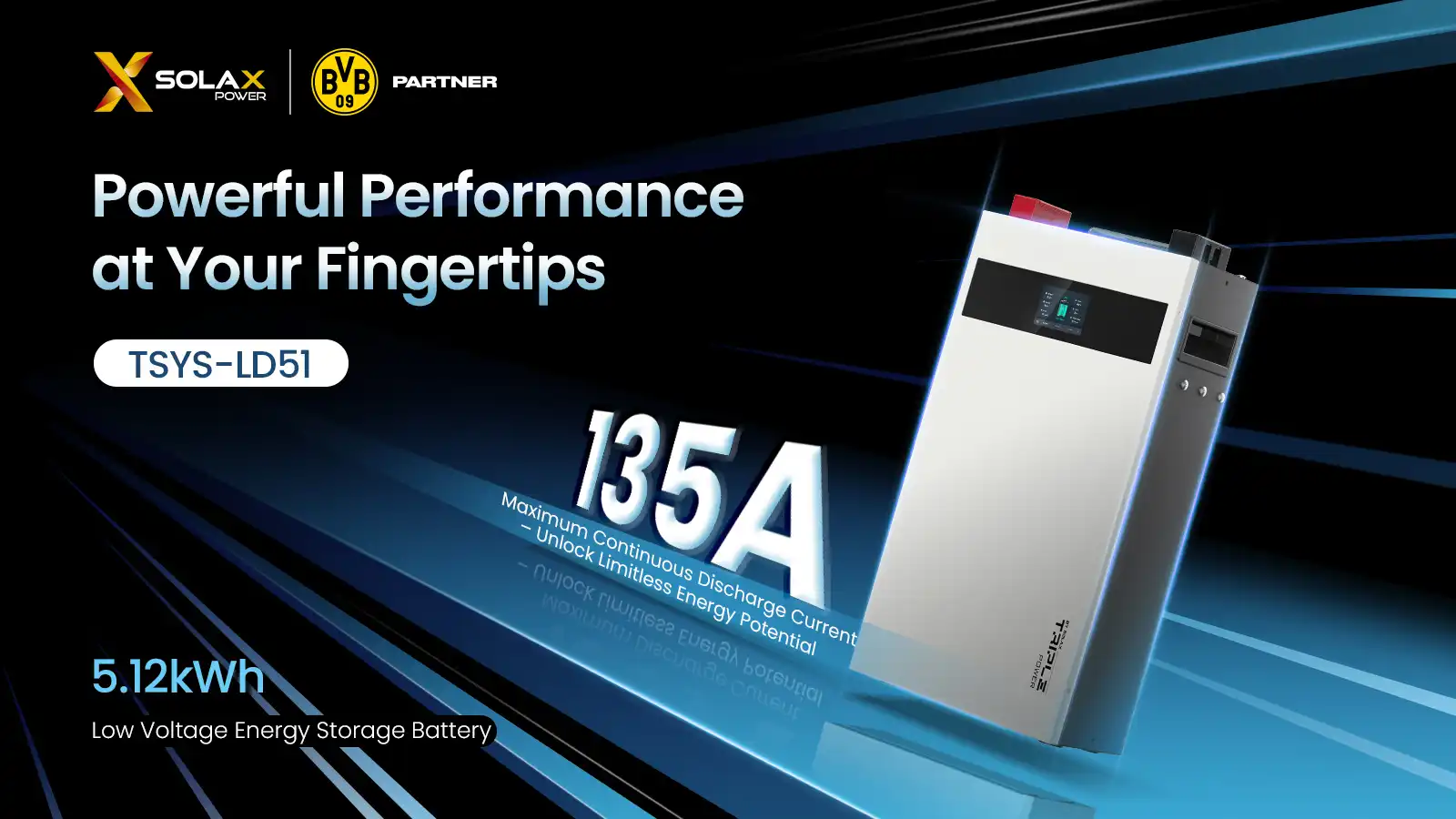
Yes. Battery chemistry is not an exemption. Lithium iron phosphate (LiFePO4 or LFP), NMC, sodium-ion and lead-acid products must be assessed using the same relevant category and capacity rules. For example, a finished 5.12 kWh LFP battery for a hybrid solar inverter falls within the industrial capacity threshold. A battery supplied within a complete solarkit or an all-in-one energy storage system is not exempt merely because other electrical equipment is included.
What is the Digital Battery Passport?
A Digital Battery Passport (DBP) is an electronic product record associated with a particular battery. It links information common to a battery model with information specific to the individual unit, including relevant information about its condition and use. The QR code provides a way to retrieve the record; it is not the record itself.
For a solar installer, the difference is easy to understand: a downloadable datasheet may describe every battery of the same model, while the passport identifies the particular battery delivered for the project. Two identical battery models can have different individual identifiers, histories and regulatory placement dates.
The framework is intended to improve product traceability and help authorised parties make informed decisions about battery maintenance, reuse, recycling and remaining useful life. Article 78 establishes requirements for data reliability, interoperability, controlled access and continued availability. [1]
Does every HV or LV solar battery module need its own passport?
Not necessarily. The decisive distinction is whether the unit is a complete, safely operating battery or only a component required to build one. Voltage class, packaging, sales SKU and the number of cabinets do not decide the answer by themselves. The Commission’s FAQ addresses this specifically for independent batteries and assemblies sharing essential components. [3]
Example A: three independent LV batteries
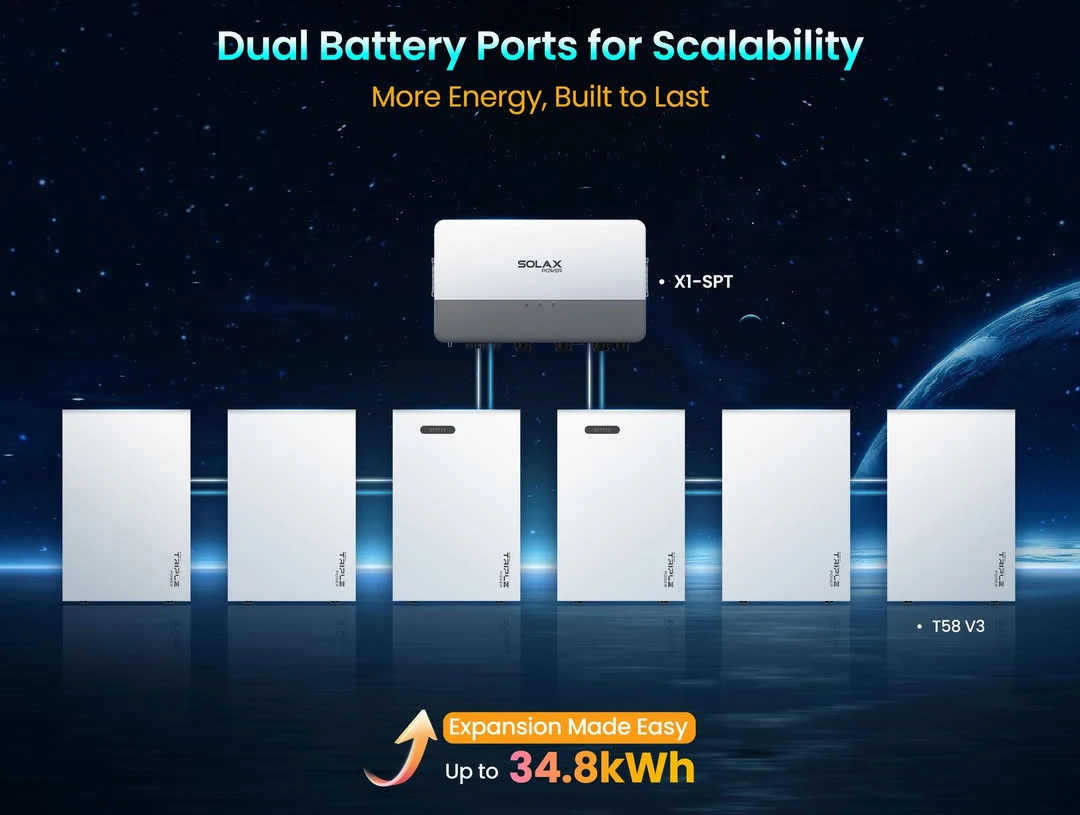
Each battery already functions independently with the necessary management and protection. Connecting them in parallel does not turn them automatically into one regulatory battery.
Example B: three dependent HV modules
If the modules and common components collectively constitute one finished battery, the passport relates to that completed battery rather than each dependent module.
Illustrative regulatory configurations, not manufacturer wiring diagrams or determinations for any specific brand. Each example assumes new placement within scope after the deadline.
| Illustrative configuration | Total energy | Full passports |
|---|---|---|
| One independent 2.048 kWh industrial battery | 2.048 kWh | 1 |
| Two independent 5.12 kWh batteries | 10.24 kWh | 2 |
| Four independent 1.5 kWh industrial batteries | 6 kWh | 0 for the individual batteries |
| Four dependent 1.5 kWh modules forming one finished battery | 6 kWh | 1 |
For SolaX, Growatt APX, Huawei LUNA, BYD Battery-Box, Dyness, Pylontech, Fox ESS, Deye, Solplanet, Fronius and other modular storage platforms, ask the manufacturer to identify the finished-battery boundary, who issues the identifier and how that identifier relates to the ordered bill of materials. Do not assume that every HV battery has one passport or every LV module has its own.
When comparing components, the Fronius Reserva Pro 3.98 kWh battery module and Deye SE-F12 12 kWh energy storage system are examples of different product listing types. Their listing or capacity alone does not establish their precise passport boundary or individual unit compliance. Browse our battery modules for expansion and replacement or complete energy storage kits with compatible inverter.
Can existing solar battery stock still be sold after 18 February 2027?
Yes, if the particular battery was lawfully placed on the EU market before the new obligation applied and remains compliant. The general EU product-law principle is that later resale does not repeat the original market-placement event. Manufacturing date, arrival at a European warehouse and the launch date of a model are not substitutes for evidence of market placement. The Blue Guide explains this distinction in Sections 2.2 and 2.3. [5]
| Supply scenario | Full passport required? | Reason |
|---|---|---|
| Finished battery lawfully supplied by EU importer to distributor in December 2026; resold in March 2027 | Generally no | Prior EU placement |
| Battery produced in 2026 but first marketed in March 2027 | Yes | Production date is irrelevant to the deadline |
| Finished battery held in importer stock, not previously made available, then first supplied after the deadline | Yes | EU warehouse presence alone is insufficient |
| Battery lawfully placed on the market before the deadline; installation takes place in April 2027 | Generally no | Ordinary installation does not repeat first placement |
| Battery installed and operating legally in 2026 | No retrospective passport | Existing installation |
| New qualifying battery supplied as a free warranty replacement and first placed on the market in 2028 | Yes | First supply can be free of charge |
These examples assume batteries above the industrial capacity threshold, ordinary onward supply without a compliance-affecting modification, and otherwise lawful market placement. The own-use and remanufacturing cases require separate assessment.
How to document pre-deadline stock
Ask your supplier to connect the specific battery serial numbers or other reliable unit identifiers to the completed product’s original EU supply transaction. Relevant records may include the invoice, purchase agreement, packing list, delivery record, inventory history and importer declaration of market-placement status. The evidence must relate to the actual units, not simply to a model already advertised in Europe.
Physical delivery is not invariably necessary for market placement; a qualifying transaction involving an already completed product can precede delivery. Conversely, a purchase order for batteries not yet manufactured is not proof of pre-deadline placement. Goods merely held in transit or under certain customs procedures must not be treated automatically as EU-marketed stock.
Should homeowners replace batteries installed before 2027?
No. The introduction of the passport is not an instruction to remove or replace an existing, lawfully installed home battery. A later capacity expansion, replacement or repurposing should be evaluated separately. There is no general requirement for owners to retrofit a new passport or QR label solely because the date changes.
Who is responsible for Battery Passport compliance?
The key party is the economic operator introducing the finished battery to the EU market or putting it into service where applicable. That party must arrange the passport and remain responsible for its data. Written authorisation can delegate practical work without shifting the underlying legal responsibility. [1] [3]
| Supply-chain role | What to establish |
|---|---|
| EU manufacturer | Conformity and passport arrangements for the finished battery it first supplies. |
| Importer buying directly from a non-EU manufacturer | Applicable importer obligations and passport registration, data and continuity for the units it first introduces. |
| European solar wholesaler buying from an EU distributor | Due care, applicable marks and documents, producer registration and traceable supply. |
| Installer reselling an already marketed complete battery | Applicable distributor duties, correct installation, commissioning records and appropriate customer handover. |
| Private-label supplier or compliance-affecting modifier | Manufacturer responsibilities may apply under Article 44. |
| System integrator building the finished battery from components | Determine whether it becomes the manufacturer or operator first supplying or putting into service the completed battery. |
Direct imports, OEM batteries and own-brand products
An installer ordering directly from a battery factory outside the EU should not assume that the manufacturer’s QR code removes its responsibilities as importer. A third-party logistics provider, customs broker or passport software provider is not automatically the legally responsible operator. Importing a finished battery for an installation company’s own use also needs assessment, even without a separate resale transaction.
Under the Commission’s published guidance, the relevant placing operator registers the Battery Passport. A non-EU manufacturer can support the creation and updating of the record under written authorisation. This is distinct from the legal act of registration. If an EU integrator completes a battery using imported unfinished modules and essential management components, it may itself become responsible for the finished product. Article 3 also includes a special rule for certain ready-to-use cell or module kits supplied to end users. [3]
What must European distributors verify?
Article 42 requires distributors to exercise due care and check the applicable producer registration, CE marking, labelling, required supporting documents and relevant manufacturer/importer identification. Instructions and safety information must meet the destination Member State’s language requirements. A distributor with reason to believe a battery fails the relevant requirements, including Article 13 labelling, must not release it until conformity is established. [1]
As an additional procurement control, test that the applicable passport resolves and matches the actual battery. Where the responsible operator or market-placement evidence is unclear, segregate the affected goods and obtain clarification before dispatch. This is preferable to discovering an incomplete record during installation or a market-surveillance review.
Battery Passport QR codes and the EU Digital Product Passport Registry
Article 13(6) introduces a QR marking requirement for all newly marketed batteries from 18 February 2027. Covered batteries link to their passport; other categories link to their relevant regulatory information. Under Article 13(7), the marking normally belongs on the battery itself, with packaging and accompanying documents used when the nature or size of the battery warrants the alternative.
The European DPP Registry became operational on 20 July 2026. The registration arrangements are set out in Commission Implementing Regulation (EU) 2026/1778. [2] [4]
| Identification element | Practical purpose |
|---|---|
| Manufacturer model / webshop SKU | Identifies the product type or commercial listing. |
| Serial number | Links the physical unit to manufacturing and service records. |
| Unique battery identifier | Identifies the individual battery passport under the applicable framework. |
| QR code | Machine-readable link to the required digital information. |
| DPP Registry registration | Records the required registration information; the registry does not host the full passport. |
For importers implementing their own ERP or product information management system, registration may be handled through the supported manual, bulk or API workflows. Under the Commission FAQ, the battery-specific registration identifier does not need to be inserted into the electronic customs declaration, unlike the general approach for products covered by the Ecodesign for Sustainable Products Regulation (ESPR). This does not waive registration or any applicable customs checks. [3]
Registration is not a third-party safety certificate, and a QR code pointing to a generic brochure does not establish compliance. Access should resolve to the correct battery-specific information, with the appropriate public or restricted data available to the entitled user.
What information must a Battery Passport contain?
Annex XIII combines model-level and individual-battery information. The Commission’s data guidance covers 71 data points across the battery categories, distinguishing fields applicable at launch from those that depend on battery type, later legislation or particular circumstances. It is not a list of 71 compulsory February 2027 fields for every solar battery. The 19 November update refines the reporting of certain dates, location information and document integrity. Suppliers should use the current data model rather than build their processes around an older spreadsheet. [1] [2] [6]
| Information group | Examples | Access / applicability |
|---|---|---|
| Identity and composition | Manufacturer, production details, chemistry, relevant materials and substances | Public model-level data, as applicable |
| Technical performance | Rated capacity in Ah, operating voltages, efficiency, durability and warranty information | Public model-level data; specified fields depend on category |
| Conformity | EU Declaration of Conformity; evidence from relevant test reports | Public declaration; specified test information restricted |
| Service and recovery | Component identifiers, spare parts, dismantling and safety information | Relevant restricted model data |
| Individual battery condition | Performance data, state of health, lifecycle status and operating history | Restricted according to legal access rights and applicability |
| Sustainability reporting | Carbon footprint, recycled content and responsible sourcing | Separate legal application schedules; not required at passport launch |
The public section is not the same as the confidential technical or operational record. Market surveillance authorities, notified bodies and persons with a legitimate interest have different access rights under Annex XIII and the applicable implementing framework. Do not promise unrestricted access to a customer’s full operating history or commercially sensitive manufacturer data. The Commission FAQ reviewed for this guide identifies the restricted-access implementing measure as an outstanding implementation detail.
State of Health (SOH), State of Charge (SOC) and battery lifetime
State of charge indicates how much energy is currently available relative to the relevant battery capacity. State of health describes the condition of the battery relative to its initial performance. A battery can be at 100% SOC while having a significantly reduced remaining energy capacity after years of operation.
For stationary storage, Article 14 and Annex VII already require relevant health and lifetime parameters in the BMS from 18 August 2024. These include remaining capacity and, where feasible, other indicators of performance, together with lifetime-related measures such as energy throughput and equivalent full cycles. The regulation also provides for read-only access for specified purposes and entitled parties, including assessing residual value, further use and participation through independent aggregators. [1]
For a commercial storage operator, these data can support a capacity assessment, maintenance planning and decisions about repurposing. They do not guarantee remaining service life, warranty entitlement, financial savings or VPP compatibility. A Virtual Power Plant still needs a suitable inverter/PCS, communications, EMS integration and a compatible market arrangement.
Do solar batteries need continuous internet access?
There is no universal requirement that every covered battery must remain permanently online or report every BMS reading in real time. The Commission FAQ explains that the update frequency depends on the information and relevant use, with important lifecycle changes requiring attention. New batteries need their required initial information; use-generated history may be absent before operation begins. [3]
For long-term service contracts, establish how information is retrieved when an owner changes internet provider, a manufacturer cloud service is discontinued or a battery operates offline. Request a documented data continuity process instead of assuming a monitoring app is itself the Battery Passport.
How should solar installers handle Battery Passports at installation and service?
In a typical residential installation, the installer purchases a finished battery through an EU distribution chain. The practical task is normally to verify the supplied equipment, install it within the approved configuration and retain an accurate handover record, rather than build a separate passport platform.
Before ordering
- Confirm the exact battery model, hardware revision, capacity and approved inverter combination.
- Identify the finished-battery configuration and responsible supplier.
- Ask for the applicable passport or documented prior market placement.
- Confirm manuals, safety information, local requirements and warranty conditions.
At commissioning
- Match the physical battery, serial number and applicable digital identifier.
- Record BMS and inverter configuration, installed modules and commissioning date.
- Check that the accessible record relates to the installed battery.
- Provide the owner with relevant access instructions, documentation and service contacts.
These are recommended professional handover controls; they do not mean that every installer is the party legally required to register or update a passport. In particular, do not overwrite the manufacturer’s or responsible operator’s data without the appropriate authority.
Can a battery installed in 2026 be expanded in 2028?
Usually the relevant question is whether the additional equipment is a finished battery or a dependent component, and whether the work changes the existing battery’s regulatory status. A new independent battery added in parallel may require its own passport. Adding a dependent module to a legacy HV battery is not automatically a reason to create a passport for every existing module.
For an approved expansion, obtain the manufacturer’s written procedure for identification, compatibility, applicable data updates and warranty. For work that completes a new finished battery or significantly alters an existing one, assess conformity and the responsibilities of the integrator before supply or commissioning. Avoid mixing incompatible BMS versions, battery generations or modules with unsupported ageing differences.
Warranty replacement, repair and second-life batteries
| Operation | Expected passport treatment |
|---|---|
| Routine maintenance or simple repair | No new passport solely because of that repair; update applicable records. |
| Replacement with a newly marketed complete battery | The replacement’s own applicable passport and identifier. |
| Replacement of a dependent module | Follow the manufacturer’s system identification and data-update procedure. |
| Repurposing, remanufacturing or qualifying preparation for reuse/repurposing | New passport where in scope, linked to previous passport(s) where they exist. |
| Battery becomes waste; then recycled | Responsibility transfers as prescribed; the passport ends upon recycling. |
Repurposing a used EV battery for stationary energy storage, or remanufacturing a pre-2027 battery after the deadline, must not be treated as an ordinary resale of exempt stock. Articles 45 and 77 address the responsibilities of the relevant operator and the need to reassess the product. [1] [3]
For a ten-year residential storage service commitment, require the supplier to explain how replacement batteries will be identified, how historical records will remain available and who corrects data following a service intervention. A long commercial warranty does not automatically cover those costs or demonstrate that a passport platform will remain supported.
Battery Passport requirements for commercial and industrial BESS projects
A C&I energy storage project is rarely just one battery purchase. The scope can include battery racks, cabinets, a Power Conversion System (PCS), BMS, Energy Management System (EMS), transformer, meters and external switchgear. A containerised 1 MWh or 5 MWh energy storage solution may contain several finished batteries, each with its own regulatory identity.
For the EPC contractor, request a passport boundary diagram from the supplier as part of the equipment documentation. It should connect battery IDs to the actual project bill of materials, cabinet or rack positions and the service model. Do not assume that a common EMS or one container serial number establishes one passport for the entire installation.
What to include in a commercial BESS RFQ
- Exact cabinet and battery model, nominal and usable energy, PCS power and coupling architecture.
- Number of independently functioning batteries and the intended passport identification level.
- Responsible economic operator, registration process and supply-chain traceability.
- Available BMS data, read-only access arrangements and supported communication interfaces.
- Battery replacement, capacity augmentation and long-term access procedures.
- Manufacturer responsibility for data corrections, warranty services and non-compliant equipment.
- Destination-country grid documentation, safety design, commissioning and service scope.
For technology selection, see our comparison of six commercial battery storage systems for 2026–2027, including Solis, JA Solar, Fox ESS, SolarEdge, Dyness and Sunsynk. Our catalogue also includes the Huawei LUNA2000 215 kWh commercial energy storage system. These are product and engineering references, not confirmation that specific units already have verified passports.
Prepare a procurement-ready commercial BESS specification
Send the project country, intended delivery and commissioning dates, site demand data, required kW/kWh, backup requirements, selected architecture and documentation requirements. Include your Battery Passport and lifecycle-service expectations in the quotation request.
Does the Battery Passport replace CE marking, UN 38.3 or EPR?
No. A passport provides digital traceability and access to regulatory information. It does not remove the need for battery safety, conformity, transport documentation, approved inverter compatibility, producer registration or national installation requirements.
| Document or obligation | Why it matters |
|---|---|
| Digital Battery Passport | Individual identity and applicable model/lifecycle data. |
| EU Declaration of Conformity and CE marking | Evidence of the manufacturer’s applicable EU conformity obligations and associated marking. |
| Stationary storage safety documentation | Battery safety evidence under Article 12 and Annex V, including applicable hazard assessment. |
| UN 38.3 test summary | Transport test-summary evidence for batteries subject to UN 38.3; not an installation safety certificate. |
| Datasheet, installation manual and compatibility list | Electrical, thermal and mechanical limits; correct inverter/BMS pairing and installation. |
| Manufacturer warranty terms | Permitted operating conditions, throughput, capacity retention and service procedures. |
| Extended Producer Responsibility (EPR) | Destination-market obligations for producers, including registration and end-of-life financing. |
| Local installation and grid approval | Site-specific electrical, fire-safety and grid connection requirements. |
For stationary batteries, relevant safety testing may reference IEC 62619, IEC 63056 or other applicable standards, depending on product design. Determine the actual evidence required; do not treat a test certificate for another model or product family as sufficient. Check the documentation available on the exact 3Buy Solar product page or request the missing documents before confirming the order.
For cross-border trading, the battery passport and EPR registration must be considered separately. A passport registered in one EU country is not a substitute for producer obligations in another. See our guide to EU battery EPR and 3Buy Solar cross-border B2B and B2C sales rules.
EU battery regulation timeline: 2026, 2027 and beyond
| Date | Requirement or milestone |
|---|---|
| 18 February 2024 | General application of Regulation (EU) 2023/1542, with phased provisions. |
| 18 August 2024 | Key stationary battery BMS information and relevant performance documentation requirements. |
| 18 August 2025 | Chapter VIII waste-battery and EPR framework; separate collection symbol. |
| 20 July 2026 | EU DPP Registry operational. |
| 19 November 2026 | Commission Battery Passport data-point guidance update. |
| 18 February 2027 | Mandatory full passports for covered batteries and QR code requirements. |
| 18 August 2027 | Battery supply-chain due diligence obligations for operators within scope, subject to the applicable rules and exemptions. |
| Later phased dates | Carbon footprint, recycled-content reporting and minimum-content requirements under Articles 7 and 8, subject to battery category, implementing/delegated acts and applicable transition provisions. |
For rechargeable industrial batteries without exclusively external storage, the carbon-footprint declaration under Article 7 is scheduled from 18 August 2027 or the later act-linked date specified in the Regulation. Article 8 recycled-content documentation for eligible industrial batteries above 2 kWh is scheduled from 18 August 2028 or the later applicable act-linked date. Minimum recycled-content requirements for relevant categories are scheduled from 2031. These are distinct obligations: the February 2027 passport launch does not automatically bring all sustainability reporting requirements into force. [1] [3]
Industry developments to watch: Energy Storage Europe has proposed a phased approach to selected complex passport data requirements for stationary storage, citing unresolved technical and data-sharing issues. This is an industry proposal, not a legislative postponement. Plan procurement against the statutory 18 February 2027 deadline unless an adopted legal change establishes otherwise. [7]
2027 solar battery procurement checklist for distributors and installers
Before approving a manufacturer or a new solar battery product family, treat passport implementation as part of your existing quality, warranty and compliance evaluation. A supplier should be able to explain exactly how its finished batteries will be identified, supported and corrected when something goes wrong.
| Procurement control | Recommended evidence or contractual requirement |
|---|---|
| Product scope and responsible operator | Written determination of the finished battery and identified manufacturer/importer. |
| Transition stock | Unit-specific market-placement evidence or applicable passport status. |
| QR and passport registration | Sample working passport, matching identifiers and evidence of registration for units when applicable. |
| Data continuity | Named data custodian, long-term hosting, backup and transfer arrangements in case of provider failure. |
| Service and warranty | Documented replacement, module expansion and relevant lifecycle-update procedures. |
| Documentation and localisation | Exact model conformity records, technical information and applicable destination-language safety instructions. |
| Non-compliant shipments | Agreed correction deadlines, quarantine and return arrangements, replacement or credit and allocation of related expenses. |
Supplier agreement: who pays if passport compliance fails?
In addition to the legal duties, negotiate the commercial allocation of risks. A battery supplier agreement can specify correction of missing or invalid records, replacement of affected units, reimbursement of return freight, re-labelling costs and reasonable service expenses. Consider delivery acceptance conditions, documented compliance before the relevant market-placement event, and protection if the supplier discontinues the product or the passport service provider.
These remedies are proposed purchasing protections, not automatic compensation rights created by the Battery Passport legislation. Their enforceability and scope depend on the negotiated agreement and applicable law.
Will the Battery Passport increase solar battery prices?
There is no prescribed battery price increase or compulsory consumer passport subscription. Operators may incur costs for labels, systems integration, data management and service continuity. Some suppliers may include these expenses in product pricing. Compare the total delivered cost of a battery and its compatible inverter, documentation, service and warranty support, not just the purchase price per nominal kWh. Article 78 requires access to the passport free of charge within the applicable access rights.
EU Battery Passport 2027: frequently asked questions
Is the EU Battery Passport mandatory in 2027?
Yes. From 18 February 2027, the obligation applies to new EU market placement or relevant putting into service of EV batteries, LMT batteries and industrial batteries with a capacity greater than 2 kWh.
Do home solar batteries need a Digital Battery Passport?
Yes, most home storage batteries qualify as industrial batteries and exceed 2 kWh. Existing lawfully marketed units generally do not need a retrospective passport.
Does a 2 kWh battery need a passport?
An independent industrial battery with exactly 2 kWh does not meet the greater-than-2-kWh threshold. EV and LMT batteries are subject to their own category-based rules. Other labelling requirements may still apply.
Can I buy a solar battery without a passport in March 2027?
Yes, if it was lawfully placed on the EU market before the obligation applied or is outside the full passport scope. Ask the supplier to confirm the basis for that status.
Does each 5 kWh HV battery module need an individual passport?
Not if it is merely a dependent component of a single finished battery. Identify the actual product architecture and regulatory boundary with the manufacturer.
Does the solar inverter need a Battery Passport?
A standalone solar inverter is not a battery. If an inverter is sold within an all-in-one product containing a covered battery, the passport requirement concerns the finished battery inside the product. Other applicable equipment rules still need to be met.
Who creates a passport when a battery is imported from China?
The responsible operator placing the finished battery on the EU market must arrange it. The manufacturer or another provider may carry out authorised practical work, without transferring the placing operator’s legal responsibility.
Do installers need to register every battery they install?
Not normally when installing complete batteries already lawfully supplied in the EU. Direct import, own-brand products or completing a finished battery can change the installer’s obligations.
How can I check a Battery Passport?
Read the applicable QR code with a compatible reader and compare the returned identity with the battery and supplier’s documentation. If the record is incomplete or mismatched, contact the responsible operator. The public record is not a substitute for conformity assessment.
Will the passport show my solar battery’s State of Health?
Relevant battery health information is part of the regulatory framework, with access subject to the battery type and the user’s legal rights. The public section does not necessarily disclose individual operating history.
Does a battery need an internet connection or blockchain?
No specific blockchain technology or permanent internet connection is universally required. The responsible party must nevertheless arrange the applicable data maintenance and access.
Can I expand an older battery after February 2027?
Potentially, subject to the approved battery architecture, compatibility and regulatory consequences of the work. An independent new battery and a dependent replacement or expansion module may have different treatment.
Does a warranty replacement need a new passport?
A complete replacement battery first placed on the EU market after the deadline must meet its own applicable passport requirements. A routine repair or dependent module replacement does not automatically create a new finished battery.
Does this apply to the UK or Switzerland?
The EU rules apply to products within the EU market scope, including goods supplied there by non-EU manufacturers. For the UK, Switzerland and other non-EU markets, check their applicable national or regional arrangements separately.
Can a battery passport expire when the warranty ends?
Warranty expiry is not a reason to withdraw the passport. Article 78 requires continued availability even if the responsible operator ceases EU activities. The passport ceases to exist when the battery is recycled under Article 77.
For additional product demonstrations and installer-oriented technical videos, visit the 3Buy Solar YouTube channel, including training resources on Growatt APX HV battery installation, NEOVOLT battery expansion and Fox ESS G-MAX Plus commercial storage. Confirm the specific model, region and version before relying on a demonstration for installation or commissioning. The video channel is a technical resource, not evidence of passport readiness.
Official EU Battery Passport sources and further reading
- Regulation (EU) 2023/1542 concerning batteries and waste batteries (consolidated text). Relevant provisions: Articles 3, 7, 8, 10, 12–14, 18–19, 38, 41–45, 48, 55, 77–78 and Annexes V, VI, VII and XIII.
- European Commission: Digital Product Passport for Batteries. Implementation milestones and battery data-point guidance (update 19 November 2026).
- European Commission: Battery Passport FAQ. Finished batteries, roles, registry, imports, data and lifecycle operations; implementation guidance, not binding legislation.
- Commission Implementing Regulation (EU) 2026/1778: Digital Product Passport Registry.
- European Commission: The Blue Guide on EU product rules (2022). Sections 2.2–2.3 on availability and first market placement.
- European Commission: Guidance to support preparations for the Digital Batteries Passport. Category-specific data applicability.
- Energy Storage Europe and EUROBAT: Industry guidance on the Battery Passport data fields. Supplementary sector guidance, not legislation.
- Energy Storage Europe: Position Paper on the Battery Passport – Phased Approach. Industry recommendations, not an amendment to the statutory application date.
Publication and compliance note: Last regulatory review: 25 November 2026. This article supports preliminary technical evaluation and professional procurement. It is not a product-specific legal opinion, market-placement determination, certification or confirmation of individual 3Buy Solar stock readiness. For a particular installation, import, expansion or warranty replacement, verify the current legislation and obtain the relevant manufacturer’s and responsible operator’s documentation. The illustrative diagrams are not electrical installation drawings.